Scalable Book Income Systems for Repeatable Royalty Growth
Scalable Book Income Systems: Build a Repeatable Royalty Machine That Grows
Estimated reading time: 16 minutes
Key takeaways
- Treat books as assets inside a repeatable system: catalogs and processes scale royalties more reliably than one-off launches.
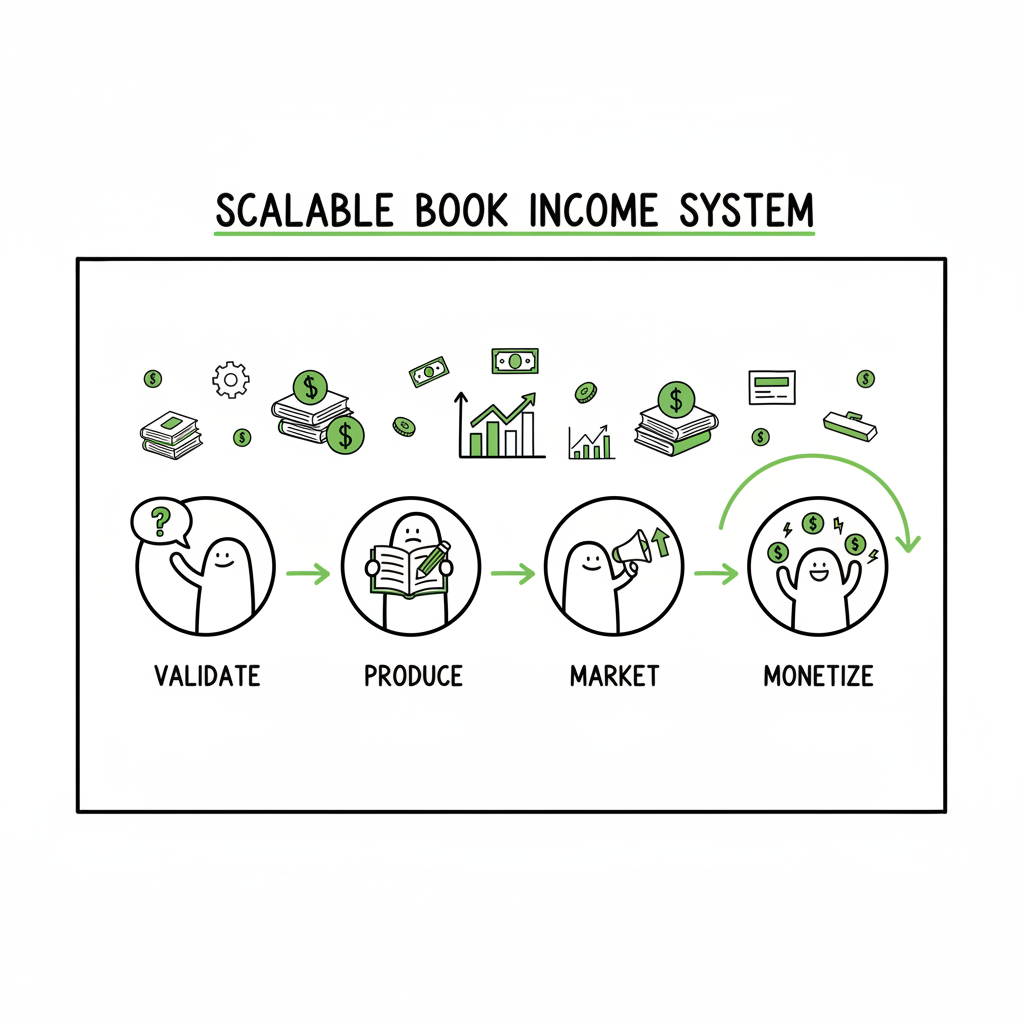
- A four-part framework—validate, produce, market, monetize—lets you add titles without multiplying work.
- Automation and platform-aware uploads reduce manual friction; multi-platform distribution protects revenue and multiplies reach.
- BookUploadPro removes the technical bottleneck: CSV batch uploads, platform intelligence, and consistent formatting save time and lower error risk.
Table of Contents
- Why scalable book income systems beat one-off launches
- A practical four-part book income scaling framework
- Operational checklist: how to run a scaling campaign
- How BookUploadPro fits into a scalable publishing stack
- FAQ
- Final thoughts
Why scalable book income systems beat one-off launches
Authors who want steady royalties soon discover a simple truth: a single bestseller is a fragile foundation. Markets shift, categories change, and algorithms favor fresh signals. Scalable book income systems solve that by treating each book as a lasting asset that both earns directly and feeds the rest of your catalog.
Scalability means systems and repeatable work. Rather than relying on one launch, you create a catalog of titles that reference and promote each other, plus a predictable process for adding new work. That reduces variance: a good new release boosts the backlist, and steady backlist performance supports more predictable cash flow.
These systems are not magic. They rest on four practical pillars:
- Validated topic selection so you publish into real demand.
- A production pipeline that keeps quality high while lowering marginal effort.
- A marketing engine that captures reader contacts and drives long-tail sales.
- A monetization ladder that converts readers into higher-value offers over time.
You can read case studies and guides that explain this idea at length; for a clear, hands-on example of how to automate book workflows for predictable royalties, see Automated Passive Income With Books. That kind of focused walkthrough shows how tasks—research, formatting, upload, metadata—can be structured to run with low overhead and consistent results.
Systems thinking also encourages platform diversity. Relying only on one retailer or one format creates single points of failure. A catalog that spans Amazon, Kobo, Apple Books, Draft2Digital, and Ingram reduces risk and opens new audiences. For an author moving from a few titles to a scalable machine, multi-platform distribution is not optional—it’s essential.
A practical four-part book income scaling framework
If you want a system that produces repeatable results, follow a simple framework that covers the full lifecycle of each title. Call it: Validate → Produce → Market → Monetize.
1) Validate: pick topics that will actually sell
Validation is where you prevent wasted effort. Use keyword research, category testing, and small experiments to pick topics with proven demand.
- Look for consistent bestseller ranks in target categories rather than fleeting spikes.
- Check search volume and competition for keywords readers use.
- Validate hooks with low-cost experiments: a lead magnet, a short guide, or paid promotion to test reader interest.
Validation reduces risk. If a topic shows traction, your next steps flow faster and require fewer course-corrections.
2) Produce: build a predictable production pipeline
Production is where systems make scaling practical. Create a repeatable pipeline with templates and clear quality gates.
- Standard outlines and chapter templates reduce drafting time.
- A consistent editing workflow keeps quality consistent even when output increases.
- Use standard interior and cover templates so formatting is predictable.
- Convert final manuscripts to distribution-ready files across formats: ebook, paperback, and audio metadata.
When you need to create many titles, the technical steps (formatting, covers, metadata) become the bottleneck. Tools and services that can handle consistent formatting and bulk uploads will let you scale without sacrificing polish. If you convert manuscripts to EPUB regularly, use a tested process to avoid errors and platform rejections; for reliable conversions, the EPUB converter streamlines the step of making upload-ready ebook files.
3) Market: make every book a lead generator
A book that sells sometimes is good. A book that builds an audience is better. Marketing at scale focuses on assets that compound.
- Capture emails from every book: end-of-book offers, reader magnets, and links to landing pages.
- Repurpose book content into blog posts, newsletters, and short video clips to keep traffic flowing.
- Use price and ad tests methodically; treat promotions as experiments with clear metrics.
- Interlink books in your backlist and use catalog bundles or boxed sets to test new price points.
High-leverage marketing assets—email lists, an evergreen content funnel, and repeatable promotions—turn royalties into a predictable revenue stream. Books act as front-end offers that feed readers into newsletters, courses, or memberships, stabilizing income beyond raw royalties.
4) Monetize: build a ladder that increases lifetime value
Royalties alone are useful, but a monetization ladder extends the value of each reader.
- Basic: single-title sales in ebook and print.
- Next: companion short products—workbooks, guided journals, or audio versions.
- Higher: paid workshops, courses, or consulting for readers who want deeper help.
- Ongoing: memberships or paid newsletters that capture recurring revenue.
Each step increases the lifetime value of a reader. When you systematize the ladder—every book links to the next rung—you unlock scalable revenue without re-creating launches from scratch.
Operational checklist: how to run a scaling campaign
This section turns strategy into repeatable operations. Think of it as the runbook your team or tools will follow for each title. Keep tasks focused and measurable.
Before you write
- Define target outcome: sales velocity, email captures, or lead generation.
- Validate topic: keyword metrics, comparable titles, and small ad or list tests.
- Create a project template with deadlines and responsibilities.
Drafting and editing
- Use outline templates to speed drafting and keep chapters consistent.
- Lock editorial standards: length, tone, and quality checkpoints.
- Stage reviews: self-edit, beta-read, copyedit, proofread.
Design and formatting
- Use standard cover specs and interior templates. For bulk projects, integrate a consistent cover process into the workflow.
- Create print-ready interiors and ebook files. If you produce both paperback and ebook versions, unify naming, ISBN allocation, and metadata to avoid confusion.
- A fast way to handle multiple cover versions and processing is to use an automated cover tool; many teams pair a cover generator to produce final art quickly.
Publishing and distribution
- Upload to a primary distributor (for many authors that is Amazon KDP) and then distribute widely: Kobo, Apple Books, Draft2Digital, Ingram.
- Use platform-specific intelligence: each retailer reads metadata differently and has its own category and keyword rules.
- Batch uploads are the scaling trick. When you have many titles, CSV batch uploads and automated metadata mapping turn hours into minutes.
Promotion and ongoing optimization
- Schedule an initial launch window and ongoing pricing/ad tests.
- Track key metrics: units, revenue, KENP (if applicable), email captures, and ad ROI.
- Revisit metadata regularly. Tweaking keywords and descriptions can revive long-tail sales.
- Consider repackaging: boxed sets, translations, or new editions to extend each title’s life.
Tools and operations that remove manual friction are central to scale. For the technically heavy parts—batch formatting, consistent metadata, and synchronized uploads—using a service that supports CSV batch uploads and platform-aware rules saves time and reduces mistakes. Authors who move from publishing five titles to fifty-or-more need that level of automation to keep quality steady and costs manageable.
How BookUploadPro fits into a scalable publishing stack
BookUploadPro is designed for authors who reach the point where manual uploads and one-off fixes no longer scale. The product does the heavy lifting for the parts of publishing that are repeatable and error-prone: formatting, metadata management, and multi-platform uploads.
Why it matters for systems-first publishing
- Unified multi-platform publishing: BookUploadPro sends a single configured package to Amazon KDP, Kobo, Apple Books, Draft2Digital, and Ingram so you don’t repeat technical steps for each store.
- Dramatic time savings: users report up to ~90% time savings on uploads and metadata tasks when they move from manual workflows to batch, CSV-driven workflows.
- Platform-specific intelligence: the system adjusts metadata and file outputs to match each retailer’s requirements automatically, cutting rejections and platform errors.
- CSV batch uploads: scale by uploading dozens or hundreds of titles with a single spreadsheet, rather than repeating the web UI dozens of times.
- Error reduction and consistency: templates and checks keep interior and cover files consistent across editions and formats.
- Affordable, with a free trial available to test the fit before committing.
BookUploadPro is an obvious upgrade once authors start publishing seriously because it treats publication as a repeatable operation, not a series of one-off tasks. Automate the upload. Own the distribution.
How automation and creative work balance
Automation accelerates research, drafts, and syndication, but human oversight remains critical. For example:
- AI can draft a chapter outline quickly, but an author should shape voice and structure.
- Automated EPUB conversion speeds up format production, but a final pass catches layout issues.
- Cover generators produce options fast, yet an experienced eye picks the version that will sell.
If you regularly create paperback and ebook editions, it’s useful to tie those publishing steps into a single workflow. For example, use a tested ebook creation workflow to make files for each format and then hand them to your batch uploader. For cover production, a dedicated cover generator speeds iteration while keeping design options consistent across a catalog.
Practical example: a 90-day scale sprint
- Week 1–2: Validate five topic ideas and select two with strongest signals.
- Week 3–6: Produce two titles using standardized outlines and templates. Prepare covers and interiors.
- Week 7: Use a batch upload to publish to KDP, Kobo, Apple Books, Draft2Digital, and Ingram.
- Week 8–12: Run coordinated promotions, capture emails from each book, and set up price tests.
- Ongoing: Every 90 days, add two more titles, monitor metrics, and update metadata on underperformers.
If parts of that flow are manual for you today, they are where scale will break. A platform that consolidates uploads and enforces consistency becomes a core part of your operation.
Operational pitfalls and risk management
- Avoid mass-publishing low-quality books. Volume without quality damages discoverability and long-term reputation.
- Don’t rely on a single platform. Diversify distribution and revenue sources.
- Monitor platform policies and metadata rules. A sudden policy change can impact a large catalog if you aren’t paying attention.
- Treat automation as a force multiplier, not an autopilot. Human review at key gates prevents mistakes at scale.
FAQ
Q: What exactly is a scalable book income system?
A: It’s a repeatable, measurable process that turns individual books into composable assets. The system combines validated topic selection, consistent production, ongoing marketing, and stepped monetization so each title adds to long-term earnings without requiring proportional time.
Q: How many titles do I need to make a system worthwhile?
A: There’s no fixed number. Many authors see clear leverage once they publish more than five titles and start running the same processes repeatedly. The gains become more visible as you can re-use templates, metadata, and marketing sequences.
Q: Can I scale without automation tools?
A: You can, up to a point. Manual workflows get you started, but they become expensive and error-prone beyond a handful of titles. Tools that handle formatting, batch uploads, and multi-platform distribution are the practical difference between hobby publishing and a scalable operation.
Q: Do I need to produce audio and translations?
A: Audio and translations are optional but high-leverage. They expand audience reach and reduce single-platform dependence. Prioritize them when a title shows stable demand and when the cost is justified by expected incremental revenue.
Q: How do I protect quality while scaling?
A: Standardize editorial checklists, use consistent design templates, and place human review gates where errors would be most damaging (covers, front matter, final proofing). Track reader feedback and maintain a small team of trusted editors/designers to enforce standards.
Q: Will automating uploads get me penalized by retailers?
A: No—automation itself is neutral. Retailers care about compliance with their content and metadata rules. Use platform-aware tools that format and tag files correctly and respect policy to avoid problems.
Final thoughts
Scaling book income is less about shortcuts and more about installing dependable processes. When you treat books as repeatable assets and build a system around validation, production, marketing, and monetization, each new title adds predictable value. Tools that remove the technical friction—batch formatting, platform-aware uploads, and multi-store distribution—turn scaling from a technical headache into an operational advantage.
If you’re serious about growing a royalty machine, aim to automate the predictable parts and protect the creative parts with disciplined review. That balance—automation plus human judgment—is the core of reliable scale.
Visit BookUploadPro.com to try the service and start a free trial.
Sources
- https://books.google.com/books/about/How_to_Make_Passive_Income_with_AI_Autom.html?id=7rqeEQAAQBAJ
- https://www.audible.com/pd/ChatGPT-AI-Passive-Income-Profit-System-Audiobook/B0FN5ZZF11
- https://www.simonwparsons.com/passive-income-playbook
- https://scalable.co/get-scalable/
- https://play.google.com/store/books/details/N_N_Digitals_The_Passive_Profit_System?id=edOWEQAAQBAJ
- https://www.bookautoai.com/epub-converter
- https://www.bookautoai.com/book-cover-generator-processing
- https://www.bookautoai.com
Scalable Book Income Systems: Build a Repeatable Royalty Machine That Grows Estimated reading time: 16 minutes Key takeaways Treat books as assets inside a repeatable system: catalogs and processes scale royalties more reliably than one-off launches. A four-part framework—validate, produce, market, monetize—lets you add titles without multiplying work. Automation and platform-aware uploads reduce manual friction;…