Publish Wide vs Exclusive KDP Practical Guide for Authors
Publish wide vs exclusive KDP: A practical guide for authors
Estimated reading time: 8 minutes
Key takeaways
- KDP Select (exclusive KDP) buys Amazon-focused tools and Kindle Unlimited exposure at the cost of selling only on Amazon for 90-day periods; wide distribution sells in many stores but requires more operations.
- Choose by goals: short-term discovery and KU-friendly genres often favor KDP Select; long-term revenue, international reach, and diversification favor wide.
- Automation changes the decision: tools that handle CSV batch uploads, platform-specific requirements, and error checks make wide distribution practical at scale.
- Test, measure, and iterate: use the 90-day KDP Select option as a test, track paid sales vs KU reads, then shift strategies based on real data.
- When you publish seriously, multi-platform automation is the obvious upgrade — automate the upload. Own the distribution.
Table of Contents
- What publish wide vs exclusive KDP means
- How to choose: a practical framework
- Operational trade-offs and how automation changes the math
- FAQ
What publish wide vs exclusive KDP means
When authors compare publish wide vs exclusive KDP they are choosing two different business models.
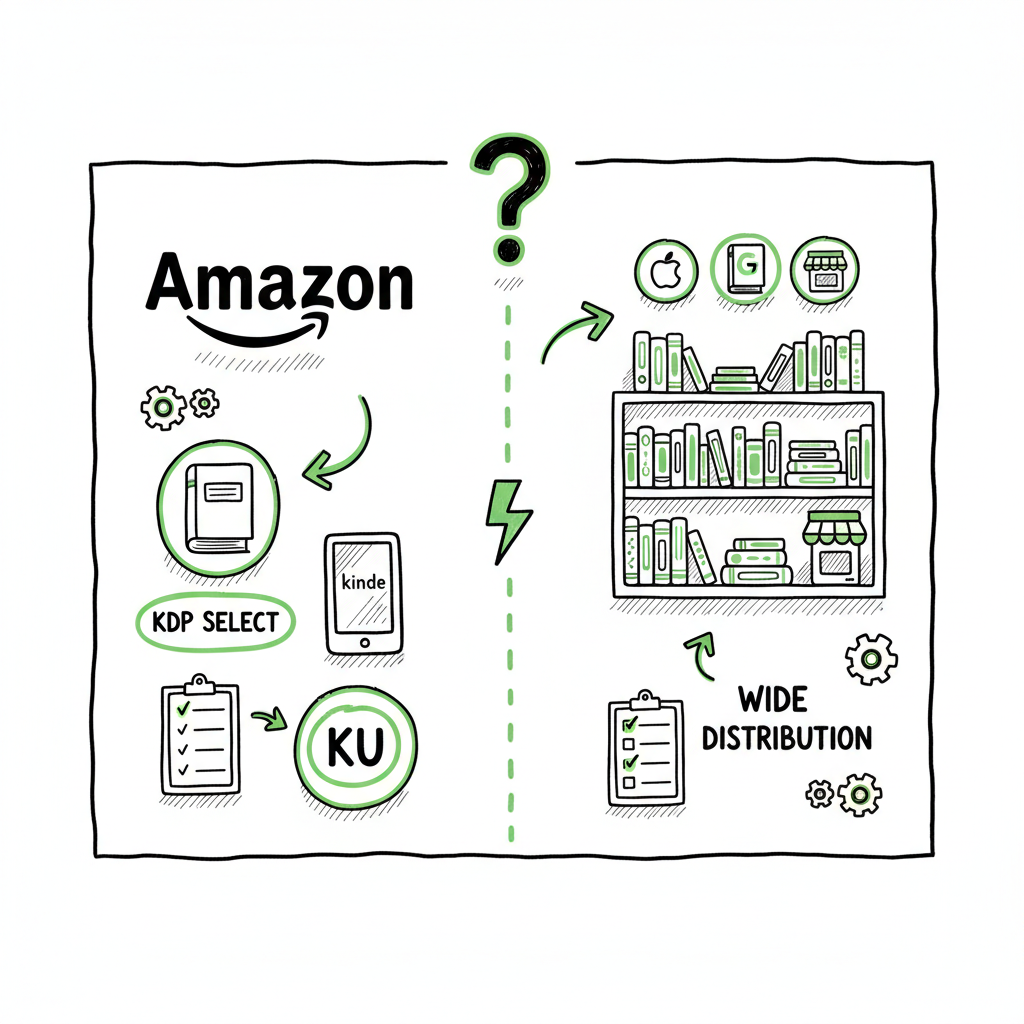
Exclusive KDP (KDP Select) requires that your ebook be sold only on Amazon for each 90-day enrollment. In return you get access to Kindle Unlimited (KU) and Kindle Owners’ Lending Library page reads, promotional tools like Countdown Deals and Free Book Promotions, and algorithms that reward KU performance. For many authors who write in genres where readers binge—romance, some fantasy, serial thrillers—KU can produce steady income from page reads.
Publishing wide means your ebook is available to other stores: Apple Books, Kobo, Barnes & Noble, Google Play where available, and library services. Wide opens multiple revenue streams and international markets, and it removes the single-point-of-failure risk of relying on one retailer. The trade-off is operational complexity: different file requirements, cover crops, metadata fields, price mapping, and sales reporting.
If you are ready to publish across stores at scale, follow a clear workflow. For teams or high-output authors, a Publish Wide Self Publishing Workflow can remove the manual burden of uploading the same book to six platforms. That workflow centralizes metadata, handles platform-specific checks, and outputs the files you need for each store.
Two practical notes on assets and files:
- If you need to convert a manuscript to EPUB for wide retailers, use a reliable EPUB converter that preserves layout and chapter structure without manual rework.
- If you are producing both paperback and ebook editions, generate clean interior files and print-ready PDFs early in the process so you can reuse them across platforms.
Covers matter. Retailers have different size and spine rules; a single master cover file rarely fits all channels without adjustment. A good book cover generator can speed variants for spine, thumbnail, and platform crops while keeping design consistent.
Put simply: exclusive KDP is simplicity + Amazon benefits; wide is diversification + operational work. The right path starts with your goals and the resources you bring to the process.
How to choose: a practical framework
Choosing between wide and exclusive isn’t a personality test. It’s a list of measurable trade-offs.
-
1) Define your short and long-term goals
- Short-term discovery: If you want fast visibility on Amazon and write in KU-friendly genres, test KDP Select. KU can produce page-read revenue quickly when a book hooks readers.
- Long-term career: If your plan is a multi-book catalog, translations, or reaching non-Amazon buyers, wide is usually better for gradual, compounding income.
-
2) Consider genre behavior
- High-engagement genres (romance, serial urban fantasy, cozy mystery) often do well in KU because readers binge.
- Niche, technical, or backlist-driven books (nonfiction, academic, specialty topics) frequently perform better wide, especially in stores where those readers shop.
-
3) Look at audience geography and channels
- Amazon has large market share in the U.S., but international readers on Apple Books, Kobo, and Google Play can add meaningful revenue. If your book targets languages or regions where Amazon is weaker, wide matters.
- Library distribution works better when you are wide: libraries buy through aggregators and services that reach more catalogues.
-
4) Measure economics, not assumptions
- Track three metrics: paid sales, KU page reads, and marketing spend. Compare net income across channels after fees and promotions.
- Remember KDP Select pays per page via the KENPC system, and the per-page rate varies month to month. Treat KU income as variable, not guaranteed.
-
5) Use the 90-day test
- KDP Select operates on 90-day terms. Use that period to measure KU performance versus expected paid sales. After 90 days you can opt out and distribute wide. This staged approach turns the debate into data.
-
6) Factor in workload and tooling
- If you plan a one-off book, the manual overhead of wide might not be worth it.
- If you plan multiple titles, translations, or frequent updates, the workload scales. Systems that support CSV batch uploads and platform-aware checks turn wide into a manageable operation.
-
7) Think hybrid strategies
- Some authors use hybrid approaches: enroll first book in KDP Select for launch visibility, then go wide for sequels or for the backlist. Others release exclusivity for one title and keep others in Select depending on performance.
A practical decision rule: if you can save more time than you spend by adding channels — because your toolset supports it — wide usually wins for long-term stability. If you have no time and need Amazon traction fast, test KDP Select.
Operational trade-offs and how automation changes the math
The core operational gap between exclusive KDP and wide is effort. Exclusive KDP is one upload, one dashboard, one set of rules. Wide is multiple uploads, multiple metadata fields, occasional re-uploads, and tracking dozens of SKU numbers. That friction changes decisions.
Why the math favors automation
- Time cost: Manual uploads take minutes per platform but hours per book when you include cover variants, categories, descriptions, and price mapping. If you plan to publish multiple books or editions, that time multiplies.
- Error cost: Typos in ISBNs, mismatched files, or incorrect pricing lead to lost sales and extra work. Platform-specific intelligence (rules and validation) reduces these errors before they happen.
- Opportunity cost: Time spent on re-uploads is time not spent writing, marketing, or building an author brand.
What automation does well
- Centralize metadata: One master record drives titles, subtitles, descriptions, contributors, and categories to multiple stores.
- Manage variants: Produce correctly sized covers and interior files for paperback, hardcover, and ebook outputs without rebuilding each time.
- Batch operations: CSV batch uploads let you publish many books or editions in one action instead of repeating manual steps.
- Platform-specific intelligence: Rules that check retailer constraints (file size, image dimensions, allowed characters) reduce rejection by stores.
- Error reduction and repeatability: Automated checks flag issues before submission. For teams, that consistency matters.
BookUploadPro’s operational pitch is practical: unify publishing across Amazon KDP, Kobo, Apple Books, Draft2Digital, and Ingram with CSV batch uploads and platform-aware validation. The outcome is predictable: authors save time (up to ~90% on repetitive tasks), avoid common upload errors, and access wider distribution without the manual overload.
A sample workflow when you go wide
- Prepare master assets: manuscript, metadata, cover master, ISBNs.
- Convert to platform formats: generate EPUB, create print-ready PDFs, and make cover variants.
- Validate: run platform checks for file integrity and metadata rules.
- Batch upload: push files and metadata to multiple platforms using CSV templates.
- Monitor: collect sales reports, reconcile earnings, and schedule price or metadata updates.
Automating the above turns wide distribution from a costly operation into a scalable process. When a new title goes live, you don’t have to rebuild the wheel; you deploy a tested workflow.
Practical tips that matter
- Keep a single source of truth: Store metadata in one place and export it to platforms. That reduces mismatch problems.
- Use ISBN strategy: Decide which editions need ISBNs and which will use platform IDs. Keep a spreadsheet to map ISBN to platform SKU.
- Version control for covers and interiors: Label files with version numbers. When you update an interior or cover, update the master record and propagate via your automation tool.
- Schedule audits: Run a monthly check that verifies your active listings are live and pricing is correct across stores.
Asset preparation and conversion
- EPUB is required by most ebook stores; create an EPUB that passes store validators. If you lack in-house tooling, a reliable EPUB converter reduces rework.
- For print, prepare PDFs according to each printer’s specs. If you generate multiple print sizes, automate the interior formatting step.
- For covers, generate crops and spine-resized versions using a cover workflow so that Amazon trim sizes, Kobo thumbnail crops, and Apple’s preview images are all correct.
Automation makes wide distribution practical. Without it, wide remains a manual burden that biases authors toward staying in KDP Select for convenience rather than strategy.
FAQ
Can I try KDP Select and then go wide?
Yes. KDP Select enrollments run in 90-day periods. You can test KU performance and decide after the term whether to stay or go wide. Use that 90-day window to gather data on KU page reads vs paid sales.
Which genres benefit most from KDP Select?
Genres where readers binge—romance, serial fantasy, some mystery—tend to get more value from KU. Niche nonfiction, technical books, and titles with strong institutional or library demand usually do better wide.
Does wide always make more money?
Not necessarily. Wide diversifies revenue and reaches more markets, but initial traction on Amazon via KDP Select can outperform wide short-term for certain genres. Over time, a wide catalog can produce steadier, more resilient income.
How much work is wide compared to exclusive KDP?
Manual wide distribution multiplies work by the number of platforms. Each store has unique rules for metadata, files, and promotional tools. Automation reduces that multiplier dramatically through CSV batch uploads and platform-specific intelligence.
What tools help make wide distribution practical?
Look for tools that centralize metadata, support CSV exports for multiple platforms, validate files against retailer rules, and automate uploads. If you handle cover variants and EPUB conversion often, include tools that automate those steps as well.
Will libraries buy my book if I go wide?
Libraries commonly purchase through aggregators and distributors that service multiple catalogues. Wide distribution that includes library channels increases your chances of library sales; KDP Select does not directly serve library purchasing.
Do I need separate ISBNs for each platform?
ISBN policies vary by platform and edition. Paperback and hardcover normally require ISBNs; ebooks may use platform IDs. Keep a central mapping of ISBNs to editions and platforms to avoid confusion.
How do I track performance across platforms?
Use a consolidated reporting approach: export sales data from each store regularly, normalize the fields in a spreadsheet or reporting tool, and compare net income rather than gross sales. Watch for trends in paid sales vs KU reads.
Final thoughts
The publish wide vs exclusive KDP choice is less a moral stance and more a systems decision. If you publish occasionally and want simplicity, KDP Select is a reasonable default. If you publish seriously — multiple books, translations, series, backlist — wide distribution backed by automation becomes a business imperative.
Automation and centralized workflows reduce the cost and friction of going wide. When you can push a CSV and have platform-specific intelligence handle validation, wide is no longer a heavy lift. It becomes the practical path to diversify revenue, reach more readers, and reduce single-platform risk.
Automate the upload. Own the distribution.
Sources
- https://publishdrive.com/kindle-unlimited-kdp-select-vs-going-wide-which-is-better-for-self-published-authors.html
- https://scribecount.com/blog/wide-vs-kindle-unlimited
- https://createifwriting.com/should-you-publish-your-book-wide-or-go-exclusive-with-amazon/
- https://marinamilesbooks.com/2025/11/14/%E2%AD%90-kdp-vs-wide-publishing-what-every-indie-author-needs-to-know-in-2025/
Publish wide vs exclusive KDP: A practical guide for authors Estimated reading time: 8 minutes Key takeaways KDP Select (exclusive KDP) buys Amazon-focused tools and Kindle Unlimited exposure at the cost of selling only on Amazon for 90-day periods; wide distribution sells in many stores but requires more operations. Choose by goals: short-term discovery and…