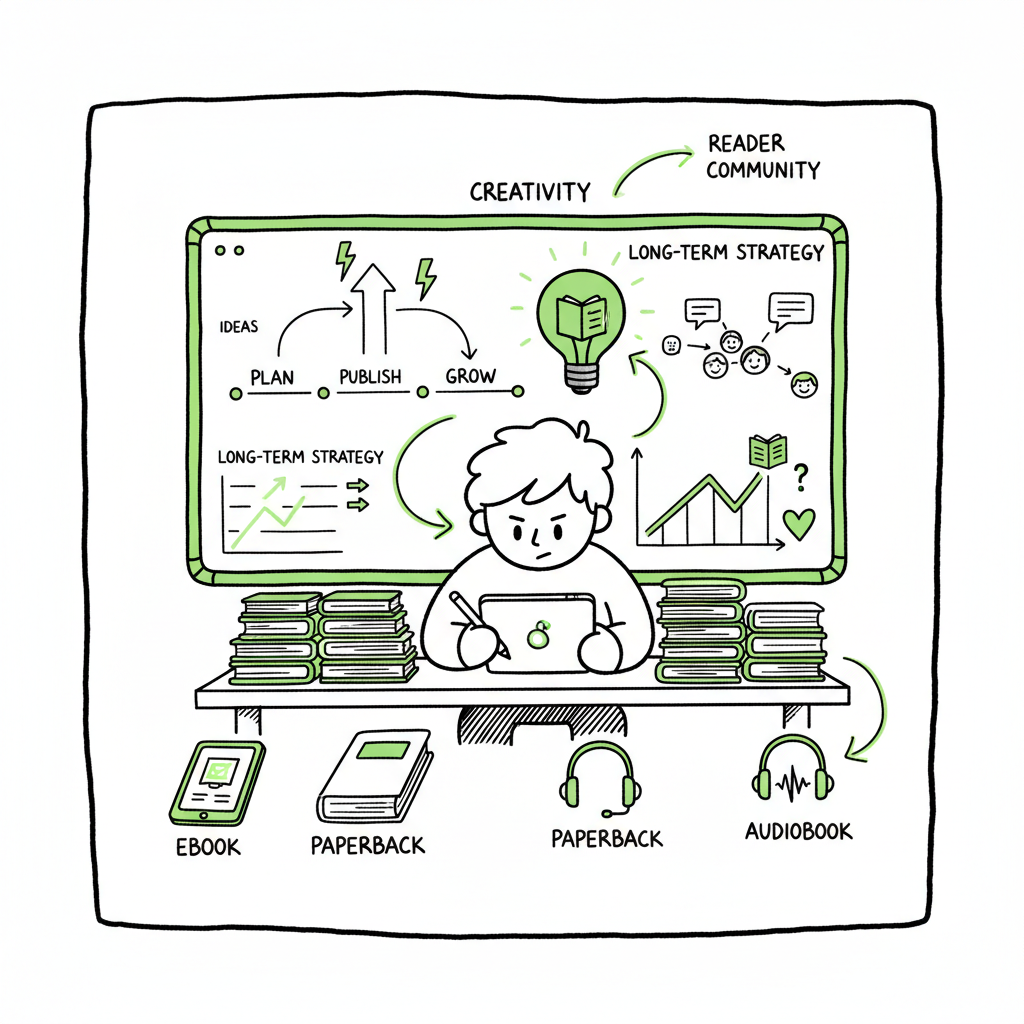
Long Term Publishing Strategy for Indie Authors and Backlist
Long Term Publishing Strategy: A Practical, Scalable Plan for Indie Authors
Estimated reading time: 14 minutes
Key takeaways
- A long term publishing strategy focuses on steady output, backlist growth, and reader relationships rather than quick wins.
- Diversifying platforms and formats (ebook, paperback, audiobook, direct sales) reduces risk and creates steady income.
- Operational efficiency—batch workflows, CSV uploads, and automation—turns a publishing plan into repeatable, low-friction execution.
- Treat publishing as a business once you aim for scale; the right tools make wide distribution practical and affordable.
Table of Contents
- Why long term publishing strategy matters
- Build a backlist with sustainable pacing
- Diversify channels and reader engagement
- How to operationalize at scale
- Final thoughts
- FAQ
- Sources
Why long term publishing strategy matters
When most authors start, they chase a single bestseller or try a rapid-release sprint. That can work for some, but for most indie authors the steady route wins over time. A long term publishing strategy is about treating your books as products in a catalog. It asks: how do you build a set of titles that keep selling and build on each other?
There are three simple reasons to plan for the long term:
– Backlist compounds sales. Each new book can lift older books, especially in series or shared worlds.
– Readers need time to find you. Building an audience with consistent releases and reliable communication pays off slowly but persistently.
– Markets change. A multi-year plan lets you adapt formats, promotion, and pricing without abandoning the work you’ve already done.
At this stage you should start thinking like a small business. If you’re ready to make that shift, a readable primer like Self Publishing as a Business can be the next step toward structured, repeatable publishing operations. Early choices—formatting, distribution, and tooling—matter because they scale with every book you add.
A long term approach also reduces stress. Instead of betting everything on one launch, you design a steady cadence that accommodates editing, covers, formatting, and promotion without burning you out. That is the sustainable indie publishing plan many successful authors follow.
Build a backlist with sustainable pacing
A backlist is simply your collection of published books. The goal of a long term publishing strategy is to grow that list deliberately. The two most common pacing models are slow-release and catalog-building. Slow-release spaces books to let each title breathe. Catalog-building focuses on consistent production to reach volume.
How to choose
– If you write complex series or need time for deep edits, choose slow-release. Space books every 6–12 months so you can promote each title fully.
– If you can produce reliably with quality, a catalog approach (publishing a book every 2–4 months) speeds discovery and algorithmic momentum.
Practical steps for either model
– Plan a 12–24 month calendar. Include writing, editing, proofing, cover work, formatting, and promotion slots.
– Track deadlines in a simple spreadsheet or project tool. Treat those dates as product milestones, not optional suggestions.
– Reuse assets: series descriptions, cover templates, and formatting presets reduce work per book.
Formatting and conversion
You’ll format once and reuse patterns. For ebooks, converting your manuscript to a clean EPUB is a must for most retailers. If you don’t want to manage multiple format pipelines, using a reliable EPUB converter saves time and avoids platform rejections. Good converters handle images, metadata, and table of contents automatically so you can focus on writing.
Cover and interior design
Covers should be consistent across a series. A consistent look helps readers recognize your work at a glance. If you need bulk cover work or a quick tool, a book cover generator can speed the process while keeping a professional look. For interiors, keep one or two layout styles and reuse them for similar formats.
Bundling and novellas
Shorter works, novellas, and boxed sets are useful backlist tools. They give new readers a low-risk way to try you and fill gaps between main releases. They also let you test subgenres or new series with less investment.
Promotion rhythm
– Launch promotion spikes visibility; evergreen promotion sustains it. Reserve one month of heavy promotion per book and steady, low-effort promotion (newsletter mentions, social posts) afterward.
– Use preorder windows where helpful. Preorders can create momentum and capture early sales.
Metrics to watch
Track first-week downloads, conversion rates from advertising, and recurring sales months after launch. Over time you’ll rely less on single-launch metrics and more on catalog-level revenue and customer lifetime value.
Diversify channels and reader engagement
Relying on a single retailer is risk. A long term publishing strategy diversifies distribution and builds direct relationships with readers.
Retail vs. wide vs. direct
– Amazon is large and useful, but a wide distribution strategy (Kobo, Apple Books, Draft2Digital, Ingram) reduces dependency and reaches different audiences.
– Direct sales via your website give better margins and more control. Use simple storefronts for signups, sales, and special editions.
– Audiobooks are growing; even one audiobook can expand reach to a new group of listeners.
Practical diversification tips
– Publish across multiple retailers. Use a service that knows platform rules to avoid format issues across stores.
– Offer a direct purchase or newsletter sign-up on your site. Your email list is the most reliable channel for launching and repeat sales.
– Use pricing experiments conservatively. Different retailers respond to price changes differently. Test small adjustments and measure.
Reader engagement
– Build an email list early. Even a small list is valuable for announcing launches and special offers.
– Offer consistent touches: a monthly newsletter, short serials, or reader-only extras. These maintain interest between releases.
– Consider a reader community (private group or paid membership) for superfans. Communities scale narrative engagement in ways ads can’t.
Packaging and presentation
– Keep product pages complete: series order, clear descriptions, and consistent metadata help catalog performance.
– Use prefaces, author notes, and bonus content to add value for direct buyers and subscribers.
Rights and formats
If you plan to sell direct, maintain format flexibility. You may need EPUB for most stores, PDF for direct sales, and a separate package for print. If you produce paperback or ebook editions at scale, tools that streamline this—cover sizing, spine calculations, and print-ready files—are worth the investment. For many authors, using a single hub to create both paperback and ebook files simplifies work and reduces errors.
If you need fast, reliable creation of paperback or ebook files, a EPUB converter can remove much of the formatting work so you can focus on content. And when you need consistent cover work for a series, a book cover generator can keep designs uniform and production moving.
How to operationalize at scale
A plan is only as good as its execution. Operationalizing a long term publishing strategy means designing repeatable processes and using tools that reduce manual tasks. At scale, the time saved compounds.
Design your workflow
– Standardize files: name manuscripts, covers, and metadata the same way every time.
– Use templates for back matter, descriptions, and author bios.
– Batch similar tasks: do covers for multiple books in one session, then do formatting in another.
Batch uploads and CSV workflows
When you publish more than a few books, manual entry into each retailer is a bottleneck. CSV batch uploads let you push metadata, pricing, and files in bulk. Look for systems that support CSV import for multiple channels. That reduces errors and saves time—often 70–90% compared with manual entry.
Quality control and platform intelligence
Different platforms have different rules for file sizes, image dimensions, and metadata fields. Platform-specific intelligence means your system warns you before upload, avoiding rejections that cost time. An effective process checks common issues automatically: missing author name, problematic images, metadata formatting, and pricing errors.
Reducing repetitive tasks
If you publish seriously, you’ll outgrow one-off entries. Reducing repetitive tasks—file conversions, metadata mapping, distribution—and running them reliably transforms publishing into a predictable pipeline. The result: fewer mistakes, faster turnaround, and consistent product presentation across stores.
Tools that bridge the gap
Services that unify multi-platform publishing and automate repetitive uploads make wide distribution practical. They offer:
– Unified multi-platform publishing so one workflow reaches Amazon KDP, Kobo, Apple Books, Draft2Digital, and Ingram.
– CSV batch uploads for catalogs of any size.
– Platform-specific intelligence to reduce rejections and formatting problems.
– Significant time savings: around 90% in repetitive tasks, according to operational benchmarks.
– Affordable pricing and free trials so you can test before committing.
Formatting and cover pipeline example
A repeatable pipeline might look like this:
1. Final manuscript saved to standardized filename.
2. Single EPUB conversion step to create the ebook file.
3. Create print-ready interior and cover files using templates.
4. Batch import metadata via CSV to distribution hub.
5. Run platform checks and publish to selected retailers.
If you need a fast way to convert many manuscripts to clean EPUB files, use a reliable EPUB converter to avoid manual cleanup. And when you need consistent cover work for a series, a book cover generator can keep designs uniform and production moving.
A single hub for publishing makes a long term strategy operational. It removes the friction between finishing a manuscript and getting it live. When tasks are repeatable and predictable, you can focus on writing and marketing rather than fighting file formats and upload screens.
A practical note on costs
Automation tools save time but cost money. Evaluate them like any business expense: calculate your hourly rate for manual uploading and compare to a tool’s price. When you publish multiple books per year, the math usually favors automation. At that point, upgrading becomes obvious: automate the upload. Own the distribution.
Finalizing details before launch
Before any release, run a checklist:
– Metadata complete and consistent across platforms.
– Cover and interior files meet platform specs.
– Pricing and territories set.
– Preorder dates and launch communications scheduled.
– Newsletter announcement and paid promotions planned.
Run a short soft launch to confirm all files and links work. Fix any last-minute issues before full promotion.
Final thoughts
A long term publishing strategy is not glamorous. It’s planning, discipline, and steady improvement. It values consistency over noise and backlist strength over one-time spikes. For authors serious about a sustainable indie publishing plan, the path is operational: define the catalog you want, standardize processes, and invest in tools that reduce repetitive work.
If you intend to scale, systems that automate multi-platform uploads and manage CSV batch processes become essential. They cut errors, save time, and make wide distribution practical. That’s when self-publishing moves from hobby to a repeatable publishing growth blueprint.
Automating repetitive steps won’t replace the craft of writing. It will remove the busy work that slows you down. When you eliminate manual upload steps and avoid platform-specific headaches, you get back the thing you care about: writing more and reaching more readers.
FAQ
Q: How many books do I need before a long term strategy pays off?
A: There’s no fixed number, but once you plan to publish more than two or three books per year, systems and processes start to save real time. Even two books a year benefit from repeatable workflows and batch uploads.
Q: Should I do slow-release or rapid release?
A: Pick based on capacity and genre. Slow-release fits complex work and allows heavier promotion per title. Rapid release can build visibility faster in certain genres. Many authors use a hybrid—pace main series releases and fill gaps with novellas or short works.
Q: Is it worth wide distribution?
A: Yes for most authors. Wide distribution diversifies risk and reaches readers who prefer non-Amazon stores. It also supports library and bookstore channels via print distribution.
Q: How important is the email list?
A: Very. An email list is the most reliable way to reach readers. Even a modest list can lift the first week of a launch and provide ongoing sales through newsletters and direct offers.
Q: How do I handle cover design and multiple formats?
A: Use consistent cover templates for series and a reliable pipeline for formatting. Tools that generate print-ready covers and convert interiors to EPUB remove much of the guesswork and reduce rework.
Sources
- Successful Slow-Release Strategies for Indie Authors
- Ultimate Indie Author Sales Strategy That Works
- Wide Publishing Strategy for Indie Authors’ Success
- The Two Survival Strategies Every Indie Author Needs Now
- Lessons from My Indie Author Crash Course
- The Journey of a Self-Published Author Calls for a Long-Term Mindset
Long Term Publishing Strategy: A Practical, Scalable Plan for Indie Authors Estimated reading time: 14 minutes Key takeaways A long term publishing strategy focuses on steady output, backlist growth, and reader relationships rather than quick wins. Diversifying platforms and formats (ebook, paperback, audiobook, direct sales) reduces risk and creates steady income. Operational efficiency—batch workflows, CSV…