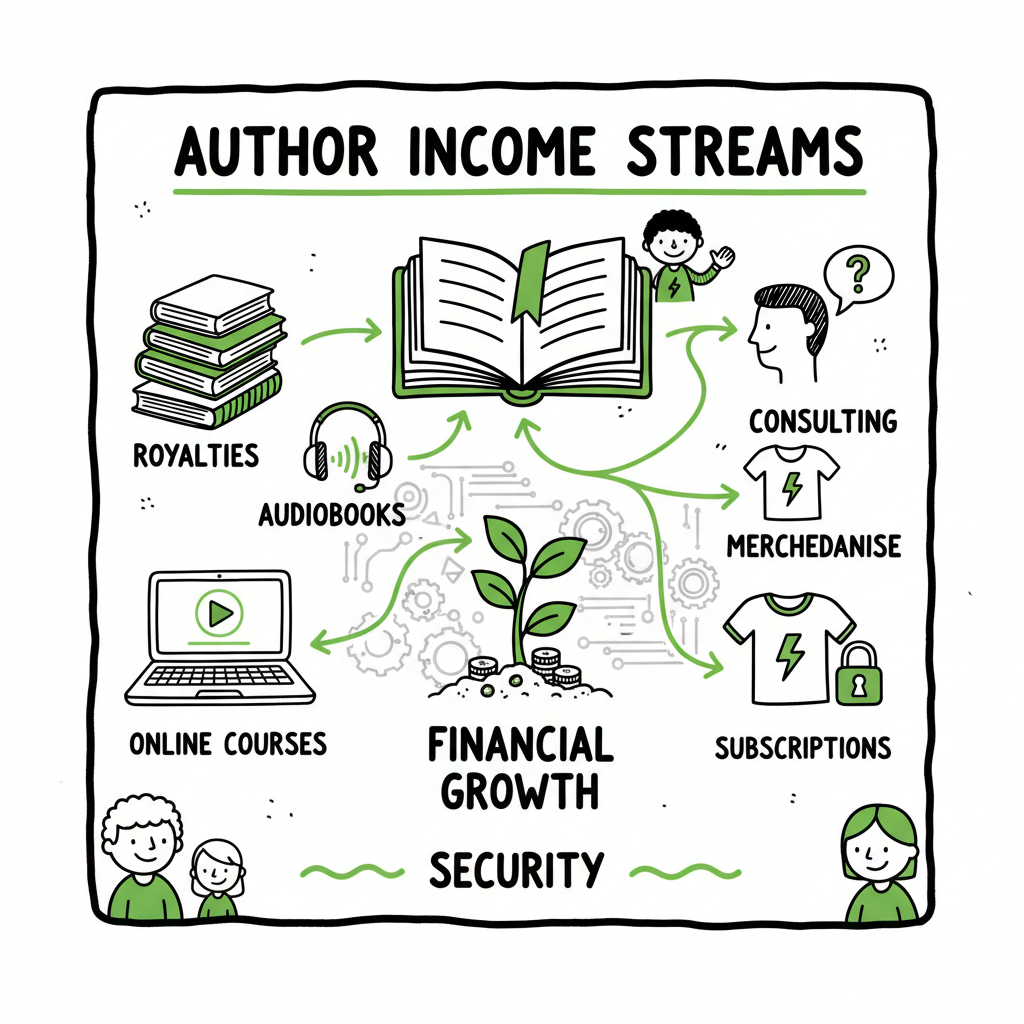
Author Income Streams and How to Build Reliable Revenue
Author Income Streams: How to Build Reliable Revenue Beyond Royalties
Estimated reading time: 9 minutes
Key takeaways
- Diversifying author income streams reduces risk and smooths cash flow by combining active services and passive products.
- Offer multiple formats, sell direct, and distribute wide; automation tools make scale practical and cut repetitive work by ~90%.
- Start with one reliable secondary stream (audio, course, or services), test pricing, and use batch publishing to grow without burning out.
Table of Contents
- Why multiple income streams matter
- How to create and combine author income streams
- Use automation and wide distribution to scale
- Final practical steps
- FAQ
- Sources
Why multiple income streams matter
A single bestseller is a lucky break. Most authors need steady income from different places: books in several formats, services, courses, speaking, and small recurring payments from fans. That mix is what “author income streams” means in practice: multiple author revenue sources working together so a short sales dip in one channel doesn’t stop you from paying the bills.
If you move from hobby publishing to treating titles like products, the work changes. You’ll plan releases, make different formats, and sell in more places. For writers ready to scale, read Self Publishing as a Business for the mindset and steps that make publishing repeatable and profitable. Early on, decide which streams you can run yourself (coaching, blogging) and which to outsource (audiobook production, wide distribution). That separation keeps active and passive income balanced.
That mix is what Self Publishing as a Business means in practice: multiple author revenue sources working together so a short sales dip in one channel doesn’t stop you from paying the bills.
How to create and combine author income streams
This section covers the practical options that most authors can start testing within months. Pick two to three paths, test them, and expand the winners.
1) Multiple book formats (ebooks, paperback, audiobook, bundles)
- Why it matters: Different readers prefer different formats. Some buy audiobooks on commute, some prefer print for gifting, and ebooks sell well during discounts. Selling multiple formats captures more of the market and raises lifetime revenue per title.
- How to start: Create an ebook and a print-on-demand paperback. Convert your manuscript to EPUB for most retailers and use an audiobook producer for spoken versions. If you need a tool to handle EPUB conversion, use a dedicated EPUB conversion service to avoid rework and distribution problems.
- Bundles: Offer a bundle (ebook + audiobook discount) or add bonus material—an extra chapter, a workbook, or a short companion guide. Bundles lift average order value and give readers a reason to buy direct.
- Pricing tips: Price ebooks to match platform norms; experiment with promo pricing on narrower distribution channels. For audiobooks, keep production quality consistent and price transparently.
2) Wide distribution vs exclusivity
- Why it matters: Exclusivity programs (like KDP Select) pay well during promos but limit reach. Wide distribution puts your books in Apple, Kobo, libraries, and more. That spreads risk and opens revenue sources like library loans and non-Amazon markets.
- Practical move: Upload wherever a book is accepted. Use Draft2Digital, Ingram, or manual uploads where needed. One practical benefit: wider reach increases visibility in markets where Amazon is smaller.
- Libraries and academic channels: Make titles available to libraries through services that support library licensing. Libraries can provide steady per-loan income over years.
3) Selling direct and building audience revenue
- Why it matters: Direct sales let you keep a bigger share of the price and collect customer data for future launches.
- Methods: Sell ebooks and bundles from your website, run small ads to build an email list, and offer exclusive pre-orders or signed print editions. Use a simple payment and delivery system and keep shipping manageable.
- Pricing and offers: Use limited-time bundles, discount codes for list subscribers, and special editions to reward loyal readers.
4) Services tied to your writing skillset
- Offerings: Editing, coaching, ghostwriting, freelance writing, or corporate writing. These are active income sources that pay predictably and can be scheduled around your publishing work.
- How to avoid burnout: Set clear capacity, price realistically, and use contract templates. Treat service work like a product with defined deliverables.
5) Passive income options (courses, membership, affiliates, merchandise)
- Courses: Package your expertise—craft, marketing, or your book topic—into an online course. Courses require upfront work but can sell repeatedly with evergreen funnels.
- Memberships: Patreon or a private member community gives predictable monthly income and deeper reader relationships.
- Affiliate marketing and ads: If you blog or run a newsletter, strategic affiliate links and non-intrusive ads can add passive dollars.
- Merchandise: Niche authors with strong branding can sell mugs, shirts, or posters tied to a popular character or series.
6) Speaking, workshops, and sponsored content
- Speaking and workshops: Pay are fees and book sales; they also build credibility for higher-priced products.
- Sponsored content and brand partnerships: Are viable for nonfiction authors in niche markets.
7) Rights, licensing, and adaptations
- Foreign rights, audio rights, and film/TV licensing are less predictable but can be lucrative. Keep accurate records and consider a literary agent for rights that require negotiation.
How to prioritize and test new streams
- Pick one active and one passive stream to add every quarter. For example: Q1 add audiobook production; Q2 launch a short course based on a book.
- Use small experiments: a landing page, a short ad test, or a single workshop. Track costs and revenue, and kill experiments that don’t pay back.
- Reinvest early wins into the channels that show the best ROI.
Use automation and wide distribution to scale
When you publish more than a couple of titles, manual uploads become a time sink. Automation, strategic batch processes, and platform-specific intelligence change the game.
Why automation matters
- Time savings: Automation can save about 90% of repetitive upload work. That means more time to write, build new products, or test channels.
- Error reduction: Automated checks and platform-specific rules reduce rejected uploads and format mistakes.
- Practical effect: You can scale to dozens or hundreds of titles without hiring a large team.
What to automate
- Batch uploads: Use CSV batch uploads to push metadata, pricing, and format files to multiple stores at once.
- Metadata management: Keep a single source of truth for titles, descriptions, categories, and keywords, then sync to each retailer.
- Distribution rules: Automate territories, pricing tiers, and exclusive/exclusive opt-outs per store.
- Reporting: Aggregate sales, royalties, and returns across platforms to get a true picture of performance.
Tools and workflow suggestions
- Use a service that understands Amazon KDP, Kobo, Apple Books, Draft2Digital, and Ingram. Look for platform-specific intelligence that auto-adjusts files and metadata to each store’s rules.
- Create a CSV master that holds title-level data and asset links. That lets you push multiple titles with consistent metadata and reduces repetitive clicks.
- Quality controls: Automate cover checks and file validation before pushing to retailers.
How BookUploadPro fits
For authors who publish seriously, BookUploadPro offers unified multi-platform publishing with CSV batch uploads and platform-specific intelligence. It reduces repetitive work and errors so you can publish widely without the heavy overhead. For many authors, it’s an obvious upgrade once they move beyond a handful of titles: automation makes wide distribution practical, and the time savings let you focus on revenue-driving activities.
Practical notes on assets and production
- Covers: A strong cover still matters. If you’re creating or testing many covers, a reliable book cover generator can speed the process and keep output consistent.
- EPUB and formatting: Convert manuscripts cleanly to EPUB for most retailers; poor conversion leads to bad reviews and refunds. If you don’t want to manage manual EPUB builds, use a dedicated EPUB conversion service to ensure compliance.
- Paperback and ebook creation: If you produce print and digital versions regularly, a streamlined book creation workflow reduces rework and keeps editions aligned.
Putting the pieces together
Start with your core product (a book) and add another format (audiobook or print). Use wide distribution for the core formats.
Add one active income source you control (coaching, freelance work) to stabilize monthly income.
Build a passive product (a short course or membership) and use book promotions to drive the first cohort.
Automate the publishing steps so new titles don’t cost you days in uploads and fixes.
Final practical steps
- Audit your current revenue. Break down where every dollar comes from today.
- Choose two streams to start next quarter: one active (services or speaking) and one passive (audio, course, or membership).
- Plan the asset work: cover, EPUB, audiobook files, and a simple landing page for direct sales.
- Build a simple CSV master and test a small batch upload so you can repeat the process without manual entry.
- Track unit economics for each stream (time invested vs revenue) and scale the ones that return profit.
FAQ
Q: How many income streams should an author aim for?
A: Quality over quantity. Start with three reliable streams—book sales across formats, one service, and one passive product—and add more as you prove each model.
Q: Are audiobooks worth the cost?
A: For many genres, yes. Audiobooks tap a separate audience and can significantly increase total revenue per title. Costs vary, but you can test with a single title and measure conversion.
Q: Should I go exclusive with Amazon KDP Select?
A: It depends. KDP Select helps with promo visibility and Kindle Unlimited revenue, but it blocks you from wide distribution. If your audience is global or you want library and Apple sales, wide distribution is preferred.
Q: How do I price courses or memberships as an author?
A: Start with simple offers. A short course can be $50–$200 depending on niche and depth. Memberships can start at $5–$15 monthly with clear member benefits. Test pricing and adjust based on conversion.
Q: What’s the easiest passive stream to start?
A: Repurposing existing content into a short online course, workbook, or ebook bundle. It leverages existing work and requires less new writing.
Q: Can automation tools hurt my brand or quality?
A: No—when used correctly. Automation should handle repetitive tasks and platform rules. Keep quality checks in place for covers, formatting, and audio. Automating uploads doesn’t replace editorial standards.
Sources
- An Indie Author’s Guide to Diversifying Income Streams
- How 5 freelance writers make money by diversifying their business
- 4 Ways to Diversify Your Income as a Writer
- Diversify Your Writing Income: Build a Resilient Business Model
- 10 Passive Income Streams for Self-Published Authors
- How to Diversify Your Income as an Author
- Diversifying Your Income Streams as an Author (video)
- Book creation: streamlined workflow
- EPUB conversion
- Book cover generator
Author Income Streams: How to Build Reliable Revenue Beyond Royalties Estimated reading time: 9 minutes Key takeaways Diversifying author income streams reduces risk and smooths cash flow by combining active services and passive products. Offer multiple formats, sell direct, and distribute wide; automation tools make scale practical and cut repetitive work by ~90%. Start with…