
In this guide
- The commute question, and AI narration’s honest place in it
- What the numbers mean for a small catalog
- FAQ
- How big is the audiobook market compared to ebooks?
- How much time do audiobook listeners spend listening each week?
- Can audiobook income overtake my ebook income over time?
- Do I need an audiobook to be taken seriously as a professional author?
- What do audiobook listeners expect that ebook readers do not?
- Are listeners okay with AI narration for long commutes?

Audiobooks are the growth format of trade publishing: industry surveys through the mid 2020s put audiobook revenue in the same league as ebooks and still climbing, with double digit growth in years when print and ebook were flat. The engine is habit, not novelty: listening fills time that reading cannot touch, commutes, workouts, housework, dog walks, and committed listeners commonly log several hours a week, with heavy listeners far above that. A catalog in audio therefore meets an audience whose consumption is measured in hours per day, not pages per sitting:
Key takeaways:
- Yes, audio income overtakes ebook income for plenty of authors, especially in genres with long books and commute listeners (epic fantasy, litRPG, business, history, self development), because audiobook prices and credit values are higher per unit and series listeners binge whole catalogs by the hour:
- You do not strictly need an audiobook to be taken seriously, but the absence increasingly reads as unfinished in audio heavy genres; reviewers, podcasters, and readers treat the audio edition as part of a professional launch.
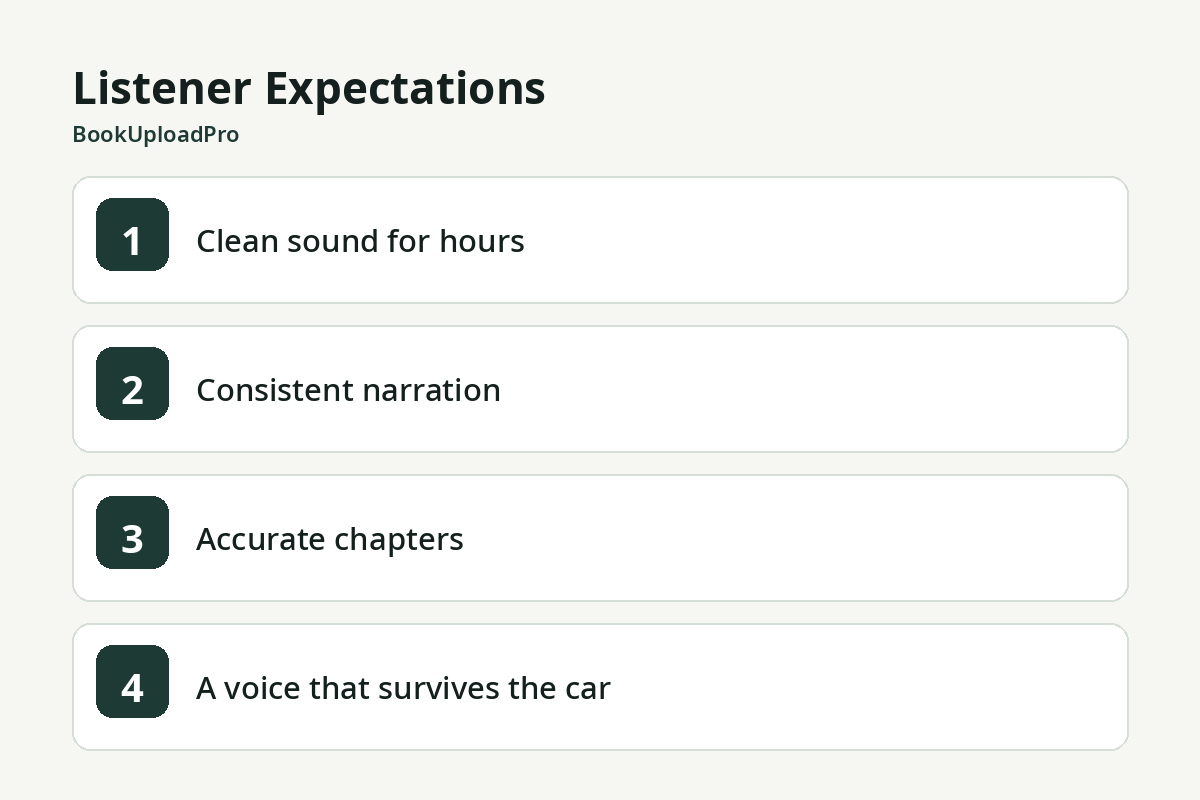
- Listeners expect what readers do not: consistent volume and clean sound across hours, narration that sustains characters and pace, accurate chapter navigation, and a performance that survives a car speaker; they also forgive a plain cover and never see your typography.
The commute question, and AI narration’s honest place in it
Long commutes are the format’s founding use case, and they are also its most demanding listening environment: road noise exposes weak mastering, and an hour a day with one voice tests narration quality hard. Listeners’ acceptance of AI narration on commutes follows the same pattern as everywhere else: disclosed, well produced AI narration gets heard; flat or mispronouncing output gets abandoned and reviewed accordingly. The commute raises the bar; it does not change its nature:
What the numbers mean for a small catalog
You do not need the whole market; you need your genre’s listeners. A backlist with steady ebook sales is the best predictor of audio demand, because it proves the audience exists and the books satisfy it; convert proven sellers first and let each audio edition fund the next:
FAQ
How big is the audiobook market compared to ebooks?
Comparable in revenue and still growing faster, per industry surveys through the mid 2020s, with audio posting double digit growth in years ebooks were flat. Exact figures vary by source and year; the direction does not.
How much time do audiobook listeners spend listening each week?
Committed listeners typically log several hours weekly, and heavy listeners, especially commuters, far more, often an hour or more a day. Filling otherwise unusable time is the format’s core advantage.
Can audiobook income overtake my ebook income over time?
Yes, it commonly does in audio friendly genres and long series, thanks to higher per unit value and binge listening. It is likeliest where your ebooks already sell steadily.
Do I need an audiobook to be taken seriously as a professional author?
Not as a rule, but in audio heavy genres the absence is conspicuous, and the edition is increasingly treated as part of a complete professional release. Where your readers listen, be there.
What do audiobook listeners expect that ebook readers do not?
Clean consistent sound, sustained narration quality, accurate navigation, and performance that survives real environments like cars. They judge production with their ears for hours.
Are listeners okay with AI narration for long commutes?
Many are, when it is disclosed and well produced, and commutes are the toughest test because duration exposes every weakness. Quality decides, on the longest drives most of all.