Amazon KDP Royalty Structure Explained and Calculated
What the Amazon KDP Royalty Structure Means Today
Estimated reading time: 18 minutes
Key takeaways
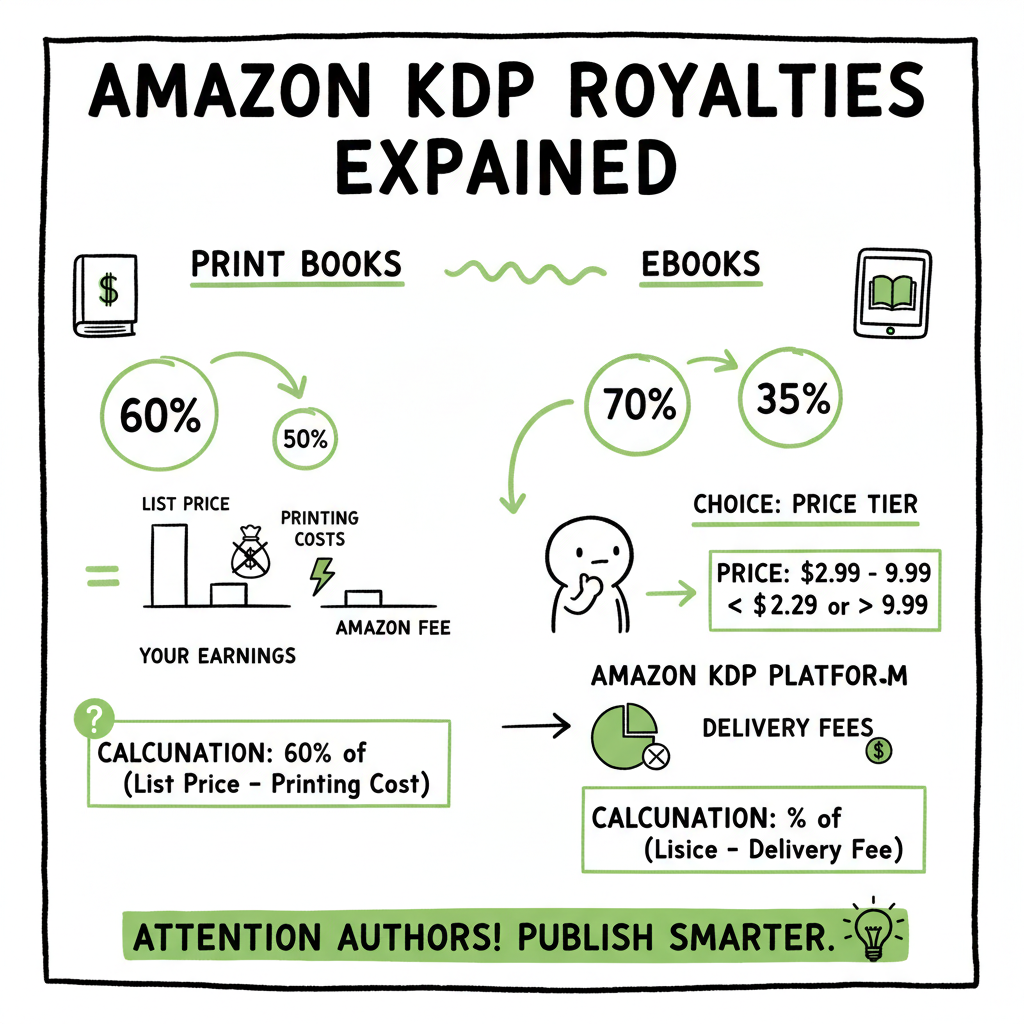
- The amazon kdp royalty structure for print now uses a 50% / 60% tier based on marketplace price thresholds; ebooks still use 35% or 70% options.
- Calculating actual earnings means subtracting printing costs and platform fees from the royalty percentage — use the marketplace calculator and clear formulas to estimate pay.
- For authors publishing at scale, multi-platform automation (CSV batch uploads, platform-specific settings) saves time and reduces errors — an obvious upgrade once you publish seriously.
Table of Contents
- What the Amazon KDP Royalty Structure Means Today
- How to Calculate Your KDP Royalties
- Pricing Strategy and Marketplace Thresholds
- Publishing Everywhere: A Practical Multi-platform Workflow
- FAQ
- Sources
What the Amazon KDP Royalty Structure Means Today
If you sell on Amazon, understanding the amazon kdp royalty structure is basic bookkeeping and pricing strategy in one. For paperbacks and hardcovers KDP switched to a tiered royalty system in 2025: print books priced at or below certain marketplace thresholds earn a 50% royalty on list price (minus printing costs); books priced above those thresholds earn 60% (minus printing costs). For ebooks the familiar 35% and 70% royalty options remain in place, with the 70% option also subject to delivery costs in certain territories.
This change matters because it directly affects how much you keep per sale at different price points. It’s no longer enough to pick a price that “feels right.” You need to know the threshold levels for each marketplace and model the math for your specific trim, page count, and distribution choices. For a concise walkthrough of how pricing thresholds change the math, see Amazon Kdp Royalties Pricing Profit.
Why the change happened
Amazon adjusted print royalties to make low-priced print books less likely to pay negative or tiny effective royalties after printing costs. The new 50% tier ensures printing costs don’t wipe out earnings for very low list prices. That protects Amazon and keeps print viable, but it also forces authors and publishers to rethink pricing if they previously aimed at low-price volume.
What stays the same
- Ebook royalty choices: 35% or 70% depending on distribution options and territory eligibility.
- Expanded distribution for paperbacks continues to carry a lower flat royalty (different from the marketplace tiers), and print costs still vary by trim, ink, and country.
How to Calculate Your KDP Royalties
You can’t manage what you don’t measure. The formula for print royalties under the new structure is straightforward once you break it into parts:
- Pick the royalty rate
- 50% of list price if your book’s list price is at or below the marketplace threshold for that currency.
- 60% of list price if it’s above the threshold.
- Subtract the printing cost
Printing cost depends on page count, color vs. black-and-white, ink and paper choices, and marketplace shipping location. KDP shows you the cost when you set up the paperback.
- For expanded distribution on paperbacks
The royalty is a fixed 40% of list price minus printing cost.
- For ebooks
- 35% royalty: straightforward percentage of the list price.
- 70% royalty: 70% of the list price minus the delivery cost, which is typically calculated per megabyte. Delivery costs are small but add up for image-heavy files.
Example, simple math
Suppose your paperback list price is $12.99, and the print cost is $4.50. If that price is above the marketplace threshold and gets the 60% rate:
– Royalty before printing = 60% of $12.99 = $7.79
– Royalty after printing = $7.79 – $4.50 = $3.29 earned per sale.
If the same book is priced at $9.98 and that price sits at or below the threshold and gets the 50% rate:
– Royalty before printing = 50% of $9.98 = $4.99
– Royalty after printing = $4.99 – $4.50 = $0.49 earned per sale.
That difference is why authors sometimes raise price above the threshold even at the risk of losing some buyers: the per-sale take can be meaningfully higher.
Tools to help
KDP publishes a royalty calculator, and many authors keep a simple spreadsheet for different trim sizes and page counts. The basic variables you’ll track are list price, royalty rate, print cost, and distribution channel. For authors building many editions or publishing multiple titles, automating price and file uploads saves hours. This is where multi-platform publishing tools become valuable — they let you run consistent price tests and push updates across channels without repeating manual steps.
Pricing Strategy and Marketplace Thresholds
Matching price to value, margin, and audience expectation is still the art here, but the new KDP royalty tiers require you to add a bit more math into the art.
Know the thresholds
Each marketplace and currency has its own threshold. For example, one common USD threshold used in public discussion is $9.98: titles priced at or below $9.98 earn the 50% print royalty; at $9.99 and above they earn 60%. Other currencies have different cutoffs. That means a global strategy needs per-marketplace checks, not a single global price.
Consider the audience and format
- Ebooks: If your target readers are price-sensitive, ebooks at low price points with the 70% option (when eligible) often outperform print in pure profitability. High-image books have higher delivery costs that push effective ebook royalty down, so model per-book.
- Trade paperback and hardcover: Page count and color usage matter more. Color increases print cost significantly, and long page counts move the print cost up. If your book is color-heavy, review whether a print retail price that crosses into the 60% tier still yields a sensible per-sale margin.
Expanded distribution trade-offs
Expanded distribution can get your paperback into more stores and wholesalers, but the royalty is different (typically 40% minus printing costs). For some books, the exposure is worth the lower margin; for others, selling direct through Amazon and platform partners yields better per-sale earnings. Model both scenarios.
Practical pricing steps
- Calculate baseline per-sale earnings at both the 50% and 60% tiers for your book’s trim and page count.
- Factor in promotional discounts and potential returns where applicable.
- Look at the market: what are comparable titles priced at? If comparable books are clustered in a higher bracket, price below the threshold might signal lower value; price above can maintain perceived value.
- Test in small controlled ways: change price in one marketplace or region, track sales, and compare revenue. If you publish many titles, automate price changes and reports so you can learn faster.
kdp royalty rates explained
When people ask for kdp royalty rates explained, they usually want the short set of rules:
- Paperback/hardcover: 50% or 60% of list price minus printing costs, with threshold values per marketplace.
- Ebook: 35% or 70% of list price (70% subject to delivery charge and territory rules).
- Expanded distribution: typically a lower percentage (e.g., 40% for paperbacks) minus printing costs.
amazon kdp earnings breakdown and kdp payout percentages
If you want an amazon kdp earnings breakdown or to understand kdp payout percentages, break every sale into line items: list price → platform royalty percentage → delivery or printing costs → final payout. That simple chain is the starting point for reliable royalty forecasts.
Publishing Everywhere: A Practical Multi-platform Workflow
If you publish one book, you can probably handle a few manual uploads. If you publish dozens, or want the book available across Amazon KDP, Kobo, Apple Books, Draft2Digital, and Ingram, manual processes become a bottleneck. This is where automation and consistent workflows pay.
What multi-platform publishing must solve
- File formats: Amazon wants a print-ready PDF for print and a properly structured EPUB for many ebook platforms.
- Metadata consistency: Title, subtitle, author name variants, series metadata, descriptions, keywords, BISAC codes, pricing tiers by marketplace.
- Cover versions: Different platforms and formats require different trim sizes and bleed settings. You’ll often need multiple cover files.
- Distribution settings: Territories, DRM choices, expanded distribution, and pre-order settings all vary by platform.
- Reporting and updates: Price changes, price matching, new editions, and reprints.
How automation helps
A reliable multi-platform workflow reduces repetitive work and errors:
- CSV batch uploads allow you to push metadata and pricing for many titles at once.
- Platform-specific intelligence applies the right settings per channel without guessing.
- Automated file conversion and checks reduce rejections and time spent fixing problems.
- Versioning and templates ensure covers and interiors match the required specs for each platform.
BookUploadPro’s operational value
For teams or serious indie authors, BookUploadPro removes the repetition. It automates uploads to Amazon KDP, Kobo, Apple Books, Draft2Digital, and Ingram. Primary benefits include:
- Unified multi-platform publishing from a single interface.
- Up to ~90% time savings on repetitive uploads.
- CSV batch uploads for scaling titles quickly.
- Platform-specific intelligence that reduces format errors.
- Practical error reduction that makes wide distribution realistic and affordable.
- Transparent pricing and a free trial so you can test at scale.
How this changes decisions
When you can push updates and variants quickly across channels, you can:
- Run controlled pricing experiments in multiple markets.
- Update metadata or covers without redoing the whole setup.
- Publish multiple editions (a lot of series authors do this) without multiplying work.
Format tasks you still need to plan for
- Creating covers that match market conventions and convert. If you need a fast, automated option for cover creation, there are tools to help with the design and processing of covers.
- Converting manuscripts to EPUB with correct navigation and embedded images. A reliable EPUB converter reduces rework and retailer rejections.
- Generating separate paperback and ebook files to match the platform requirements. If you’re building formats at scale, look for a unified book creation workflow that handles both paperback and ebook generation.
Balancing price, format, and distribution
If you price a print book just below the threshold to target impulse buyers, expect much lower per-sale earnings. If the same title is priced above the threshold, you may earn more per sale but could see fewer sales. Automation removes the friction of testing both approaches across stores; you can run the experiment properly and compare real results instead of guessing.
FAQ
Q: What are the exact threshold values for my marketplace?
A: Thresholds vary by country and currency. KDP lists current thresholds and a royalty calculator on its help pages. Always verify on the KDP dashboard before finalizing price.
Q: How much will printing costs reduce my royalty?
A: Printing costs depend on page count, trim size, ink selection (color vs. black-and-white), and the marketplace printing location. KDP shows the print cost when you set up the paperback, and you should model both high- and low-cost scenarios if you print color books or long page counts.
Q: Do ebook delivery costs matter much?
A: For typical text-only ebooks delivery costs are small. For image-heavy books (children’s books, graphic novels, textbooks) delivery costs can materially affect the 70% royalty option, so calculate delivery based on file size.
Q: Should I avoid expanded distribution because royalties are lower?
A: Not necessarily. Expanded distribution can place your book in libraries, bookstores, and catalog channels that Amazon alone does not reach. It’s a trade-off of margin for reach; test where you get meaningful sales before making a permanent call.
Q: When should I consider multi-platform automation?
A: If you have more than a handful of titles, or you update content or prices frequently, automation is worth the investment. It eliminates repetitive uploads, enforces consistency, and reduces the chance of errors that cost time.
Sources
- Paperback Royalty – Kindle Direct Publishing
- Hardcover Royalty – Kindle Direct Publishing
- eBook Royalties – Kindle Direct Publishing
- Dibbly, Amazon KDP Royalty Changes 2025: what to know
- Self-Publishing with Dale, KDP’s Royalty Cut Isn’t the Whole Story
Final thoughts
Understanding the amazon kdp royalty structure isn’t optional if you want predictable revenue from print and ebook sales. The new print tiers force deliberate pricing decisions, and the best-performing authors treat pricing as an experiment backed by clear math.
If you publish multiple books or distribute across KDP, Kobo, Apple, Draft2Digital, and Ingram, shift the operational burden off manual uploads and into repeatable workflows. Use a system that supports CSV batch uploads, platform-specific settings, and file conversion tools so you can manage volume without firefighting. Automate the upload. Own the distribution.
Try BookUploadPro to streamline multi-platform publishing and test how pricing and distribution changes affect your bottom line. Visit BookUploadPro.com and start the free trial.
What the Amazon KDP Royalty Structure Means Today Estimated reading time: 18 minutes Key takeaways The amazon kdp royalty structure for print now uses a 50% / 60% tier based on marketplace price thresholds; ebooks still use 35% or 70% options. Calculating actual earnings means subtracting printing costs and platform fees from the royalty percentage…