
In this guide
You can make a sudoku by hand, and authors did for years, at the cost of hours per puzzle and constant errors. A saleable puzzle book needs hundreds of puzzles, each verified to have exactly one solution, graded honestly by difficulty, with correct answer keys, and that verification is the real product. Generator software does the construction and the uniqueness check in seconds and exports print ready grids; your skill moves to choosing difficulty curves, sampling and solving puzzles yourself as quality control, and layout. Hand made belongs in the marketing story of an artisanal few puzzle special, not in a 300 puzzle paperback competing on price:
Key takeaways:
- A sudoku with two solutions is a defect readers photograph for one star reviews; whatever generates your puzzles must prove a unique solution, and you must spot solve across every difficulty band.
- Stock images are licensed, not owned: the license type decides whether book interiors and covers are allowed, resale and merchandise terms differ, and some licenses prohibit use in products for resale in exactly the form low content books take. Read the license of the specific asset, not the site’s homepage promise:
- Public domain is real but narrower than it looks: the text of an old work may be free while a modern edition’s typesetting, translation, illustrations, and introduction are protected. Build from genuinely old sources or properly licensed critical material, and remember public domain status varies by country.
The puzzle production pipeline
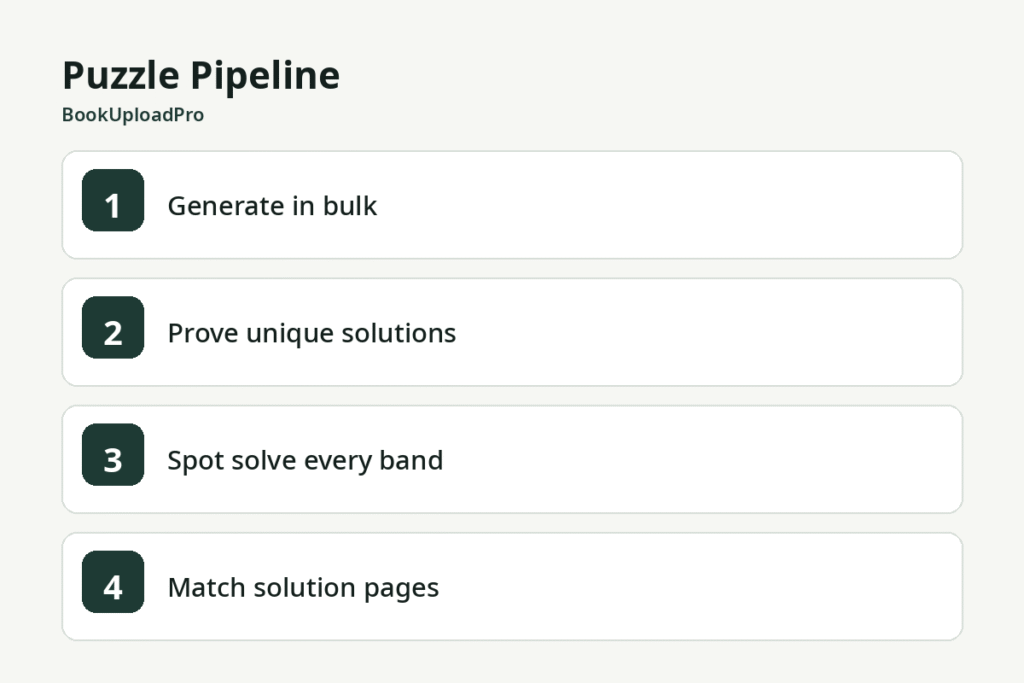
Generate in bulk with target counts per difficulty, export grids and solutions, assemble in your layout tool with consistent numbering, and run the QA pass: solve two puzzles per band, verify every solution page matches its puzzle number, and check that easy is actually easy, because mislabeled difficulty is the second most common complaint after multiple solutions. Other puzzle types follow the same shape: word searches and crosswords have their own generators, and the value you add is theme selection, curation, and a book that feels made for one specific buyer:
Stock and public domain books, the publisher’s checklist
For every asset: where did it come from, what license or status, does that license cover commercial book use at your print volume, and is a human model or trademark in the frame adding more rules? For public domain texts: whose edition are you copying, and is anything in it (translation, notes, images) still protected? Keep the answers in a rights log per book. This is unglamorous work, and it is the difference between a catalog and a takedown queue:
FAQ
Do I need special software to generate sudoku puzzles or can I make them by hand?
By hand is possible and impractical at book scale. Generators construct puzzles, prove each has a unique solution, and export print ready grids; your job becomes difficulty grading, spot solving for quality, and layout. Unique solution verification is the part you cannot skip.
Is it legal to sell books built from stock images or public domain content?
Yes, inside the terms: stock assets only as their specific license allows for commercial book products, and public domain material only where the underlying work is truly public domain in your market and the edition you copy adds nothing protected (modern translations, illustrations, and introductions often are). Keep a rights log per book.