
In this guide
- Stopping the unrealistic amounts
- Nutrition numbers without the liability trap
- FAQ
- Can AI calculate nutrition information for the recipes in my cookbook?
- Can AI format recipes with ingredients, servings, and prep times consistently?
- How do I stop AI recipes from using unrealistic ingredient amounts?
- How many recipes should an AI generated cookbook include?
AI is genuinely good at the shape of a recipe and genuinely unreliable at its quantities, and a cookbook succeeds when you use it for the first and police the second. Formatting is the safe win: give the model one finished recipe as the template, ingredients in a fixed order and unit style, servings, prep and cook times, and numbered steps, and it will hold that structure across a hundred recipes more patiently than any human assistant. Nutrition is an estimate with a confident face: AI can approximate calories and macros from standard ingredient values, but its numbers drift with portion assumptions and ingredient choices, so treat them as drafts to verify in a nutrition calculator for any recipe where the numbers are a selling point, especially diet books where readers act on them.
Key takeaways:
- Unrealistic amounts have a cause: the model averages thousands of recipes and scales badly, so half a teaspoon becomes two tablespoons when a recipe doubles. Fix at the prompt level (state servings and total yield) and at the testing level (cook the flagship recipes).
- Recipe count follows the promise, not a quota: a focused cookbook is complete at 30 to 50 tested recipes; a broad one runs 75 to 150. More untested recipes make a worse book, not a bigger one.
- Every AI cookbook needs a test pass on at least the recipes you feature in marketing, because one broken recipe in a review costs more than ten good ones earn.
Stopping the unrealistic amounts
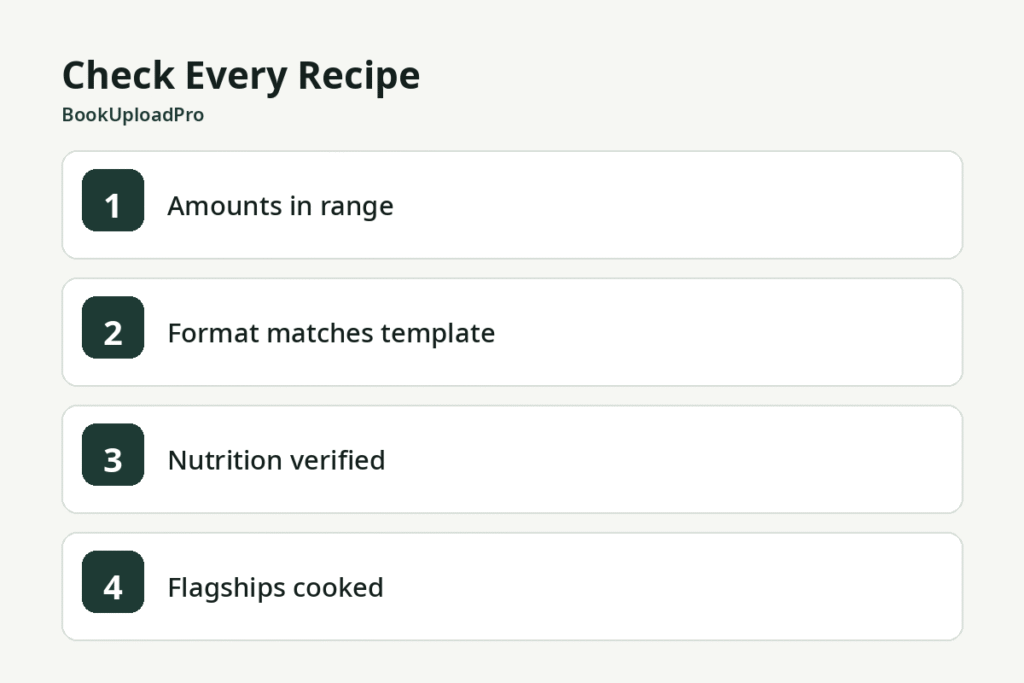
Work in this order. Set the frame before generation: servings, pan size, and total yield in the prompt, every time. Demand baker’s percentages or weights for baking, where volume guessing fails hardest. After generation, scan for the classic tells: spices measured in cups, salt beyond a teaspoon or two per dish, liquids that cannot fit the stated pan, and cook times that ignore thickness. Then cook. A recipe developer tests everything; an AI assisted author tests the flagships and spot checks the rest with a cook’s eye, and says honestly in the introduction how the recipes were developed and checked. That honesty is also what makes the book feel authored rather than generated.
Nutrition numbers without the liability trap
Generate the estimate, then verify it in a dedicated nutrition calculator using your exact ingredients and servings, and print the verified number with a plain note that values are estimates. For diet and health positioned books, raise the standard: verify every recipe, keep the calculator outputs in your project files, and never let the model invent health claims around the numbers. Nutrition is the one cookbook area where an AI error is not a bad review but a reader harmed, and the workflow above is the difference between AI assisted and AI trusted.
FAQ
Can AI calculate nutrition information for the recipes in my cookbook?
It can estimate calories and macros from standard ingredient data, and the estimates are drafts, not data. Verify any number you print, especially in diet books, with a dedicated nutrition calculator using your exact ingredients and serving sizes.
Can AI format recipes with ingredients, servings, and prep times consistently?
Yes, this is one of its best cookbook uses. Give it one finished recipe as the template, with your order, units, and structure fixed, and it will hold the format across the whole book. You still check each recipe’s content; the formatting is the reliable part.
How do I stop AI recipes from using unrealistic ingredient amounts?
Fix the frame in every prompt (servings, pan size, total yield), ask for weights in baking, scan for the classic tells (spices by the cup, impossible liquid volumes), and cook the flagship recipes. Amounts are where AI averages instead of understands.
How many recipes should an AI generated cookbook include?
As many as the book’s promise needs and you can stand behind: roughly 30 to 50 for a focused topic, 75 to 150 for a broad one. Tested and working beats numerous; readers review the recipe that failed, not the count.