
In this guide
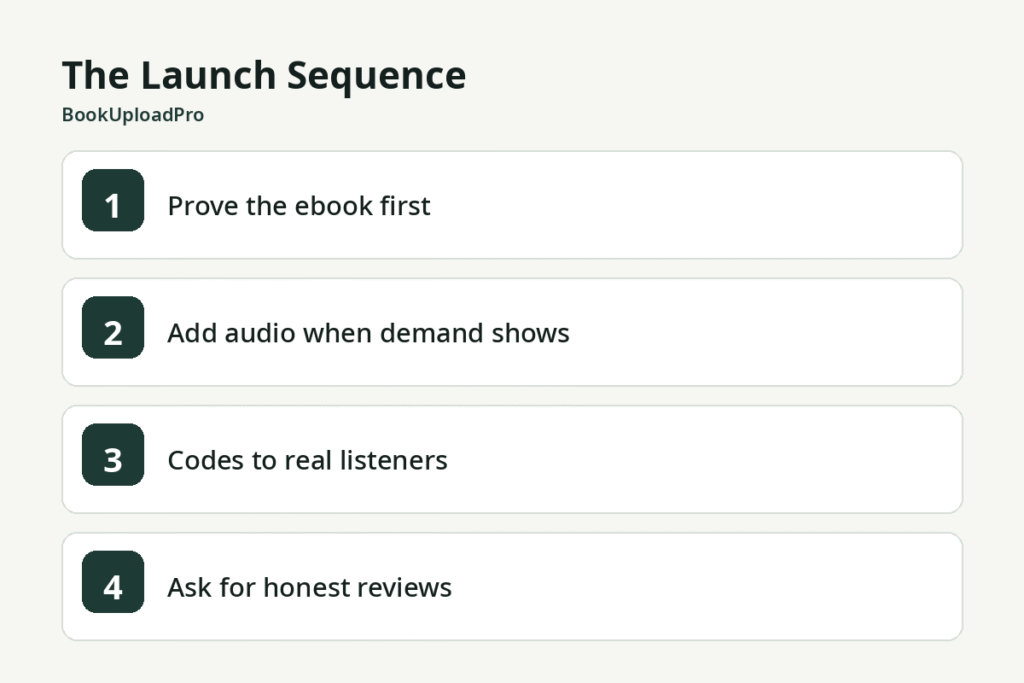
For a brand new author with no audience, the honest default is: not yet, and not because audiobooks are a bad format, but because an audiobook multiplies an audience you already have rather than creating one. Audio production, even the cheap AI route, costs money or serious time, and a title nobody knows exists earns the same in three formats as in one. The sequence that works is to prove the book in ebook and print first, where changes are cheap and feedback is fast, then bring audio to a title that already sells, where the audiobook launches to readers who were waiting for it. The exception: if your genre is audio heavy, your book is finished and selling even modestly, or the low cost AI route makes the test genuinely cheap, an early audiobook can be a reasonable experiment as long as it is budgeted as an experiment.
Key takeaways:
- Audio follows proof: steady ebook sales, reviews asking for audio, or a series with read through are the signals that an audiobook will find listeners.
- Free codes are a launch tool, not a strategy: they put the book in the ears of reviewers, book clubs, and your existing readers, and their value depends entirely on who receives them.
- Codes come from your channels: ACX provides promotional codes for titles distributed there, and some distributors run their own giveaway programs; availability and terms change, so check your dashboards at launch.
Using free codes so they produce reviews, not silence
Give codes to people with a reason to listen and a place to talk: your mailing list’s most engaged readers, reviewers in your genre, podcast and book club hosts, and the readers who asked for the audiobook in the first place. Ask plainly for an honest review where reviews matter, never a positive one, and follow up once, politely, a few weeks later. Track who got codes and what came back; a code redeemed by a stranger who never listens teaches you nothing. One caution: never sell codes, and never trade them for guaranteed positive reviews; both violate store policies and the reviews they produce are worthless anyway. Done well, a code round seeds the first handful of ratings that make the next listener press buy.
The decision, compressed
If the book is unproven: publish ebook and print, build the first audience, and record the audio the moment demand shows itself. If the book already sells: the audiobook is overdue, and the only question is which production route fits the budget. Either way, an audiobook is a second launch of a proven book, and treating it that way is what separates a catalog asset from an expensive file sitting in a dashboard.
FAQ
Should a brand new author with no audience make an audiobook yet?
Usually not first. Prove the book in ebook and print, where feedback is fast and changes are cheap, then add audio when the title sells or readers ask for it. The low cost AI route can justify an earlier test if you budget it honestly as an experiment.
Should I give away free audiobook codes to get early listeners and reviews?
Yes, targeted: your engaged readers, genre reviewers, book club and podcast hosts, and readers who requested audio. Ask for honest reviews only, follow up once, and track redemptions. Never sell codes or trade them for positive reviews.