
In this guide
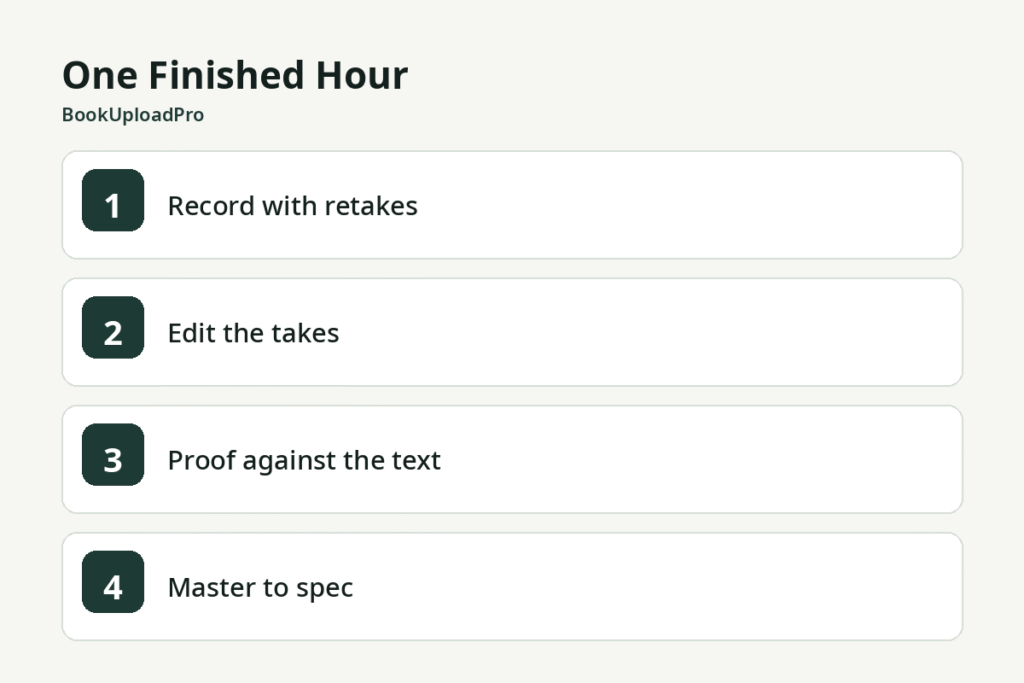
Narrators charge per finished hour because the finished hour is the product, and it is a surprisingly expensive hour to make. Behind one hour of retail ready audio sits roughly one and a half to two hours of recording with retakes, two to three hours of editing, a full proofing listen against the text, and mastering, so a professional is selling you five or six hours of skilled work and studio time inside every finished hour. Pricing by the finished hour also protects you: the narrator absorbs the cost of their own slow days, difficult chapters, and pickup sessions, and you can compute the whole budget from your word count before anyone records a word, at roughly 9,300 words per finished hour.
Key takeaways:
- Per finished hour is a fixed price contract in disguise: total cost equals rate times finished hours, known upfront, with overruns on the narrator.
- The 100 to 400 dollar range is mostly four variables: experience and demand, whether editing and mastering are included or billed separately, studio and union status, and genre difficulty.
- A cheap rate that excludes editing is not cheap; compare finished, mastered, retail ready hours against finished, mastered, retail ready hours.
What the rate is actually buying
At the top of the range you are buying a narrator whose name sells copies, a treated studio, an engineer or a polished self production workflow, and reliability across a long series. In the middle, working professionals with solid home studios and full production included. At the bottom, newer narrators building a catalog, sometimes with editing billed on top, sometimes recording in spaces that will struggle to pass quality control. None of that makes the bottom wrong for every book: a short nonfiction title with modest sales expectations and a careful beginner can be the right match, and the audition sample plus the first 15 minutes approval exists precisely to test the match before the money commits.
Doing the math on your book
Take your word count, divide by 9,300 for finished hours, and multiply by the rate: a 75,000 word book is about 8 finished hours, so 800 dollars at the bottom of the range, about 2,000 at a typical 250 mid rate, and 3,200 at the top. That single multiplication is why the alternatives exist on a ladder: royalty share removes the upfront cost and replaces it with years of split income, and AI narration removes most of the production cost and replaces it with your review time. Judge the rate against the book’s realistic audio income, not against your hopes, and the pricing structure stops looking arbitrary.
FAQ
Why do narrators charge per finished hour instead of per hour of their time?
Because the finished hour is the deliverable, and it bundles recording, editing, proofing, and mastering into one predictable number. It also lets you budget exactly from your word count, and puts the cost of retakes and slow sessions on the narrator, not on you.
Why do some narrators charge 100 dollars per finished hour and others 400?
Experience and demand, what is included (editing and mastering bundled or billed separately), studio quality and union status, and the difficulty of the book. The cheapest quote often excludes production work you then pay for elsewhere, so compare the retail ready total.