
In this guide

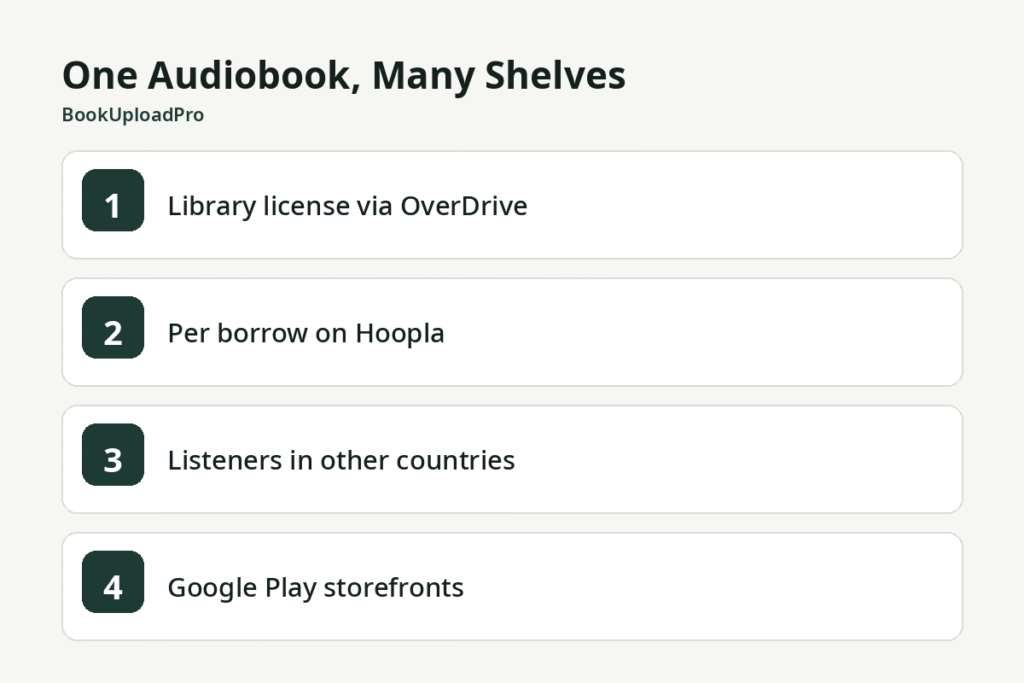
Libraries do not stock your audiobook the way a reader buys it; they license it, and the licenses flow through a small number of platforms, mainly OverDrive, whose Libby app most readers know, and Hoopla, which pays per borrow instead of per license. Independent authors reach those platforms through distributors and aggregators that supply library catalogs, because OverDrive and Hoopla contract with suppliers, not with individual authors uploading files. One important exception from the store rules: Kobo sends no audiobooks to library distribution, so a Kobo only audiobook never reaches a library shelf; the library route runs through audiobook distributors with library channels. Abroad is simpler than most authors expect: the big stores sell internationally by default, so a listener in Canada, the UK, Australia, or Germany buys your audiobook in their local storefront at a regional price.
Key takeaways:
- Library income is licensing income: a library license sale, or a per borrow payment on Hoopla style models, and it arrives through your distributor’s reporting like any other channel.
- AI narration narrows the library route: the verified store rules show INaudio accepting AI narrated audiobooks only as unmodified packages from three named providers, so an independently produced AI edition may not pass library supply checks; ask your distributor before counting library income
- International sales need no separate editions: check that your distributor’s territory rights are set to worldwide and that nothing in your deals restricts regions.
How the library path actually works
Your distributor supplies the catalog; librarians select titles through their buying tools; readers borrow through Libby, Hoopla, or similar apps. You cannot pitch OverDrive directly as an individual author, and you do not set the library price the way you set a retail price; library terms are negotiated at platform level. What you control: being in a distributor with real library channels, having clean metadata and a proper retail sample so librarians can evaluate the title, and the same discovery basics that work everywhere, series, categories, and reviews. Library listeners are heavy listeners; a borrowed first in series that ends in retail sales of the sequels is a well worn pattern.
Google Play Books and the international storefronts
Google Play Books sells audiobooks directly in many countries and, per the verified rules, accepts AI narrated audiobooks uploaded by the author with the narrator set to Synthesized voice, making it the most open major storefront for independent audio. Its storefronts are regional, prices convert, and promotions run per country. The wider pattern: Audible has separate marketplaces (your ACX deal names its territories), Kobo is strong in Canada, Australia, and parts of Europe, and Spotify streams in most markets. Selling abroad is mostly a settings and rights check, not a project: worldwide rights on, distributor channels on, and your tax and payment details able to receive foreign royalties.
FAQ
How do I get my audiobook into libraries like OverDrive and Hoopla?
Through a distributor or aggregator that supplies library platforms; OverDrive and Hoopla contract with suppliers, not individual authors. Libraries then license your title or pay per borrow, and the income reports through your distributor.
Can I sell my audiobook to listeners in other countries?
Yes. The major stores sell across their regional storefronts by default. Confirm your rights are worldwide, your distributor’s territories are set to worldwide, and no deal you signed restricts regions.
Can I sell my audiobook on Google Play Books?
Yes, authors upload directly, and Google Play accepts AI narrated audiobooks with the narrator credited as a synthesized voice. Sales run through its regional storefronts with local pricing.