
In this guide
- How it works, step by step
- Does it sound human?
- Emotion, emphasis, and where the flatness creeps in
- FAQ
- What is AI narration for audiobooks and how does it work?
- Can AI narration really sound human, or will listeners hear a robot voice?
- Can AI voices handle emotion and emphasis, or do they read everything flat?

AI narration is audiobook production where software, not a person in a studio, reads your manuscript aloud. You give the service your book file, choose a voice, and it generates the narration chapter by chapter, which you then review, correct, and export as finished audio files. Modern narration voices are built from recordings of real human voices, which is why the result is measured in how it handles pacing, emphasis, and tiredness over hours, not whether it sounds like a robot from a phone menu. It does not read everything flat, but it also does not act: the performance is shaped by the text, the voice model, and the corrections you make in review.
Key takeaways:
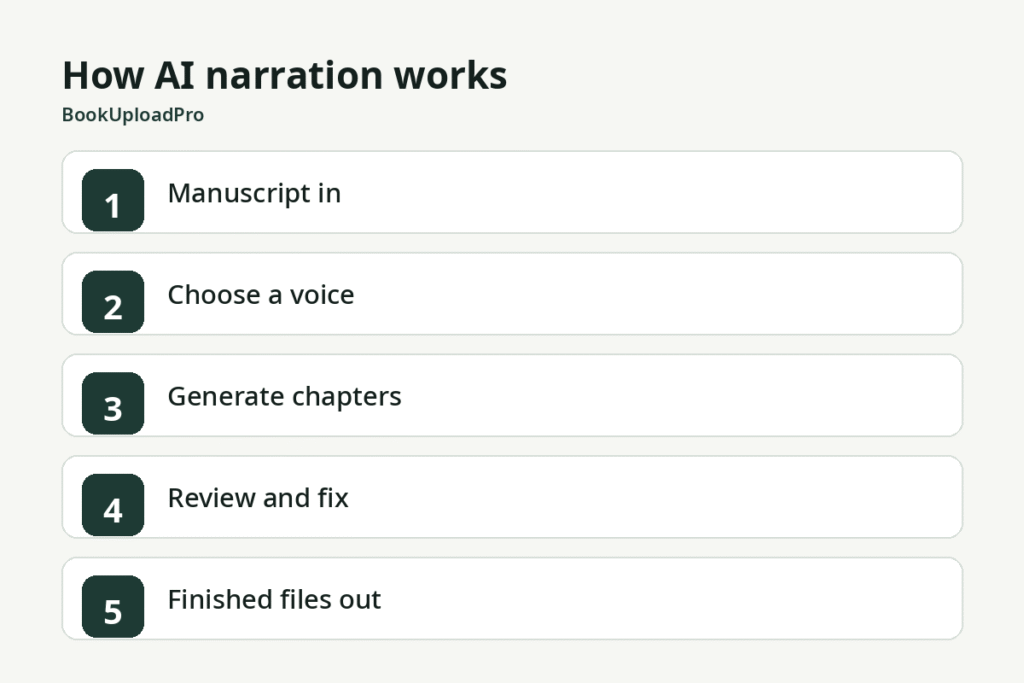
- The workflow is manuscript in, narration out: upload a DOCX or EPUB, pick a voice, generate, review each chapter, fix problem passages, export finished files with credits and a retail sample.
- Today’s best AI voices sound human at the sentence level. The honest limits are long form: pacing variety, emotional range across a whole book, and tricky pronunciation.
- Emotion and emphasis come from the voice model reading punctuation, dialogue, and context. It handles normal expressive range well; dramatic scenes and character voices are where human narrators still lead.
How it works, step by step
A narration service ingests your manuscript and detects its chapters and structure. You choose a voice, ideally by hearing it read your own words in a sample, because a voice that suits another book may not suit yours. The engine generates the audio chapter by chapter. Then comes the part that separates a production service from a text reader: review. You listen to each chapter, flag passages where pronunciation, pacing, or emphasis went wrong, regenerate or replace just those passages, and keep the takes you approve. The finished package is chapter audio files, opening and closing credits, and a retail sample, ready for upload to the stores that accept AI narration. Our walkthrough of making a book this way covers the production pass in order.
Does it sound human?
At the level of a sentence, yes, convincingly: modern narration models are trained on human reading, and listeners in a blind sample often cannot tell. The differences show over distance. A human narrator manages energy across an eight hour book, leans into a climax, and lets a quiet chapter sit quiet. AI voices keep a more even profile, which suits nonfiction, business, memoir, and how to books very well, and is a weaker match for fiction that lives on character voices and drama. Judge with your own ears on your own text: any serious service lets you hear a sample passage before you commit, and fifteen minutes of your chapter three tells you more than any review page. Our sound quality guide covers what good finished audio looks like on the meters.
Emotion, emphasis, and where the flatness creeps in
AI voices read the signals in your text: question marks lift, italics stress, short sentences punch. What they do not do is decide that a paragraph matters more than the one before it, the way a human narrator interpreting the book does. The practical result: instructional and narrative nonfiction reads naturally, dialogue is serviceable, and highly emotional scenes can come out calmer than you pictured them. Manuscript preparation helps more than authors expect: clean punctuation, dialogue on its own lines, and chapters that end where the beat ends all give the voice better instructions. And when a passage lands wrong, a production workflow lets you regenerate that passage rather than accepting the whole chapter as it came out.
FAQ
What is AI narration for audiobooks and how does it work?
It is audiobook production by software: you upload your manuscript, choose an AI voice, and the service generates the narration chapter by chapter. You review the chapters, fix passages that mispronounce or misread, and export finished audio files with credits and a sample, ready to upload to stores that accept AI narration.
Can AI narration really sound human, or will listeners hear a robot voice?
The current generation sounds human at the sentence level, because the voices are modeled on human readers. Where it differs from a studio performance is over the whole book: a more even energy, and less dramatic interpretation. For most nonfiction that trade is invisible to listeners; hear a sample of your own text before deciding.
Can AI voices handle emotion and emphasis, or do they read everything flat?
They are not flat: they follow punctuation, dialogue, and context to place emphasis and vary delivery. What they lack is a narrator’s judgment about which moments deserve more weight, so emotional peaks land softer than a human performance. Clean manuscript punctuation and per passage regeneration close much of the gap.