
In this guide
Set up wide distribution for a whole series at once by doing the series level work once, before any single book is uploaded: fix the series name and numbering, build one metadata record per book, choose your direct and aggregator mix, and set up one tracker for the series. Then every book in the series follows the same path, and book three is a copy of book one’s routine instead of a fresh project. A series is where wide publishing pays for its setup, because the setup is reused once per book.
Key takeaways:
- Series level decisions belong in one place: the same series name, the same numbering, the same categories, on every store.
- Book one sets the pattern. Get book one right everywhere, then repeat it.
- An aggregator is usually the right call for the long tail of a series, while the main store stays direct.
The four steps, in order
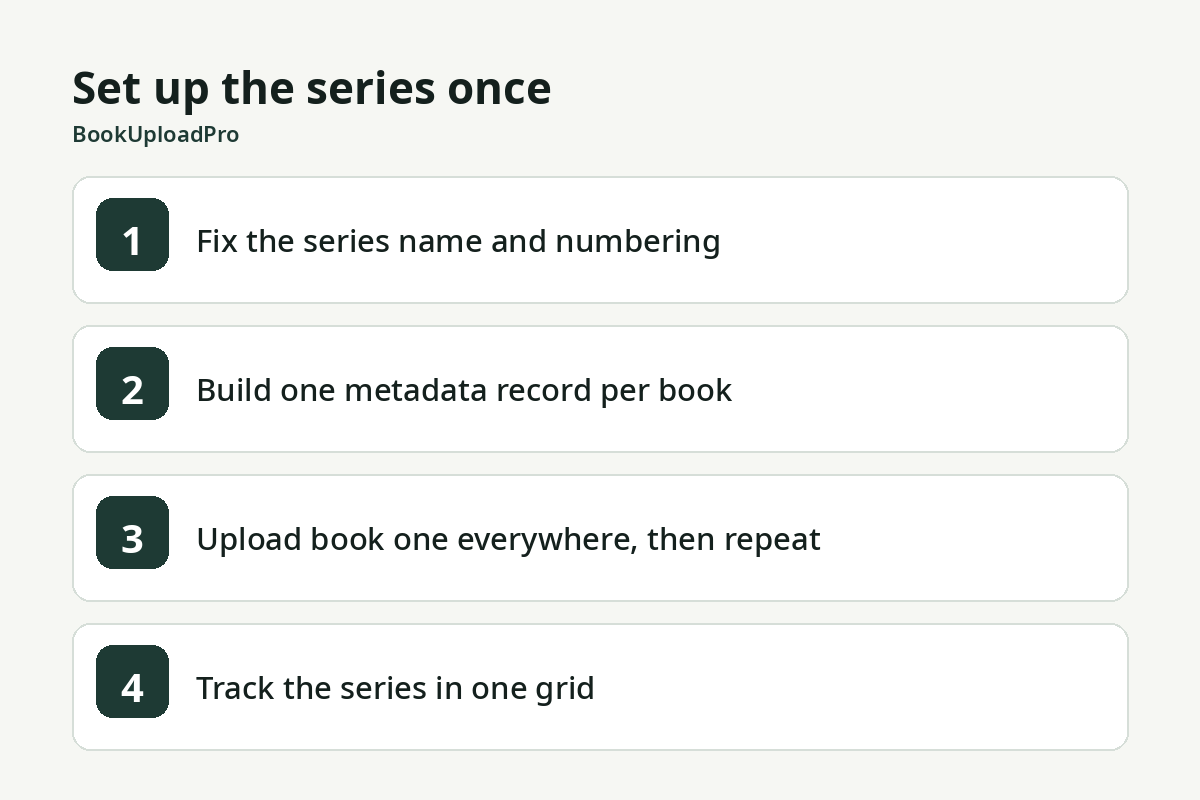
First, fix the series name and numbering. Every book carries the same series name, spelled the same way, with its number in the series field where the store offers one. A series that reads “The Ashford Saga” on Amazon and “Ashford Saga” on Kobo is two different series to readers and to the stores’ recommendation systems. Second, build one metadata record per book: title, subtitle, author, description, keywords, categories, series name and number, and price, all in one sheet. Third, upload book one everywhere, direct at your main store and through your aggregator for the rest, and fix every problem book one finds before book two starts. Fourth, track the series in one grid, one row per book and format, one column per store, so you can see at a glance which books are live where. Our tracking system for wide catalogs is here.
Direct, aggregator, or both
The same mix that works for a single book works for a series, and it matters more, because the royalty difference multiplies across books. Go direct at the store where the series sells best, because that is where the full royalty per copy adds up across the whole series. Use an aggregator for the stores and library channels you would otherwise skip, because a series benefits most from being discoverable everywhere a reader might look for book two. If you are new to aggregators, this explainer lays out the trade.
What goes wrong with series
The classic failure is drift: book three launches with a different series name, a different category, or a price that does not match the series pattern, and readers who finished book two cannot find it. The second failure is the orphan: a series where book one is wide and book two is Amazon only, because nobody repeated the setup. Both are fixed by the same thing, the one routine, written down and followed. And remember the ISBN rule: each book in the series needs its own ISBN per format, and the same ISBN follows the same edition to every store. Our ISBN guide covers that.
FAQ
How do I set up wide distribution for a whole series at once?
Do the series level work once: one series name and numbering scheme, one metadata record per book, one direct and aggregator mix, one tracker grid. Then upload book one everywhere, fix what it teaches you, and repeat the same routine for every book after it.