
In this guide
- The test: fix it yourself when the error is specific
- Hire a formatter when the layout is the problem
- Use a tool when the same work repeats
- What to ask before you pay anyone
- FAQ
- Is it better to fix errors myself, hire a formatter, or use a tool that prepares files for every store?
- How do I know if my book needs a formatter at all?
Fix it yourself when the error is small, named, and repeatable. Hire a formatter when the layout is the problem, not a single error. Use a preparation tool when the same fixes keep coming back across many books and many stores. The wrong choice is the expensive one: a weekend lost to a layout problem a formatter would have solved in an hour, or a formatter paid to fix a typo you could have corrected in five minutes. This post gives you the test.
Key takeaways:
- If the error message names one field, fix it yourself. That is a five minute job.
- If the book’s layout fights you at every step, that is a formatter’s job, not a file error.
- If the same errors repeat across books and stores, a tool that prepares files from one master saves the repetition.
The test: fix it yourself when the error is specific
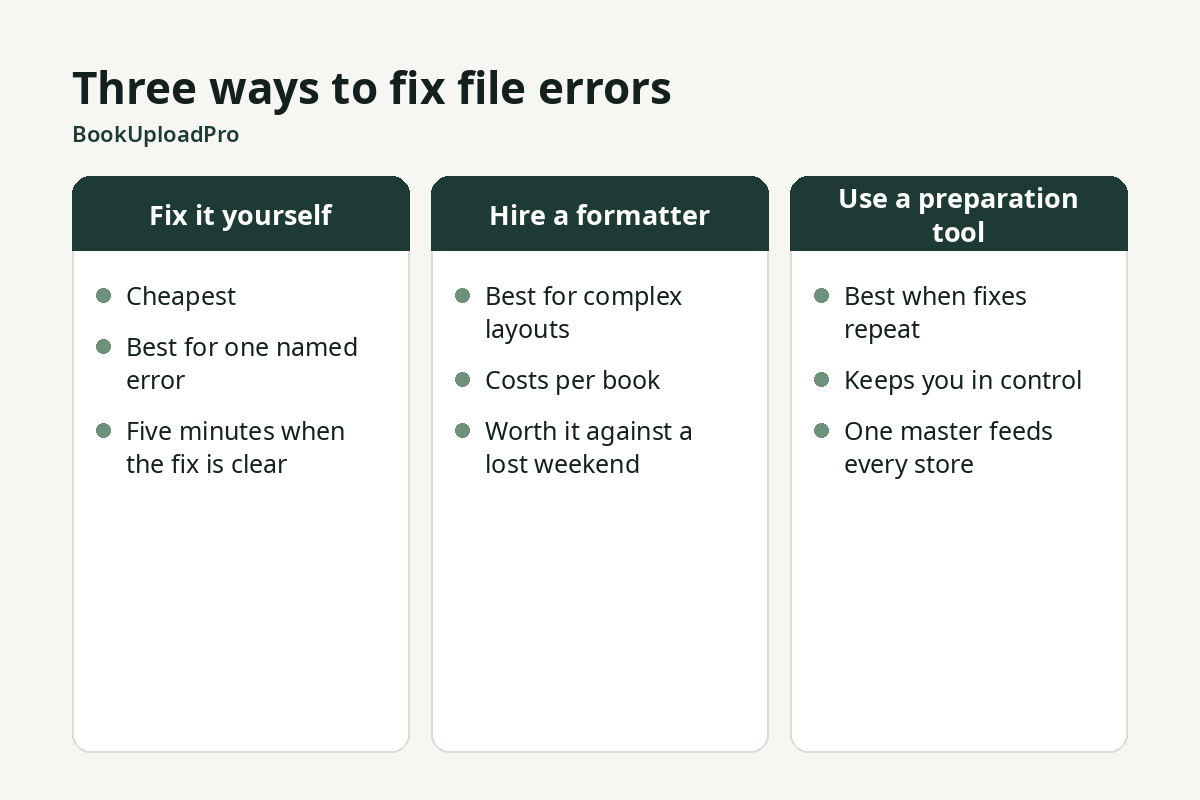
A specific error is one you can name and repeat: a mismatched author name, a cover that needs bleed, a missing table of contents, a validation error that points at one chapter. These are source file problems with source file fixes, and the fix belongs in your master file so it never comes back. Our metadata mismatch guide shows the pattern: find the field, fix the source, re-export, validate. If you can describe the error in one sentence and the fix in one step, do it yourself.
Hire a formatter when the layout is the problem
Some books are not broken in one place. They are broken in the layout itself: tables that will not behave, images that land in the wrong chapter, a print interior whose margins shift with every edit, a book with footnotes, indexes, or complex headings that reflow badly. A formatter does this work every day and owns the tools for it. Hiring one makes sense when the book is complex, when the deadline matters more than the fee, or when you have already spent more time fighting the layout than the formatter would charge. What a formatter cannot do for you is decide your metadata or run your uploads; those stay yours either way.
Use a tool when the same work repeats
The third option fits a different pain: not one hard book, but many books with the same repeated preparation. A tool that prepares files from one master, validates them, and carries the same checked metadata into each store’s form removes the repetition that creates most errors. It is the right choice when you publish wide, publish often, or keep fixing the same class of mistake. The same logic applies to the uploading itself, which is why our post on when to stop uploading by hand runs the same honest math.
What to ask before you pay anyone
Ask what is included: file conversion only, or layout, cover, and validation too. Ask what you get back: the finished files, or also the editable master you can fix next time. Ask how revisions work, because the first export is rarely the last. And ask what happens when a store rejects the file: a good formatter or tool stands behind the file it produced, and that answer tells you more than any portfolio.
FAQ
Is it better to fix errors myself, hire a formatter, or use a tool that prepares files for every store?
Fix it yourself when the error is one named field or one chapter. Hire a formatter when the layout itself is the problem, especially for complex interiors. Use a preparation tool when the same fixes repeat across many books and stores, because the tool removes the repetition that causes the errors.
How do I know if my book needs a formatter at all?
If your book is mostly text with simple chapters and one or two images, it probably does not. If it has tables, footnotes, an index, sidebars, or a print interior that keeps breaking, get a quote. The quote costs nothing and the answer is usually obvious once you hear the price against the hours you would spend.