Publish Wide vs Amazon Exclusive Full Comparison Guide
Publish Wide vs Amazon Exclusive: Full Comparison
Estimated reading time: 14 minutes
Key takeaways
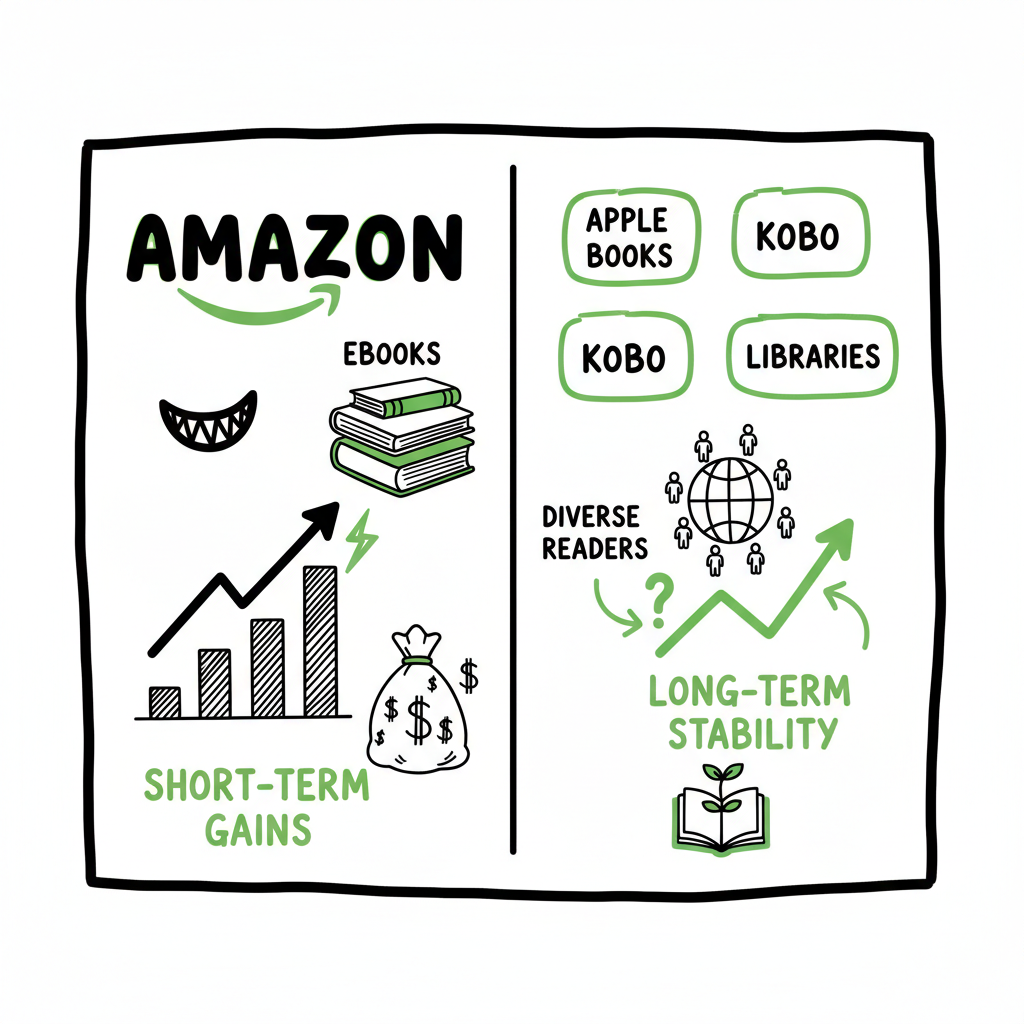
- Amazon exclusive (KDP Select/Kindle Unlimited) gives short-term visibility and KU page‑read income but requires 90‑day ebook exclusivity and concentrates risk.
- Publishing wide spreads distribution across Apple, Kobo, Google Play, libraries, and direct sales for long-term stability and global reach, but it demands broader marketing.
- Many authors use a hybrid approach: KDP Select for launches or series, then move wide, or keep some titles exclusive and others wide to diversify income.
Table of Contents
- Publish Wide vs Amazon Exclusive: Full Comparison
- How the models work
- Pros and cons — side by side
- Choosing for your genre and career
- FAQ
Publish Wide vs Amazon Exclusive: Full Comparison
If you’re deciding whether to stay in KDP Select (Amazon exclusive) or publish wide, this comparison lays out the facts and the tradeoffs. Publish Wide vs Amazon Exclusive: Full Comparison is a practical guide for authors who want to understand how each path affects visibility, revenue, control, and long‑term business risk. The right choice depends on your genre, release cadence, appetite for risk, and whether you want to build a multi‑platform business or focus on Amazon’s ecosystem.
How the models work
(a) Amazon exclusive (KDP Select / Kindle Unlimited)
- What it demands: Enroll the ebook in KDP Select and keep the digital file exclusive to Amazon for each 90‑day enrollment period. You can still sell print editions elsewhere.
- What it gives: Inclusion in Kindle Unlimited (KU) membership, access to KU page‑read payouts (a monthly per‑page rate), and Amazon‑only promotional tools like Kindle Countdown Deals and Free Book Promotions.
- How authors earn: Standard royalties on paid Kindle sales plus KU royalties based on pages read. KU payout rates change monthly and are determined from a global fund; authors do not control the per‑page rate.
(b) Publishing wide
- What it demands: Upload the ebook to multiple retailers (Apple Books, Kobo, Barnes & Noble, Google Play) either directly or via an aggregator such as Draft2Digital, PublishDrive, or an aggregator of your choice.
- What it gives: No exclusivity requirement, access to multiple storefronts, library distribution, subscription programs beyond KU (e.g., Kobo Plus in some regions), and the option for direct sales from your site.
- How authors earn: Royalties from multiple retailers, library licensing fees or holds, subscription program payments where applicable, and direct sales revenue if you maintain your own storefront.
Common workflows and practical steps
- Deliverables: Both paths need a clean manuscript file, properly formatted EPUB or Kindle file, and a professional cover. If you need a streamlined way to create an EPUB or handle covers, tools exist to speed that work: many authors rely on an EPUB converter to move between formats smoothly and a book cover generator when creating covers at scale. For authors building a book product, a complete book creation workflow helps keep files consistent across platforms.
- Distribution tools: Aggregators simplify wide distribution by sending one file to many stores. But if you use KDP Select, you’ll upload directly to Amazon and enroll the ebook for a 90‑day term.
Pros and cons — side by side
(a) Advantages of Amazon exclusive
- Faster traction in Amazon’s ecosystem: KU membership often boosts discoverability inside Amazon; readers who use KU look for books included in the program. For high‑consumption genres, that can translate to rapid page reads and improved Amazon ranking.
- Simpler marketing funnel: If your focus is Amazon, all ad campaigns, links, and email calls to action point to a single store. That simplicity lowers the overhead for new authors.
- Amazon promotional tools: Kindle Countdown Deals and Free Book Promotions (available via KDP Select) can help launch or revive a title, especially when coordinated with advertising.
(b) Disadvantages of Amazon exclusive
- Concentration risk: You rely on one retailer. Any policy change, algorithm shift, or KU payout change affects your business directly.
- Variable and opaque KU payouts: KU income is tied to a monthly fund and per‑page rate that changes; authors can see swings month to month.
- Lost readers on other platforms: Readers who prefer Apple Books, Kobo, or local retailers won’t find your ebook while it’s exclusive to Amazon.
(c) Advantages of publishing wide
- Diversified income: Sales and library borrows can come from multiple retailers, subscription services, and direct sales. That spreads risk.
- Global reach: Different stores have regional strengths—Kobo and Apple Books are strong in Canada, parts of Europe, and Australia. Google Play grows internationally. Wide distribution improves discoverability outside Amazon’s footprint.
- Pricing and marketing control: You can run series strategies like permanent free or permafree first-in-series, price differently by store in some cases, and sell directly to readers without violating exclusivity.
(d) Disadvantages of publishing wide
- More complex marketing: You need to manage links, ads, and email CTAs across platforms. That takes time and attention.
- Slower ramp: Wide often builds slower. Without KU’s concentrated readership, sales may climb more gradually; long‑term stability tends to compensate if you persist.
Choosing for your genre and career
Genre matters
- High-consumption fiction: Romance, some subgenres of fantasy, and certain thrillers often do very well in KU. Readers in those genres voraciously consume books, making KU page reads a meaningful revenue source for prolific series authors.
- Nonfiction and literary fiction: These categories often perform better wide. Readers buy nonfiction across multiple stores and consult libraries; they’re less KU-centric. Academic or niche nonfiction benefits from library distribution and direct sales.
- Mixed results: Some midlist genres or cross‑genre works may perform variably; testing is necessary.
Career horizon and release strategy
- Short-term traction vs long-term stability: If you want a fast start and have a quick-release plan (multiple books in a series), KU can accelerate discovery. If you want a resilient, multi‑channel business, wide is the safer long haul.
- Hybrid and staged approaches: Many authors use a hybrid strategy. Examples:
- Enroll a first-in-series or a new title in KU for the initial 90 days to leverage promotions and KU visibility, then remove it and go wide for backlist sales and library distribution.
- Keep fast‑release genre series in KU while publishing standalones or nonfiction wide to diversify.
- Stagger releases: release the ebook in KU for a cycle, then wide with added bonus material or paperback options.
Practical decisions and metrics to watch
- Track per‑title revenue by channel. If most of your earnings come from KU and those payouts cover your cost of acquisition and ads, KU may be working. If sales on Apple, Kobo, or direct channels add significant revenue once you go wide, that supports wide distribution.
- Look at reader behavior and market: Do readers in your niche use KU heavily? Are libraries or international markets important? Use analytics and retailer dashboards to learn where your readers are.
- Consider time and resources: Wide requires more marketing time. If you’re scaling publishing and need to upload many titles, automation saves time. Services that automate uploads to Amazon KDP, Kobo, Apple Books, Draft2Digital, and Ingram can cut repetitive work, reduce errors, and make wide publishing practical at scale. For authors publishing seriously, automated multi‑platform publishing is an obvious upgrade once you outgrow manual uploads—Automate the upload. Own the distribution.
How to test with low risk
- Start small: Put one title into KDP Select for a 90‑day trial while keeping others wide. Gauge KU reads, promotional impact, and visibility gains.
- Use staged transitions: Move a title wide after a KU cycle to see how long tail sales compare. Keep careful records of sales, reads, and promos so you can compare returns.
- Control variables: When testing, avoid changing too many things at once—release timing, ad spend, price, and promotional activity should be consistent so you can measure the impact of distribution choice alone.
Making wide practical: automation and file handling
- Wide distribution sounds good, but the practical hurdles are real: multiple file formats, different cover specs, localized metadata, and repeated form fields. Solve these with a disciplined workflow:
- Standardize your source files: Keep a master manuscript and a master cover file with layered versions for different trim sizes and retailers.
- Convert and validate formats: A reliable EPUB conversion step reduces rejections and display issues. If you need a consistent converter that automates the process and validates output for major retailers, using an EPUB converter can save time and avoid formatting errors.
- Automate uploads and metadata: A publishing automation service can push the same metadata and files to Amazon KDP, Apple Books, Kobo, Draft2Digital, and Ingram while handling store‑specific nuances. That reduces manual repetition and mistakes.
- Batch processing: If you publish multiple books or series, CSV batch uploads and platform‑specific intelligence cut the time dramatically—most authors see up to ~90% time savings over manual uploads when they automate repetitive tasks.
Tools that speed production
- Cover generation: When you need many covers or quick variants, a book cover generator speeds iteration while keeping consistent branding.
- EPUB conversion: A robust EPUB converter takes care of styling, table of contents, front/back matter, and validation for retailers.
- Book creation workflow: For authors producing both ebooks and paperbacks, a single book creation workflow ties manuscript, typesetting, cover, and metadata together so every platform gets the right files.
Note on tools referenced above: services that handle cover processing, EPUB conversion, and end‑to‑end book creation exist to take repetitive work off your plate and keep files consistent across retailers and formats.
Practical example scenarios
Scenario 1 — Romance series author (high release cadence)
- Goal: Build a fast reader base and maximize page reads.
- Strategy: Enroll new releases in KDP Select for initial 90‑day bursts, use free or countdown promos to spike KU readership, then consider going wide later for backlist or compiling boxed sets for wide distribution.
- Rationale: Voracious KU readers in romance can drive volume quickly; exclusivity helps rankings.
Scenario 2 — Nonfiction author (evergreen reference titles)
- Goal: Reach readers across devices and institutions, including libraries and universities.
- Strategy: Publish wide from day one, prioritize library distribution and direct sales, and use platform‑specific promotions on Apple Books or Google Play where appropriate.
- Rationale: Nonfiction readers buy across platforms; library access and direct sales create long‑term revenue.
Scenario 3 — Hybrid midlist author (mixed genres)
- Goal: Diversify risk and test markets.
- Strategy: Keep fast‑moving series in KU, publish standalones and nonfiction wide, and track per‑title performance for six months before committing to a single model.
- Rationale: Hybrid reduces dependence on a single source of income while enabling KU benefits where they exist.
Book packaging, covers, and files: avoid common mistakes
- Metadata consistency: Use identical title, subtitle, series name, and author name across all platforms to avoid fractured discoverability.
- Correct formats: Upload a validated EPUB to Apple, Kobo, and Google Play; Amazon prefers a Kindle file but accepts EPUB too. Always check each store’s current technical requirements.
- Cover specs: Different stores and print services have different cover dimensions and spine math. Keep master PSD or layered cover files for rapid export to each spec.
- Quality checks: Preview files in device simulators and run retailer validators. Rejections cost time and can delay launches.
Integrating automation for scale
- If you plan to publish multiple titles per year, automation becomes a business decision, not just a convenience. Benefits of automation include:
- Unified multi‑platform publishing: One place to manage uploads, metadata, and distribution rules for Amazon KDP, Kobo, Apple Books, Draft2Digital, and Ingram.
- CSV batch uploads: Upload dozens of titles with a single spreadsheet instead of repeating forms.
- Platform-specific intelligence: The system applies store rules automatically, reducing rejections and formatting errors.
- Error reduction and version control: Automated checks prevent common mistakes such as mismatched ISBNs, wrong file formats, or incorrect territory settings.
- Time savings: Many authors report roughly ~90% time savings versus manual uploads when using a reliable automation service.
When to think about automation
- You hit more than two or three titles per year and found uploads take too long.
- You need consistent metadata across stores and want to reduce human error.
- You want to distribute simultaneously to multiple retailers and keep release dates synchronized.
For authors who publish seriously, a publishing automation service is an obvious upgrade once the business scales beyond occasional releases.
Final steps and call to action
If you’re publishing more than a title or two a year, make distribution work for your schedule. BookUploadPro automates multi‑platform publishing across Amazon KDP, Kobo, Apple Books, Draft2Digital, and Ingram, offering CSV batch uploads, platform‑specific intelligence, and significant time savings—often up to ~90% versus manual uploads. Automate the upload. Own the distribution.
Visit the BookUploadPro site to try the free trial and see how automation makes wide publishing practical.
Common workflows and practical steps
Scenario-specific workflows for building a scalable publishing process include how to structure your master files, ensure consistent metadata, and prepare assets for all stores.
Where to start if you’re testing distribution models: begin with a single title in KDP Select for 90 days and gauge KU reads, then compare long‑tail sales once you go wide. Use careful, controlled experiments so you can measure outcomes.
Choosing for your genre and career
Genre matters
- High-consumption fiction: Romance, some subgenres of fantasy, and certain thrillers often do very well in KU. Readers in those genres voraciously consume books, making KU page reads a meaningful revenue source for prolific series authors.
- Nonfiction and literary fiction: These categories often perform better wide. Readers buy nonfiction across multiple stores and consult libraries; they’re less KU-centric. Academic or niche nonfiction benefits from library distribution and direct sales.
- Mixed results: Some midlist genres or cross‑genre works may perform variably; testing is necessary.
Career horizon and release strategy
- Short-term traction vs long-term stability: If you want a fast start and have a quick-release plan (multiple books in a series), KU can accelerate discovery. If you want a resilient, multi‑channel business, wide is the safer long haul.
- Hybrid and staged approaches: Many authors use a hybrid strategy. Examples:
- Enroll a first-in-series or a new title in KU for the initial 90 days to leverage promotions and KU visibility, then remove it and go wide for backlist sales and library distribution.
- Keep fast‑release genre series in KU while publishing standalones or nonfiction wide to diversify.
- Stagger releases: release the ebook in KU for a cycle, then wide with added bonus material or paperback options.
Practical decisions and metrics to watch
- Track per‑title revenue by channel. If most of your earnings come from KU and those payouts cover your cost of acquisition and ads, KU may be working. If sales on Apple, Kobo, or direct channels add significant revenue once you go wide, that supports wide distribution.
- Look at reader behavior and market: Do readers in your niche use KU heavily? Are libraries or international markets important? Use analytics and retailer dashboards to learn where your readers are.
- Consider time and resources: Wide requires more marketing time. If you’re scaling publishing and need to upload many titles, automation saves time. Services that automate uploads to Amazon KDP, Kobo, Apple Books, Draft2Digital, and Ingram can cut repetitive work, reduce errors, and make wide publishing practical at scale. For authors publishing seriously, automated multi‑platform publishing is an obvious upgrade once you outgrow manual uploads—Automate the upload. Own the distribution.
FAQ
Q: Can I be in KU for 90 days and then go wide?
A: Yes. KDP Select enrollments are for 90‑day terms and can be renewed or ended. Many authors use that cycle as a short test or launch window, then un‑enroll and distribute wide. Plan the transition carefully: check any remaining promotional price history, and ensure you don’t accidentally leave any exclusive content tied to Amazon.
Q: Does enrolling in KDP Select affect paperback or audiobook distribution?
A: No. KDP Select exclusivity applies only to the ebook digital edition. You may publish paperbacks, hardcovers, or audiobooks elsewhere.
Q: Will going wide hurt my Amazon ranking?
A: Going wide can change how a title performs on Amazon because you leave KU’s ecosystem. If KU drove the majority of your reads and rankings, expect Amazon visibility to drop. However, wide distribution can build a broader reader base over time across multiple stores, which may offset Amazon declines.
Q: How do KU payouts work?
A: KU payouts come from a global fund and are paid per page read (KENP). The per‑page rate fluctuates monthly and is not directly controlled by authors. Payouts can vary month to month, making KU income less predictable than straight sales royalties.
Q: Should I use an aggregator for wide distribution?
A: Aggregators simplify uploads by sending a single file to many stores. They’re useful when you want to reach multiple platforms without managing each store individually. Some aggregators also handle returns to authors, library distribution, and expanded metadata options. Evaluate aggregator fees, payment schedules, and store coverage when deciding.
Q: What’s the easiest way to keep files consistent for wide?
A: Keep a single source-of-truth manuscript and cover file. Use a validated EPUB exporter, keep cover masters, and use a publishing checklist. If you publish many titles, invest in automation to push consistent files and metadata to all stores.
Sources
- https://www.writtenwordmedia.com/amazon-kdp-select-vs-wide-which-is-better-for-authors/
- https://scribecount.com/author-resource/publishing-a-book/wide-vs-kindle-unlimited
- https://marinamilesbooks.com/2025/11/14/%E2%AD%90-kdp-vs-wide-publishing-what-every-indie-author-needs-to-know-in-2025/
- https://kindlebookillustrations.com/blog/kdp-select-vs-going-wide-new-author-guide
- https://kayla-hicks.com/blog/482/wide-vs-exclusive-should-you-publish-beyond-amazon
- https://nybookeditors.com/2022/03/is-it-time-to-publish-wide/
Publish Wide vs Amazon Exclusive: Full Comparison Estimated reading time: 14 minutes Key takeaways Amazon exclusive (KDP Select/Kindle Unlimited) gives short-term visibility and KU page‑read income but requires 90‑day ebook exclusivity and concentrates risk. Publishing wide spreads distribution across Apple, Kobo, Google Play, libraries, and direct sales for long-term stability and global reach, but it…
Comments