Amazon KDP Pricing Strategy Practical Guide for Authors
Amazon KDP pricing strategy
Estimated reading time: 11 minutes
Key takeaways
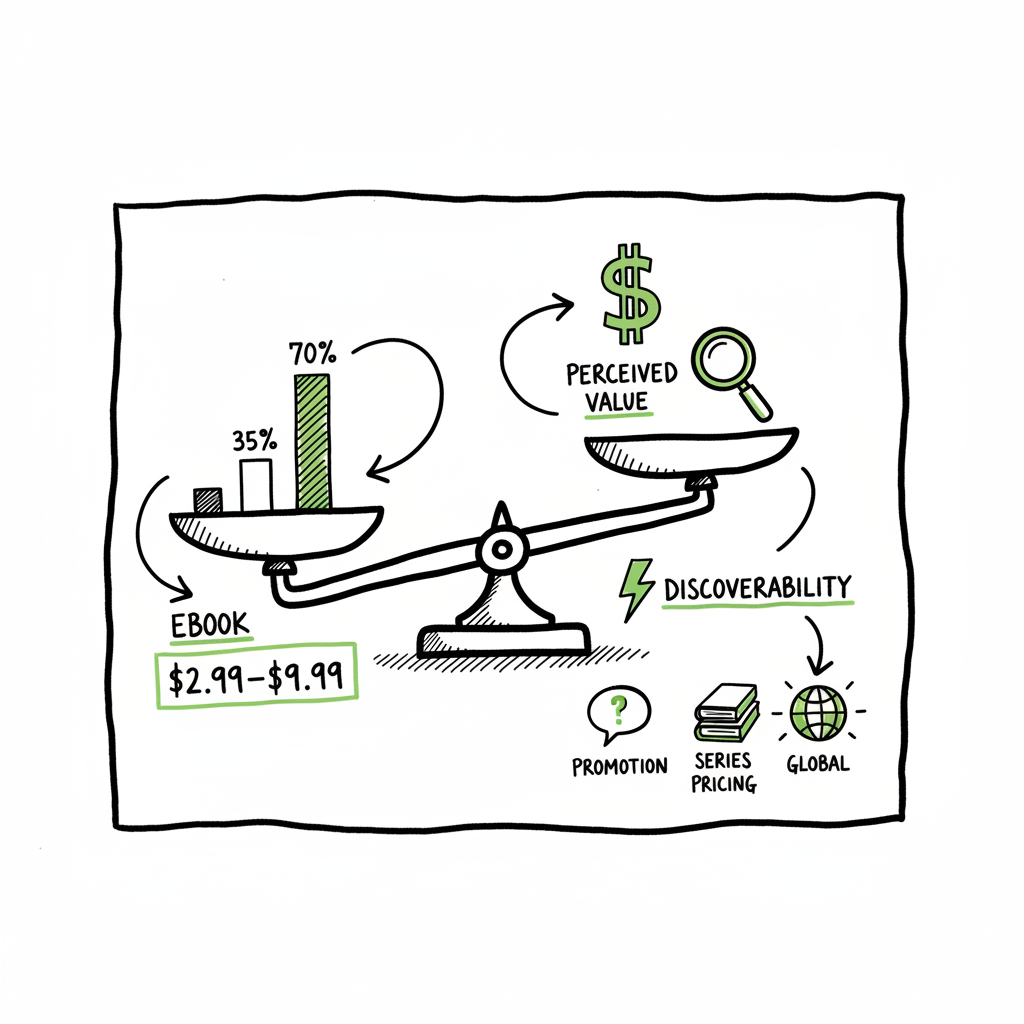
- A practical amazon kdp pricing strategy balances royalties, perceived value, and discoverability—test, track, and adjust.
- Price ebooks $2.99–$9.99 to qualify for 70% royalties; account for print costs when setting paperback prices.
- Use dynamic tactics—promos, series pricing, and regional adjustments—and automate uploads and distribution once you scale.
Table of Contents
- Pricing fundamentals for Amazon KDP
- Tactical pricing moves that work
- Setting prices for ebooks and print
- FAQ
Pricing fundamentals for Amazon KDP
If you want a clear amazon kdp pricing strategy, start with the basics: how royalties are calculated, what ranges trigger higher payouts, and how production costs affect print profits. For most authors the math drives the decision more than gut feeling.
Ebook royalties
- Amazon pays 70% on ebooks priced between $2.99 and $9.99 (with delivery fees taken on files delivered), and 35% outside that range. That means a $2.99 ebook at 70% typically earns more per sale than a $0.99 ebook at 35%.
- The “best price for Kindle ebook” depends on your goals. If you want maximum per-sale income while keeping volume, the $2.99–$5.99 band often hits the sweet spot for many genres.
Paperback and print
- Paperbacks use a 60% list-price royalty minus printing costs. Printing costs scale with page count and color. That makes page count and trim size critical inputs to kdp paperback pricing.
- For print, set a list price that covers production and still leaves margin. Low-priced thick paperbacks can easily lose money once printing is subtracted.
Goals and trade-offs
- Are you building an audience or maximizing immediate profit? Low prices (or free promotions) drive volume and rank but compress margins. Premium pricing raises per-unit profit but demands stronger positioning—better cover, blurbs, and reviews.
- Series books often use a loss leader: price Book 1 low to capture readers, then price sequels higher. Bundles and boxed sets let you capture higher lifetime value from fans.
A practical step you can take today: read your royalty reports and calculate per-sale net revenue for likely price points. Then pick a starting price and plan 4–8 weeks of monitoring before changing it. If you want an end-to-end self-publishing workflow, consider services that simplify multi-platform publishing—tools that automate uploads and batch prices make testing multiple price points practical for serious authors. For a one-click reference on getting a book live on Amazon, see Self Publish Book Amazon Kdp.
Tactical pricing moves that work
Successful authors treat pricing like ongoing optimization, not a one-time choice. Here are tactical moves that scale with your publishing program.
Start with competitor analysis
Look at books that sell well in your category. Track list prices, formats, page counts, and how they’re positioned (trade paperback vs. mass-market style, long vs. short).
If your book is similar to high-selling titles priced at $7.99, matching that price is reasonable. If your book is shorter or less produced, start lower.
Use psychological pricing and endings
Prices that end in .99 or .97 often convert slightly better than round numbers. Small psychological nudges matter when many decisions are marginal.
Promotions and temporary discounts
Temporary drops to $0.99 or free promotions can re-energize an older title, move BSR, and attract reviews. Use promotions strategically: don’t train readers to wait for sales if you want steady revenue.
Consider automated pricing changes across retailers if you distribute widely, but maintain one pricing “home” (usually Amazon) and adjust elsewhere to protect perceived value.
Series and bundling
If you have multiple books, price the first lower to attract readers, then keep sequels at full price. Bundles and box sets let you capture readers who skipped earlier price points.
Regional and currency strategy
Amazon supports regional pricing. Consider cheaper list prices in lower-purchasing-power regions. This widens reach and can increase international sales without hurting domestic perceived value.
Testing framework
Run small price tests: change price for 2–4 weeks, track units sold and revenue, revert or adjust. Keep records so you don’t guess twice.
Watch reviews and conversion rate alongside raw units sold; price moves can affect perception.
Automation and scale
When your catalog grows, manual updates become slow and error-prone. That’s when multi-platform, batch upload tools and CSV workflows make experimentation repeatable and fast—saving time and reducing mistakes while you run tests at scale.
Setting prices for ebooks and print
Set prices that cover costs and match reader expectations. Below are practical guidelines and specific numbers you can use as a starting point for your kdp book pricing tips.
Ebook pricing band suggestions
- $0.00–$0.99: Lead magnets and promos only. Good for launching authors who want volume quickly.
- $0.99–$2.99: Low-cost entry; suitable for short reads, novellas, and list-building.
- $2.99–$5.99: Volume and respectable royalties. A common sweet spot for most fiction and non-fiction shorter than 200 pages.
- $6.99–$9.99: Premium consumer price for full-length books with strong positioning—best when you have reviews and comparable titles in that band.
- $10+ (35% royalty band): Use only for very niche, high-value content where buyers expect to pay more (workbooks, specialized non-fiction, textbooks).
Best price for Kindle ebook
If you want a simple rule: price between $2.99 and $5.99 unless you have a strong reason not to. This maximizes royalty rate and balances discoverability and revenue.
Paperback pricing checklist
- Calculate printing cost: KDP provides per-book print costs by page count and color.
- Desired net: decide how much you want to earn per sale after printing costs. A common target is $3–$7 net on mass-market style paperbacks, higher for specialty books.
- Set list price = printing cost + desired net + Amazon’s cut (Amazon takes 40% of list price for paperbacks after printing cost). Do the math before publishing to avoid losing money on low-price books.
Example math
Assume printing cost = $3.00, desired net = $4.00. Amazon keeps 40% of list price: let list = P.
Net = P * 0.6 – printing cost. Solve for P: P = (desired net + printing cost) / 0.6.
So P = (4 + 3) / 0.6 = $11.67 → round to $11.99 or $12.99.
This shows why short, thin paperbacks are often priced lower: printing costs and the 60% factor drive minimums.
Special considerations
- Color interiors are expensive; specialty images or full-color books often require significantly higher list prices.
- Page count matters: trimming unnecessary pages reduces printing cost and allows lower list prices.
Practical production and distribution note
If you need tools to create a paperback or ebook and manage distribution, there are services that handle conversion, cover, and multi-platform uploads. These tools streamline getting a book into Kindle and other stores without rebuilding each listing by hand, helping you test prices and formats faster. For authors ready to move from single uploads to batch distribution, consider tools that support creating a paperback or ebook and multi-platform distribution.
Automating pricing changes and distribution
Once you publish multiple titles, small price tests on each title take time. Automated, CSV-based uploads and platform-aware automation let you run price experiments across Amazon, Kobo, Apple Books, Draft2Digital, and Ingram without repeating manual steps.
Automation also reduces input errors—typos in list price or wrong currency can cost sales or lead to compliance issues. When authors start publishing seriously, automation becomes an obvious upgrade: it saves time, reduces mistakes, and makes multi-market testing practical.
FAQ
Q: What is the simplest amazon kdp pricing strategy for a new author?
A: Start at $2.99 for ebooks to qualify for 70% royalties, and price paperbacks to cover printing plus at least $3–$5 net. Use promotions to build early momentum.
Q: Should I price my first book low to build an audience?
A: Yes, many authors price Book 1 low or run a free/promo period to acquire readers. Make sure sequels are priced to capture value once you have a reader base.
Q: How often should I change my price?
A: Change only to test. Allow each price to run 2–8 weeks and measure sales, page reads (if enrolled in KDP Select), and conversion before concluding.
Q: How do I set prices for international markets?
A: Use regional pricing to reflect local purchasing power. Start by matching perceived value rather than exact currency parity—adjust to performance.
Q: Does making my ebook cheaper always increase revenue?
A: Not always. Price drops can increase units but lower net revenue per sale. Track total revenue, conversion, and long-term reader value (e.g., series take rates) before assuming cheaper equals better.
Q: Can I automate price tests across platforms?
A: Yes. Once you have multiple titles, batch uploads and CSV-based distribution tools reduce the time and errors involved in changing prices across stores, making experimentation scalable.
Sources
- Pricing Strategies for Profit Maximization on Amazon KDP — https://www.barnesandnoble.com/w/pricing-strategies-for-profit-maximization-on-amazon-kdp-digital-world/1148784147
- Pricing Strategies for KDP Books: How to Price Your Books Competitively While Maintaining Profitability — https://bookbolt.io/pricing-strategies-for-kdp-books-how-to-price-your-books-competitively-while-maintaining-profitability/
- Amazon KDP Royalty Rates & Pricing Strategies – Publish Drive — https://publishdrive.com/guide-amazon-self-publishing-pricing-and-royalties.html
- Amazon KDP Pricing Strategy For MAXIMUM Profits – YouTube — https://www.youtube.com/watch?v=aIIlD1uhOLc
- Pricing Self-Published Books – Daniel J. Tortora — https://danieljtortora.com/blog/how-to-price-a-self-published-book
Final thoughts
Automating the upload. Own the distribution. When you publish more than one or two books, manual price changes and single-platform uploads slow growth and add risk. A repeatable pricing plan, regular tests, and inexpensive automation make wide distribution and reliable revenue practical. BookUploadPro automates repetitive uploads across Amazon KDP, Kobo, Apple Books, Draft2Digital, and Ingram, supports CSV batch uploads, applies platform-specific intelligence, and reduces errors—saving roughly 90% of the time publishers spend on manual uploads and making multi-platform testing realistic.
Visit BookUploadPro.com to try the free trial..
Amazon KDP pricing strategy Estimated reading time: 11 minutes Key takeaways A practical amazon kdp pricing strategy balances royalties, perceived value, and discoverability—test, track, and adjust. Price ebooks $2.99–$9.99 to qualify for 70% royalties; account for print costs when setting paperback prices. Use dynamic tactics—promos, series pricing, and regional adjustments—and automate uploads and distribution once…