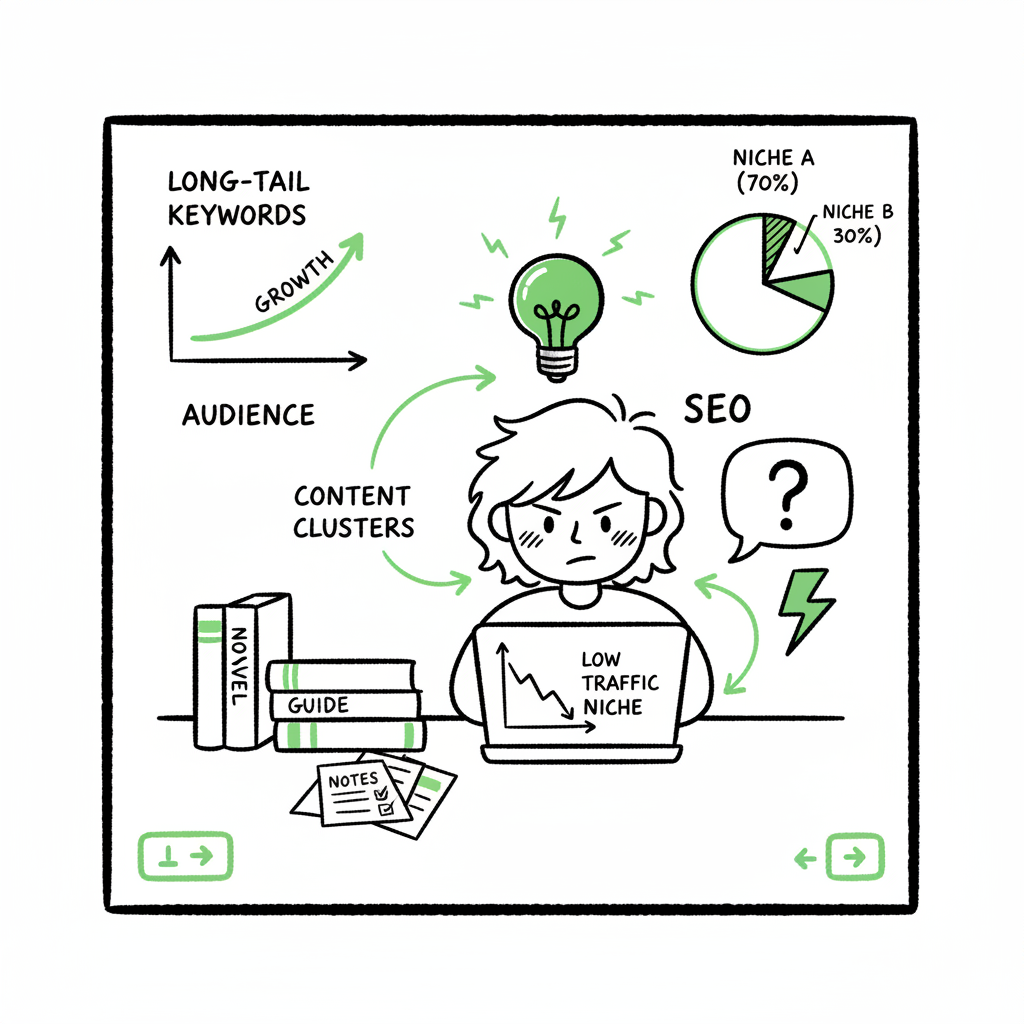
SEO for Low Traffic Niches Practical Guide for Authors
SEO for Low Traffic Niches: A Practical Guide for Self-Publishing Authors
Estimated reading time: 8 minutes
Key takeaways
- Low-volume niches win when you prioritize relevance over raw traffic: long-tail keywords and tight topics convert better.
- Small, tactical changes — keyword targeting, content depth, and platform-specific distribution — offer the fastest gains.
- Automating uploads across stores saves time and reduces errors, making multi-platform reach practical at scale.
Table of Contents
- Why niche SEO works
- Keyword strategy and content that converts
- Operational publishing: distribution and automation
- Measuring results and next steps
- FAQ
- Sources
Why niche SEO works
Anchor: #why-niche-seo-works
Most authors hear “low traffic” and assume it’s a dead end. It isn’t. SEO for low traffic niches is about moving a small, targeted audience toward a clear action — a sale, a newsletter signup, or a series follow — rather than chasing broad visibility. In practice this means choosing narrow topics where readers use specific, intent-rich phrases. A title search like “historical romance set in 16th-century Lisbon” may only have a few dozen searches a month, but those searches are highly likely to convert.
Two realities make this work for self-publishers:
– Fewer competitors. Large sites ignore tiny queries; books that match the exact phrase stand out.
– Higher intent. People searching narrow queries already know what they want, so a relevant book will sell at a higher rate.
If you sell on Amazon, the specific practices in our post Amazon Book SEO for Authors show how to tune your metadata and use subtitle keywords for low-volume queries — a useful complement to the tactics below.
Keyword strategy and content that converts
Anchor: #keyword-strategy
Target fewer words, and make them precise
Target fewer word phrases with low competition and clear buying intent. Use tools to filter for low difficulty (under ~30) and modest monthly volume (100–500 searches). Think like a reader: what exact phrase would someone use when they want to buy or learn from your book?
Map phrases to content pieces
Don’t cram many unrelated topics into one page. Create short, focused pages or landing sections that match a single intent. For an author that means:
– A book page optimized for its exact subtitle and niche phrase.
– Short companion articles (author blog posts or newsletter content) that answer related questions and link back to the book’s sales page.
Write deeper, not broader
Search engines reward depth on narrow topics. A 1,200–1,800 word article or a detailed book description that covers common reader questions will outrank thin pages. Use headings, examples, and short lists to keep reading easy.
Optimize existing pages first
If a book page is on page two or three of search results, refine the title, sharpen the subtitle keywords, rewrite the first 150 words, and improve the meta description. Small edits can push low-competition queries into the top results quickly.
Niche link-building
You don’t need mass backlinks. Reach out to niche blogs, book clubs, and micro-influencers who already serve your audience. A mention on a community forum or a guest post in a specialized newsletter carries more weight than a generic placement on a large but irrelevant site.
For broader context on niche strategies, see Niche SEO Strategies.
Operational publishing: distribution and automation
Anchor: #publishing-automation
Once you find niche phrases that convert, scale distribution without repeating work. That’s the operational side of SEO for low traffic niches: make your book available everywhere your niche readers might search.
Why distribution matters for niche traffic
A reader in your niche may search on Amazon, Apple Books, Kobo, or an aggregator like Draft2Digital. Each store has its own search system and metadata priorities. Publishing widely increases the chance your book appears where the buyer is looking.
Make assets platform-ready
– Formats: Prepare EPUB and platform-specific files so every store accepts your upload.
– Covers: Each store needs correctly sized covers and thumbnails.
– Metadata: Store descriptions, categories, and keyword slots vary.
Tools to speed the work
Manual uploads to five platforms burn time and introduce copy/paste errors. Batch processes and CSV uploads turn hours into minutes and reduce mistakes. For authors publishing multiple titles or editions, that efficiency is essential; it’s an obvious upgrade once you publish seriously.
If you need fast, consistent cover files, a book cover generator can produce the sizes and variations each store requires. For file formatting, an EPUB converter helps you transform manuscripts into clean EPUBs that pass each platform’s checks. When you need to turn a manuscript into multiple formats or push the same title to many retailers, using centralized book creation tools prevents rework and keeps metadata consistent.
How a multi-platform workflow looks at scale
– Prepare a single metadata sheet (CSV) with title, subtitle, keywords, categories, and pricing that maps to every store.
– Generate the EPUB and print-ready PDF, plus cover variants.
– Upload with a batch tool that applies platform-specific rules and flags issues before publishing.
BookUploadPro automates repetitive uploads across Amazon KDP, Kobo, Apple Books, Draft2Digital, and Ingram. It offers platform-specific intelligence, CSV batch uploads, and error checks that typically save authors roughly 90% of the time spent on manual uploads. Automate the upload. Own the distribution.
Measuring results and next steps
Anchor: #measuring-results
Metrics that matter
In low traffic niches, volume will be small; conversion rate is the real KPI. Track:
– Click-through rate from the store listing
– Conversion rate (views to sales)
– Keyword rankings for your target long-tail phrases
Test, then iterate
Run small experiments: tweak the first 150 words, test a new subtitle, or try alternate cover art with a small ad spend. Measure a single variable at a time and give each test a clear time window.
Refresh content
A page or listing that ranks on page two may need fresh content to move up. Update descriptions, add reader reviews, and expand your author page with topical posts that reinforce the book’s niche authority.
Pricing and categories
Price testing matters more in small markets. Try narrow price bands and track conversion. Also pick the most specific category you can find — a precise category increases the odds a niche reader will discover your book.
Final steps before publishing widely
– Verify EPUB files with an EPUB converter and check for validation errors.
– Generate store-ready covers at the correct sizes.
– Use a batch uploader to push consistent metadata across stores.
FAQ
Q: Will targeting low-traffic keywords limit my long-term growth?
A: Not if you build a cluster. Start with narrow phrases, then expand to adjacent topics once you own those queries. Small wins compound: rank in many tightly defined searches and you’ll get steady, qualified sales.
Q: How many keywords should I optimize per book listing?
A: Focus on a few highly relevant long-tail phrases. Use the store’s keyword slots for variations and synonyms. The goal is precise alignment between the listing and a reader’s search.
Q: Do I need paid ads for low-traffic niches?
A: Not necessarily. Organic ranking and niche community promotion often perform well. Ads can help validate a phrase quickly but use them sparingly and measure conversion.
Q: What role does distribution automation play in niche SEO?
A: Automation ensures your book is available wherever niche readers search, keeps metadata consistent, and frees time for testing and writing. It’s especially helpful if you publish multiple titles or formats.
Q: Should I test different subtitles?
A: Yes. Run small subtitle tests with clear time windows and compare results to refine your positioning.
Q: How important are price and category choices in small markets?
A: Pricing and precise categories can significantly affect discovery and conversion in small markets; test narrow bands and specific categories to uncover what resonates.
Q: What about automation for multiple titles?
A: Automation and batch uploads save substantial time, reduce errors, and keep metadata consistent as you expand your catalog.
Sources
- https://byter.com/niche-seo-strategies/
- https://www.papers-pens.com/insights/blogs/how-low-hanging-fruit-seo-can-skyrocket-your-website’s-traffic
- https://www.babylovegrowth.ai/blog/understanding-seo-for-niche-markets
- https://ridarec.com/overcoming-low-website-traffic-with-seo/
- https://www.pageoptimizer.pro/blog/best-niche-for-seo-unlocking-your-path-to-success
- https://www.seo.com/blog/seo-strategies-for-niche-industries/
SEO for Low Traffic Niches: A Practical Guide for Self-Publishing Authors Estimated reading time: 8 minutes Key takeaways Low-volume niches win when you prioritize relevance over raw traffic: long-tail keywords and tight topics convert better. Small, tactical changes — keyword targeting, content depth, and platform-specific distribution — offer the fastest gains. Automating uploads across stores…