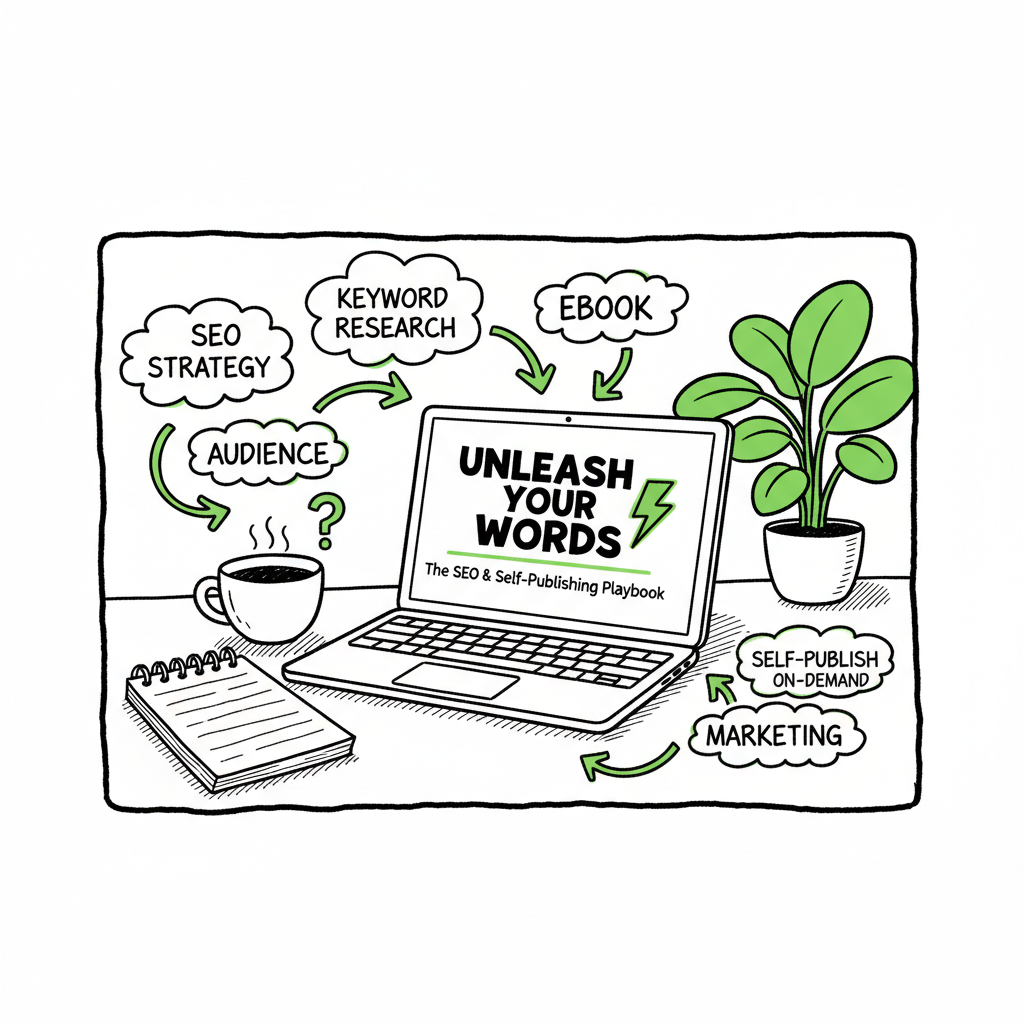
Title Subtitle SEO for Books Practical Guide for Authors
Title subtitle seo for books: A practical guide for self-publishing authors
Estimated reading time: 10 minutes
Key takeaways
- Put the strongest keyword near the start of the title and use the subtitle for targeted long-tail phrases.
- Balance discoverability with readability: avoid stuffing keywords and favor phrases readers will actually search for.
- Test variations fast and at scale; automation tools make multi-market experiments practical.
Table of Contents
- How titles and subtitles affect discoverability
- Writing titles that rank across platforms
- Testing titles at scale with automation
- FAQ
How titles and subtitles affect discoverability
The phrase title subtitle seo for books matters because stores and search engines read both fields. Use the main keyword close to the start of the title, and put niche, buyer-intent, long-tail keywords in the subtitle. That combination improves visibility without turning your title into an awkward string of terms. For more context, Amazon Book Seo For Authors.
On marketplaces like Amazon, KDP will index exact words in your title and subtitle for search and category signals. But human readers decide whether they click. So the title must be readable, memorable, and aligned with genre expectations while the subtitle delivers specific search phrases that capture intent.
For platform-specific guidance and deeper Amazon tactics, see Amazon Book Seo For Authors — it’s a useful reference when you want to test exact-match phrasing and learn how Amazon treats title fields. Early placement of the primary keyword in metadata tends to move the needle in impressions; the subtitle is where you can safely fit genre, problem, or benefit phrases that target sub-niches.
Writing titles that rank across platforms
Different stores treat metadata slightly differently. Amazon favors compact, exact-match terms and readability. Kobo and Apple often reward category-relevant phrasing. Keep these principles in mind:
- Lead with the book’s primary searchable phrase. If your research shows the phrase “how to start a podcast” is high-value, put that near the front.
- Use the subtitle to add three to five high-value long-tail terms: audience, problem solved, format (e.g., “Workbook,” “Short Stories”), or setting details that readers search for.
- Keep combined title + subtitle under 60–80 characters where possible to avoid truncation in listings and search results.
- Avoid repeating the same keyword as that can look like stuffing and hurt conversions.
Tools like keyword research platforms help identify low-competition, high-demand phrases. When you write, prioritize phrasing a human would type. A clean, descriptive title with a targeted subtitle converts better than an awkwardly stuffed headline.
Formatting notes and platform rules
Each market has its own rules on character limits, punctuation, and use of promotional phrases. Learn the basic constraints for the platforms you plan to publish on and format accordingly.
- Amazon KDP: Keep main keywords prominent; avoid excessive symbols and all-caps. Titles and subtitles are both indexed.
- Kobo / Apple Books: Category and tag terms matter; subtitles can lean on specific sub-genre language.
- Ingram / wholesale feeds: Metadata often feeds downstream, so keep titles clean and standardized.
If you’re handling conversions or cover production as part of your workflow, use reliable tools. For example, an EPUB converter can remove formatting friction when you move from manuscript to retail-ready files. If you’re creating covers, a dedicated book cover generator speeds approvals and keeps dimensions correct.
Testing titles at scale with automation
When you publish more than one or two books, testing titles becomes a repeatable, measurable process. Automation removes the busywork.
Why scale matters
A single title change can be the difference between obscurity and steady sales. But manual edits across KDP, Kobo, Apple, and Ingram are slow, error-prone, and costly in time. That’s where multi-platform publishing automation pays off: you can push variations, monitor impressions and ranks, and roll back quickly if something underperforms.
What scaled testing looks like
- Pick a control title and one variable (e.g., subtitle phrase).
- Publish the variant to a subset of stores or markets.
- Track impressions, click-throughs, and early conversion indicators.
- Iterate based on data.
Automation tools designed for publishers remove repetitive uploads and maintain per-market fields (categories, keywords, BISAC codes). They save time on each iteration and reduce human error when publishing the same book to many outlets. For authors publishing seriously, unified multi-platform publishing with CSV batch uploads and platform-specific intelligence is an obvious upgrade: it cuts upload time dramatically, reduces errors, and makes wide distribution practical. BookUploadPro speeds this process by automating repetitive uploads across Amazon KDP, Kobo, Apple Books, Draft2Digital, and Ingram. The platform reduces upload time by about 90% for batch work, supports per-market customization, and lowers the risk of human error. For mid- to high-volume publishers the efficiency gains are material and ongoing.
Practical workflow tips
- Keep a CSV with title, subtitle, description, keywords, price, and territory fields. That file should be the single source of truth for experiments.
- Use small, measurable changes. Test one variable at a time—subtitle phrase, subtitle order, or subtitle length.
- Log results and keep versions labeled. If you find a winning subtitle, promote that variant across the catalog.
BookUploadPro speeds this process by automating repetitive uploads across Amazon KDP, Kobo, Apple Books, Draft2Digital, and Ingram. The platform reduces upload time by about 90% for batch work, supports per-market customization, and lowers the risk of human error. For mid- to high-volume publishers the efficiency gains are material and ongoing.
Practical production notes
- – Before publishing, convert your manuscript to clean EPUB using a trusted EPUB converter to avoid formatting issues that can trigger rejections. A reliable EPUB converter reduces back-and-forth with stores and keeps your titles live sooner.
- – Produce a cover that fits store templates. A dedicated book cover generator speeds approvals and keeps dimensions correct.
- – If you’re creating paperback and ebook versions, set those up together so metadata remains consistent across formats; that avoids marketplace mismatches and customer confusion. This is where BookAutoAI can help streamline publishing.
FAQ
Q: Should I include keywords in both title and subtitle?
A: Yes. Put the strongest, most searchable phrase in the title and use the subtitle for supporting, long-tail keywords that match reader intent.
Q: How long should a title and subtitle be?
A: Aim to keep combined length under about 60–80 characters where possible to reduce truncation and keep listings readable.
Q: Can automation help test different subtitles quickly?
A: Absolutely. Automation and CSV batch uploads let you push variations across platforms fast and track outcomes without manual re-entry.
Q: Will adding keywords hurt readability?
A: Keyword-rich subtitles should still read naturally. If it feels awkward, it will hurt conversions even if it brings impressions. Prioritize human clarity over exact-match stuffing.
Q: Is there a recommended workflow for testing across platforms?
A: Use a control title and single-variable subtitle tests, publish variants to subsets of stores, track performance, and scale winning variants across markets.
Final thoughts
Title and subtitle SEO for books is a small set of deliberate choices: keyword placement, subtitle specificity, and platform-aware formatting. When you combine clear writing with measured testing and targeted linking, discoverability improves without sacrificing reader-first clarity.
Sources
- https://bookuploadpro.com/pricing
- https://bookuploadpro.com
- https://bookuploadpro.com/about
- https://blog.bookautoai.com/kdp-ai-book-writer-6/
- https://blog.bookautoai.com/ai-book-generator-kdp-54/
Title subtitle seo for books: A practical guide for self-publishing authors Estimated reading time: 10 minutes Key takeaways Put the strongest keyword near the start of the title and use the subtitle for targeted long-tail phrases. Balance discoverability with readability: avoid stuffing keywords and favor phrases readers will actually search for. Test variations fast and…