Amazon Book Search Intent Explained for Self-Publishers
Amazon Book Search Intent: What Self-Publishers Need to Know
Estimated reading time: 9 minutes
Key takeaways
- Amazon book search intent shapes how readers find and buy books; match listing signals to the intent for better discoverability.
- Optimize title, subtitle, description, categories, and backend keywords for the likely intent (navigational, informational, or transactional).
- Use a multi-platform workflow and automation to scale listings, reduce errors, and save time once you publish regularly.
Table of Contents
- Understanding amazon book search intent
- Optimize listings for the reader’s intent
- Scale distribution with multi-platform automation
- FAQ
- Sources
Understanding amazon book search intent
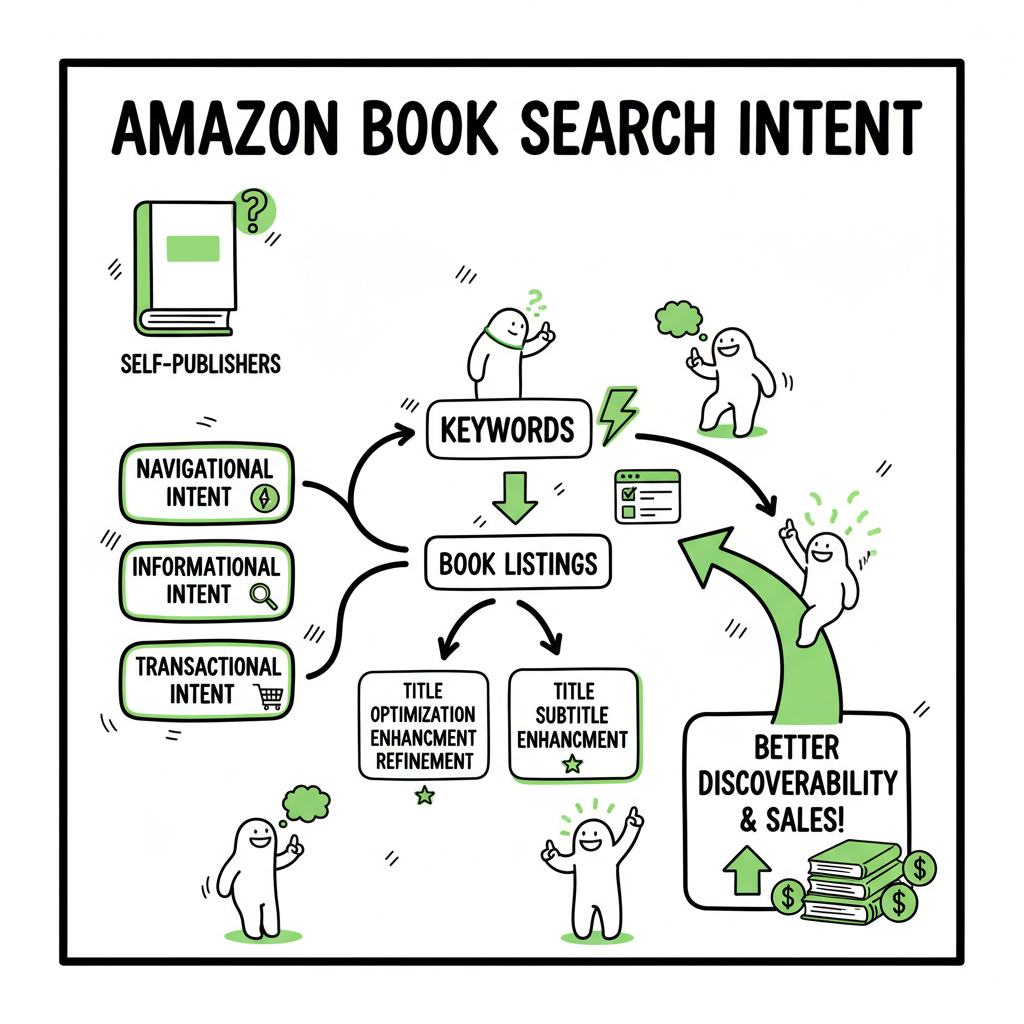
“Amazon book search intent” describes what a shopper means when they type a query into Amazon. Are they looking for a specific title or author (navigational)? Trying to learn something (informational)? Or ready to buy and comparing options (transactional)? The difference matters because Amazon measures relevance and conversion differently for each intent.
Reader behavior breaks down simply:
- Navigational: exact-title or author searches. The metadata must match exact phrasing.
- Informational: topic, question, or how-to searches. Good descriptions and keyword-rich content help.
- Transactional: commercial phrases like “best,” “buy,” or “recommended.” Sales copy, cover, reviews, and price matter most.
As you audit a listing, start by identifying the dominant intent for your target keyword set. That determines which parts of the listing get priority. For title and subtitle, prioritize clarity and exact-match terms for navigational intent; for informational intent, include topical phrases and benefit-driven language; for transactional intent, lead with credibility signals and strong calls to action.
If you need a practical guide that walks through the technical fields—title, subtitle, bullets, backend keywords, and categories—see Amazon Book SEO for Authors for step-by-step examples and tests that publishers use at scale.
Understanding intent also helps with ad targeting and pricing. For example, a reader searching “how to stop procrastinating” is farther from purchase than someone searching “best productivity books 2025.” Your ad copy, landing page (book page), and price should reflect that.
Cultural note: the reader’s intent informs how you assemble the page, but the same page must still feel trustworthy and helpful to both humans and the Amazon algorithm.
Optimize listings for the reader’s intent
When you optimize, think of the listing as a single system where each element signals to Amazon and to human readers how well the book satisfies the intent.
Title and subtitle
- Use the strongest intent keywords early in the title when the search is navigational or transactional.
- Use a subtitle to add topical keywords or benefits for informational searches.
Description and bullets
- Informational intent needs clear topic signals and a helpful table of contents or chapter highlights.
- Transactional intent requires social proof: short review snippets, awards, or notable endorsements.
Categories and keywords
- Choose categories that match the niche intent. A mismatch reduces conversion signals.
- Backend keyword space is limited—use it to cover alternate phrasings, synonyms, and common misspellings.
Cover and price
- Covers influence clicks immediately for transactional traffic. Test variants and use a clear genre signal.
- Price matters more for transactional searches; a competitive price can lift conversion and ranking.
Formats and distribution
– Make sure your book is available in the formats your audience expects. Some readers search specifically for “paperback” or “ebook.” If you plan to publish wide and offer both paperback and ebook editions, consider tools that streamline the process so you don’t repeat manual uploads on every platform. For example, when you’re ready to create a paperback or ebook at scale, a dedicated cover creation workflow can remove friction and speed distribution.
– Some parts of the publishing workflow—format conversion, or bulk metadata processing—are better handled by specialized utilities. If you’re creating paperback and ebook editions repeatedly, using an integrated service to create and manage assets will reduce friction, including a book creation workflow.
Metadata testing
- Track impressions, clicks, and conversion for different keywords. Swap title wording, subtitle focus, or cover and measure which change improves conversion for your priority intent.
Practical reminders
- Don’t stuff keywords into titles or descriptions. Keep language natural for readers.
- Use customer-facing language first; algorithm-friendly tweaks second.
- Monitor search terms in Amazon Advertising reports to validate actual queries and adjust intent mapping.
Scale distribution with multi-platform automation
Intent plays out differently across retailers. Amazon handles queries differently than Apple Books, Kobo, or Ingram. As you commit to publishing multiple titles, manual uploads become a bottleneck and a source of errors. That’s where a multi-platform automation service becomes an operational upgrade.
Why automation matters for intent-aware publishing
- Consistency: Same metadata across channels preserves your intent signals and avoids confusing readers.
- Speed: Automate CSV batch uploads and push a single cleaned dataset to Amazon KDP, Kobo, Apple Books, Draft2Digital, and Ingram.
- Platform intelligence: Automation tools can tailor fields to each store’s requirements so your intent signals survive format differences.
- Error reduction: Automated validation reduces rejected uploads, missing files, or wrong trim sizes.
What automation looks like in practice
- Prepare one master CSV with canonical titles, subtitles, descriptions, category mappings, and pricing tiers.
- Attach format-specific files (interior PDF, ebook file, cover) and let the system route them to each retailer’s expected format.
- Use rollbacks and logs to fix issues quickly rather than redoing manual forms across platforms.
When authors start publishing seriously, automation becomes an obvious upgrade: it saves roughly 90% of repetitive work, reduces mistakes, and keeps wide distribution practical. Automating upload doesn’t replace craft decisions about intent and metadata, but it buys you time to iterate and test.
A note on tools: some parts of the publishing workflow—cover creation, format conversion, or bulk metadata processing—are better handled by specialized utilities. If you’re creating paperback and ebook editions repeatedly, using an integrated service to create and manage assets will reduce friction.
FAQ
Q: How do I determine which intent a keyword has?
A: Look at the query language. Exact titles and names are navigational. Questions and topic phrases are informational. Phrases with “best,” “buy,” or “top” are often transactional. Validate by reviewing the top results on Amazon and the product detail pages they return.
Q: Should I change my keywords for ads versus organic?
A: Use broader informational keywords in content and long-tail transactional keywords for ads that target buyers. Ads can also reveal converting queries you can fold into metadata where appropriate.
Q: Will automation hurt discovery because listings are identical across stores?
A: Consistency preserves intent signals. Platform-specific tailoring (e.g., different category mappings or editorialized descriptions) is possible inside automation workflows so you get the best of both consistency and platform fit.
Q: How do I test which metadata changes impact conversions?
A: Run controlled experiments by swapping one element at a time (title wording, subtitle focus, cover), measure impressions, clicks, and conversions, and compare results to identify the most effective variations.
Q: Is automation needed for a single title?
A: Automation shines when publishing at scale, but even for a single title it can reduce manual errors and make distribution easier across platforms.
Sources
- Amazon ranking and keyword research summaries
- Trends in Amazon search behavior
- Search intent frameworks
- Example discussion of Amazon search signals
Amazon Book Search Intent: What Self-Publishers Need to Know Estimated reading time: 9 minutes Key takeaways Amazon book search intent shapes how readers find and buy books; match listing signals to the intent for better discoverability. Optimize title, subtitle, description, categories, and backend keywords for the likely intent (navigational, informational, or transactional). Use a multi-platform…