Book SEO vs Product SEO Explained for Indie Authors
Book SEO vs Product SEO: What Authors Need to Know
Estimated reading time: 9 minutes
Key takeaways
- Book SEO and product SEO share some tools, but they solve different problems for authors and publishing teams.
- Effective book discoverability mixes metadata, category strategy, and platform-specific tactics—then scales through processing.
- Once you publish seriously, unified multi-platform publishing (CSV batch uploads, platform-specific intelligence) saves time, reduces errors, and makes wide distribution practical.
Table of Contents
- Why the difference matters for authors
- How book SEO works in practice
- How product SEO differs and when it helps
- Applying both approaches at scale
- Final thoughts
- FAQ
- Sources
Why the difference matters for authors
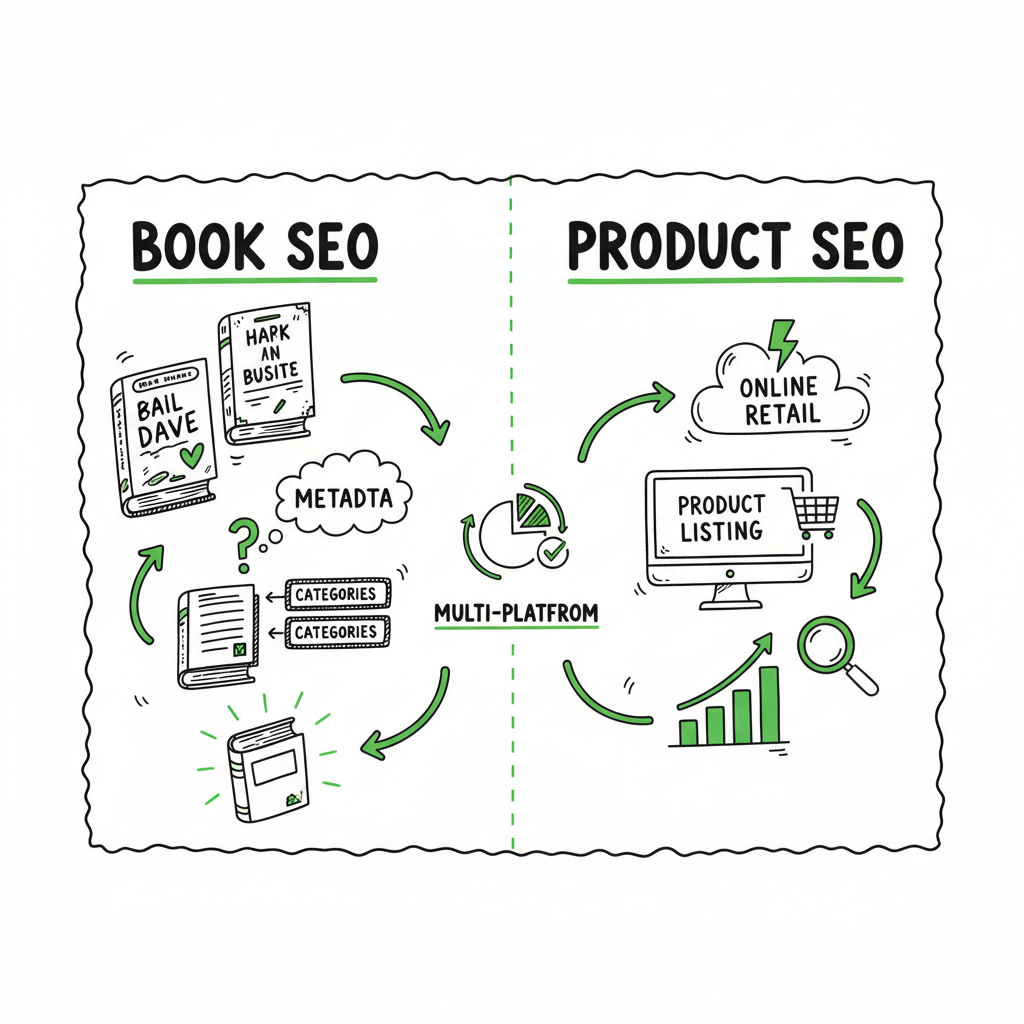
“Book SEO vs product SEO” is a useful frame because the two approaches change what you optimize and where you spend your time. For most indie authors the immediate priorities are discoverability in book stores, clean metadata, and reliable distribution. Book SEO focuses on catalog signals: title, subtitle, book description, categories, keywords, reviews, and the platform behaviors that shape visibility. Product SEO treats search as part of a broader product experience — it often applies when the product (a book series, app, or subscription) itself is the thing that must earn clicks and retention via content and technical signals.
On Amazon and other stores, practical book-level choices matter first. If you sell widely, you’ll want platform-specific tactics; for example, see Amazon Book SEO for Authors for an in-depth look at how retailer algorithms treat book metadata and content. Early attention to the right metadata and distribution removes the biggest friction authors face when scaling multiple titles.
How book SEO works in practice is a matter of repeatable actions that blend metadata engineering with discovery psychology.
How book SEO works in practice
Book SEO is built from a small set of repeatable actions. Think of it as metadata engineering plus discovery psychology.
Key elements
- Title and subtitle: Clear, searchable, and honest. Include genre signals and a strong hook.
- Book description: Use readable formatting and front-load important phrases. Store listings and external search both scan this text.
- Categories and keywords: Choose the best niche spots on each platform rather than gaming broad categories.
- Reviews and social proof: Early reviews increase click-through and conversion, which in turn improves ranking on many platforms.
- Covers: A professional cover that fits genre expectations improves click-through; consider a dedicated cover generator if you create many titles.
Format and distribution
- EPUB and file quality: Converting cleanly to EPUB is essential for Apple Books, Kobo, and Ingram. If your workflow includes many books, use a reliable EPUB converter to avoid rework and errors.
- Print-ready files: Paperback production needs correct trim sizes, margins, and spine math. A single bad file can delay distribution across multiple stores.
Practical tone: start with one retailer’s rules, then generalize. Amazon, Kobo, and Apple each read metadata differently; build a canonical metadata spreadsheet and apply platform-specific fields from there. A good publishing platform automates those mappings so you can push updates to multiple stores without repeating manual steps.
How product SEO differs and when it helps
Product SEO treats search as a growth channel for a product experience rather than just items in a store catalog. It’s common for publishers of ebook subscription services, serialized fiction platforms, or authors with active author websites that host excerpts and community features.
Core differences
- User intent: Product SEO optimizes for longer flows — landing pages, series hubs, author platforms — not only item-level conversions.
- Content breadth: It makes sense to produce long-form content tied to the book (author pages, guides, reading lists) to capture informational queries.
- Product signals: Beyond metadata, product-led approaches invest in the site architecture that surfaces books naturally and keeps readers engaged.
When to use product SEO
- You have an author platform or a portfolio of books where cross-promotion matters.
- You want search to drive newsletter signups, course sales, or serialized content consumption beyond a single book sale.
- You’re aiming for long-term traffic that supports an ecosystem (blog articles, reading guides, series pages).
Product SEO can complement book SEO, but it requires product design and content resources. For many indie authors, focusing on store-level SEO first gives the fastest returns.
Applying both approaches at scale
When you publish more than a few titles, the challenge shifts from “what to do” to “how to do it reliably.” That’s where processing and platform-aware uploads make the difference.
Operational best practices
- Canonical metadata sheet: Keep one CSV with all title-level fields and platform-specific columns. Update the master record and push changes to stores.
- Template-driven descriptions and categories: Create genre templates that fit store norms and speed copy creation.
- Batch file handling: Convert manuscripts to EPUB and print-ready PDFs in bulk, and generate covers from a repeatable design system.
- Platform-specific intelligence: Apply rules so that a keyword in your CSV maps correctly to Amazon’s seven keyword fields, Kobo’s subject system, or Ingram’s BISAC mapping.
Tools and processing
- Automated publishing systems remove repetitive uploads and reduce human error. They make wide distribution practical by handling differences between Amazon KDP, Kobo, Apple Books, Draft2Digital, and Ingram. Use CSV batch uploads and platform-specific intelligence to save time — vendors report roughly ~90% time savings when authors move from manual uploads to an automated pipeline.
Practical integrations to consider
- Automated EPUB conversion reduces formatting rejections on Apple and Kobo. If you convert manuscripts routinely, a dedicated EPUB converter removes a frequent bottleneck.
- A book cover generator keeps covers consistent across series and speeds production for multiple editions.
- Single-click or batch mapping from your master CSV to each platform’s required fields avoids copy-paste errors and prevents distribution delays.
A unified publishing service that supports CSV batch uploads, platform intelligence, and error reduction is an obvious upgrade once authors start publishing seriously. It fits a book creation workflow.
Final thoughts
“Book SEO vs product SEO” is a useful way to prioritize work. Start by optimizing the book-level signals that retailers use. Once you have several titles or a broader author platform, layer in product SEO tactics to drive long-term discovery and retention. Operational discipline — canonical metadata, batch conversions, and platform-aware uploads — multiplies your output without compromising quality.
If you produce EPUBs or paperbacks frequently, consider tools that automate conversion, cover processing, and multi-store uploads so you can focus on writing and promotion rather than repetitive file handling.
FAQ
Q: Which should I learn first, book SEO or product SEO?
A: Start with book SEO. Get reliable metadata, descriptions, categories, and distribution. Product SEO is valuable later when you have multiple titles or an author site to leverage.
Q: Can one metadata sheet really work for all platforms?
A: Yes, but you need platform-specific mappings. Keep a canonical CSV and map fields to each store’s requirements before upload.
Q: How important are covers for SEO?
A: Covers affect click-through, which indirectly affects discoverability. A genre-appropriate, professional cover helps conversions on store pages.
Q: Do I need EPUB conversion tools?
A: If you publish to Apple Books, Kobo, or Ingram, clean EPUBs are necessary. Automated EPUB converters save time and reduce rejections.
Q: How should I approach multi-title publishing?
A: Start with a single title, then build a canonical process for metadata, formatting, and distribution that scales to additional titles.
Q: Are there suitable tools for batch production?
A: Yes—look for solutions that support CSV batch uploads, platform mappings, and consistent cover and EPUB workflows.
Sources
- https://www.bookautoai.com/epub-converter
- https://www.bookautoai.com/book-cover-generator-processing
- https://www.bookautoai.com
- https://blog.bookuploadpro.com/amazon-book-seo-for-authors
Visit BookUploadPro.com to try the free trial.
Book SEO vs Product SEO: What Authors Need to Know Estimated reading time: 9 minutes Key takeaways Book SEO and product SEO share some tools, but they solve different problems for authors and publishing teams. Effective book discoverability mixes metadata, category strategy, and platform-specific tactics—then scales through processing. Once you publish seriously, unified multi-platform publishing…