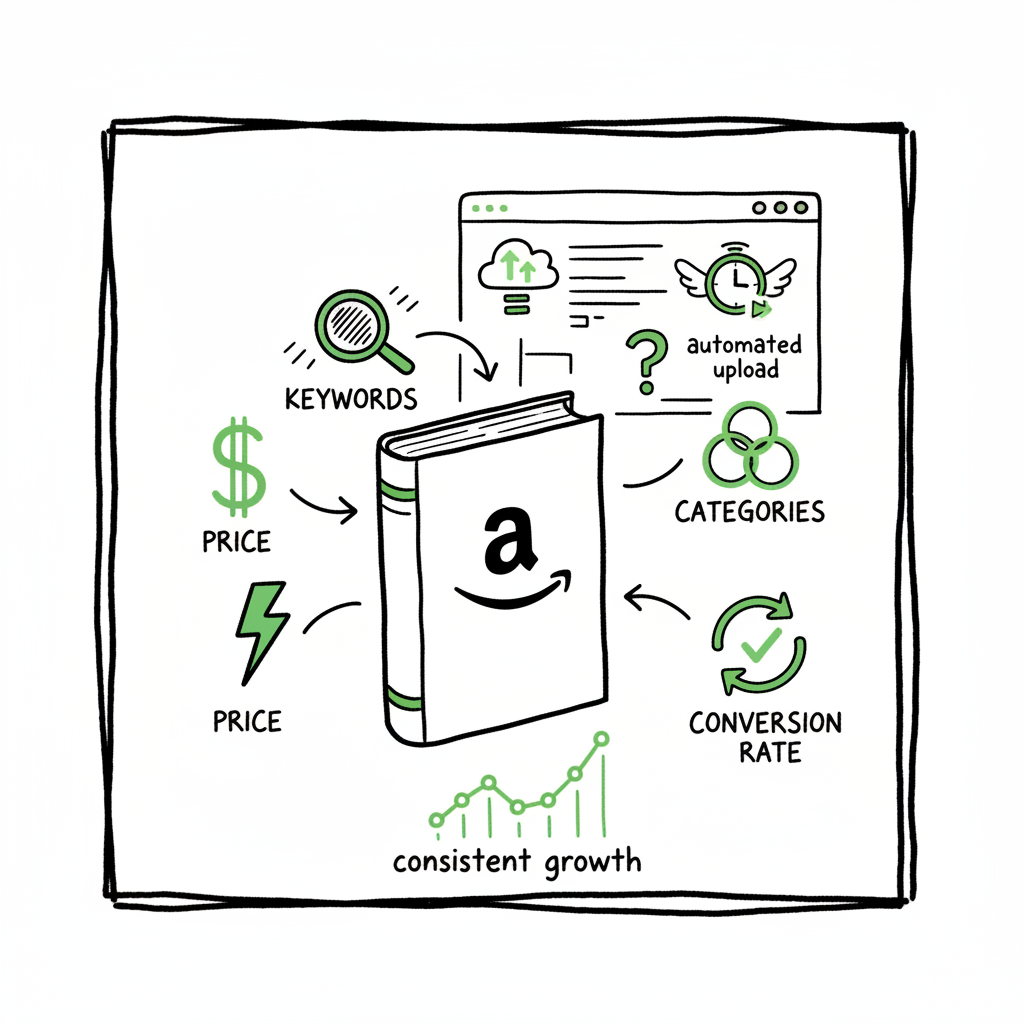
Amazon Book Ranking Factors Every Author Should Know
Amazon Book Ranking Factors
Estimated reading time: 9 minutes
Key takeaways
- Amazon’s algorithm favors consistent sales velocity, conversion, and strong metadata over one-off spikes.
- Practical changes — price, keywords, categories, and a better cover — move the needle faster than vague marketing.
- Automating multi-platform uploads and formatting saves time and reduces errors, so you can focus on books that sell.
Table of Contents
- How Amazon Book Ranking Factors Work
- Tactical Steps to Improve Rank
- Scaling Distribution with Automation
- FAQ
How Amazon Book Ranking Factors Work
If you want a clear name for the problem: amazon book ranking factors are mostly a sales-and-conversion game. Recent research and platform behavior in 2026 show the algorithm prefers steady, recent performance over old or bursty numbers. That means daily sales, consistent borrows from Kindle Unlimited, and steady conversions from product pages matter most.
For a deeper, step-by-step look at metadata and on-store SEO, see Amazon Book Seo For Authors.
Three core signals to know:
- Sales velocity over the last 30 days. New sales count more than old sales; consistent daily buys beat a single large spike.
- Conversion and engagement. Clicks that turn into purchases, add-to-cart events, and reading/borrow behavior feed recommendation systems.
- Metadata and price. Clean titles, optimized backend keywords, a high-impact cover, and pricing in the $2.99–$4.99 sweet spot often balance units and revenue, which the algorithm rewards.
Practical note: metadata is not just keywords. The title, subtitle, description, seven backend keyword slots, and category choices all shape discoverability and conversion. If you want a deeper, step-by-step look at metadata and on-store SEO, see Amazon Book SEO for Authors — it explains how to use keywords without stuffing and how small changes in descriptions and backend fields change search visibility.
Tactical Steps to Improve Rank
This is the operational part. Treat each item as a testable lever.
- Prioritize daily sales, not a single launch spike
- Aim for repeatable buys. Short promos and ads can help, but plan for sustained visibility: price tests, email sequences, and small, repeat campaigns produce the steady velocity the algorithm prefers.
- Hit the conversion basics
- Title and cover do the heavy lifting for clicks; description and first lines of the book (Look Inside) close the sale.
- Make the cover professional and genre-accurate — readers judge in a second. If you need fast cover iterations, try a cover generator that processes designs at scale.
- Optimize pricing with purpose
- For fiction and many nonfiction categories, $2.99–$4.99 often maximizes visibility while keeping revenue reasonable. Use short experiments and measure units sold, not just revenue.
- Use all metadata fields
- Fill the seven backend keyword slots with natural, separate phrases (don’t repeat words). Put a primary search phrase into the subtitle when it reads naturally.
- Choose categories wisely: low-competition, high-relevance niches can get you to the top of a list faster than broad categories.
- Build social proof methodically
- Early reviews boost conversion substantially. Ask early readers in targeted ways, and use follow-up sequences that make reviewing easy.
- Remember that ratings affect conversion more than raw rank — a better-converting book ranks higher because it generates more sales.
- Convert and format correctly
- Delivering clean EPUBs and error-free paperbacks removes friction that can hurt conversion and reviews. If you handle high volume or multiple formats, a reliable EPUB converter helps you produce consistent files quickly.
- Use Kindle Unlimited and pre-orders strategically
- KU borrows count as sales for ranking. Pre-orders help initial rank at launch day when those aggregated sales hit.
- Track and iterate
- Ranks update often. Monitor hourly and focus on 7–30 day trends. Small changes to price, cover, or keywords with clear measurement beat guesswork.
Scaling Distribution with Automation
Once you move beyond one title, manual uploads and format fixes become a tax on your time. That’s where multi-platform automation matters.
A practical solution handles:
- CSV batch uploads for hundreds of titles instead of one book at a time.
- Platform-specific intelligence that maps metadata to Amazon KDP, Kobo, Apple Books, Draft2Digital, and Ingram without repeated manual edits.
- Error reduction by catching common submission problems before they go live.
When authors publish seriously, a platform that automates the upload is an obvious upgrade. You keep editorial control while cutting repetitive work by roughly 90%. That makes wide distribution practical: publish the same files in multiple stores without repeating the same tedious steps. Automate the upload. Own the distribution.
Operational tips
- Batch your metadata edits and push to all platforms at once.
- Keep master files (manuscript, cover, EPUB) clean. If you need fast bulk creation of paperbacks or ebooks, automated creation tools can generate consistent files across formats.
- Use processing tools for cover variants and quick EPUB conversion to avoid manual fixes across systems.
Note on tools mentioned above: EPUB converter and cover generator processing can handle batch tasks, and BookAutoAI book creation tools can help with producing consistent files across formats.
Final paragraph before FAQ: real rank improvement requires both book-level work (cover, metadata, price, conversion) and publishing-level work (distribution, scaling, and clean files). The two together give you measurable, repeatable results.
If you need a dependable EPUB conversion service and tools for cover design and book creation, you can explore BookAutoAI:
BookAutoAI book creation tools
FAQ
Q: How fast will rank changes show after I optimize metadata?
Expect visible changes in 24–72 hours for search visibility and hourly updates for category ranks. Real momentum usually needs a week or two of consistent sales.
Q: Do Kindle Unlimited borrows really count?
Yes. KU borrows contribute to ranking signals similar to sales, especially when borrows are consistent over time.
Q: Should I prioritize reviews or price for a new release?
Both matter, but price tests can increase volume quickly. Use short price promotions while you gather honest early reviews to improve conversion long-term.
Q: Can distributing to many stores hurt Amazon rank?
No. Wider distribution doesn’t harm Amazon rank. The algorithm cares about sales and engagement on Amazon itself. Wider distribution helps overall earnings and reader reach.
Q: How quickly can price changes impact rank?
Price changes can influence visibility within days, but sustained impact comes from repeated, tested pricing and accompanying promotions.
Final thoughts
Amazon’s ranking system in 2026 rewards consistent, recent performance, strong conversion, and correct metadata. Tackle the visible levers—price, cover, keywords, categories, and steady promotion—then scale distribution and file quality with automation. When you publish at scale, automation stops being optional: it saves time, reduces errors, and makes multi-store distribution manageable.
Visit BookUploadPro.com to try the free trial.
Sources
- https://neucitepress.com/amazon-book-ranking-algorithm-what-authors-need-to-know-in-2026/
- https://booklaunchers.com/amazon-book-rank-and-sale/
- https://eliteauthors.com/blog/marketing-book-amazon-what-works-2026/
- https://pittsburghseoservices.com/exploring-amazons-2026-algorithm-the-hidden-ranking-factors-sellers-overlook/
- https://blog.bookuploadpro.com/amazon-book-seo-for-authors
- https://www.bookautoai.com/epub-converter
- https://www.bookautoai.com/book-cover-generator-processing
- https://www.bookautoai.com
Amazon Book Ranking Factors Estimated reading time: 9 minutes Key takeaways Amazon’s algorithm favors consistent sales velocity, conversion, and strong metadata over one-off spikes. Practical changes — price, keywords, categories, and a better cover — move the needle faster than vague marketing. Automating multi-platform uploads and formatting saves time and reduces errors, so you can…