Amazon A9 Algorithm for Books and How It Ranks for Authors
amazon a9 algorithm for books
Estimated reading time: 5 minutes
Key takeaways
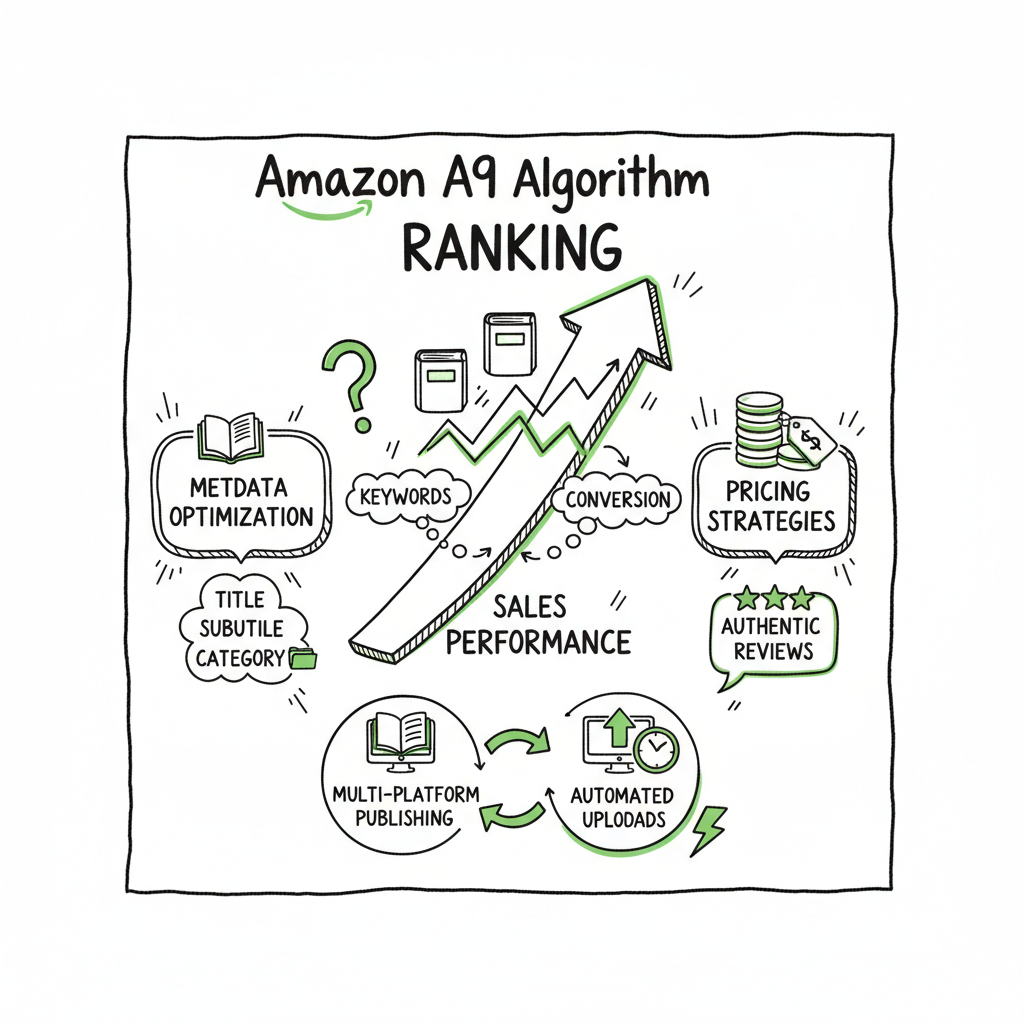
- The A9 system ranks books based on sales performance and relevance: sales velocity, conversion rate, and keyword fit matter most.
- Practical optimization mixes solid metadata (title, subtitle, backend terms), category and pricing strategy, launch sales, and authentic reviews.
- Multi-platform publishing and automated uploads reduce friction, letting authors focus on books and promotion instead of repetitive uploads.
Table of Contents
- How A9 works for books
- Actionable optimization steps for authors
- Multi-platform publishing and workflow automation
- FAQ
- Sources
How A9 works for books
Amazon doesn’t use a single static “A9” box you can flip — it runs several ranking systems that combine relevance and performance signals. For books, the practical effect is simple: the engine shows customers items that are likely to convert into sales. That means two big buckets matter equally: keyword relevance (title, subtitle, description, and backend search terms) and demand signals (sales velocity, conversion rate, and reviews).
Sales velocity is especially important. A product that sells quickly signals purchase likelihood to Amazon; that feeds more visibility, which can create a virtuous loop. Conversion rate is the fraction of shoppers who buy after seeing your page, so your cover, title, price, and reviews shape that metric. Inventory and price matter too — out-of-stock or poorly priced listings get suppressed. Account health and fulfillment (FBA preference for many categories) are additional filters.
Keyword placement remains tactical: put primary terms early in the title and use the description, bullets, and backend fields effectively. If you want tactical on-page tips for Amazon listings, see Amazon Book SEO for Authors. Real-world results come from combining relevance with an initial promotional push to build velocity and reviews. Over time, those performance metrics outweigh one-off optimization tweaks.
Actionable optimization steps for authors
Start with clean metadata and a simple launch plan. Below are practical steps you can apply without jargon.
1) Titles and subtitles
– Put the strongest keyword phrase near the front of the title (first 60–80 characters matter most on mobile).
– Use the subtitle to add genre, hook, and secondary keywords naturally.
– Avoid stuffing. Clear, readable titles convert better.
2) Book description and backend terms
– Use the description to answer reader intent: who is this for and what will they get? Short hooks, then benefits and social proof.
– Fill backend search terms with true synonyms and common misspellings up to the byte limit. Backend fields are invisible to readers but used by A9 for relevance.
3) Cover, formatting, and previews
– A cover that reads clearly at thumbnail size improves click-through and conversion. If you’re generating covers or iterating quickly, use a reliable cover tool — a solid cover reduces wasted ad spend and boosts organic conversions. If you need a fast option, consider a professional cover generator to speed review cycles.
– Ensure your ebook file converts cleanly to EPUB and that the preview on retailer pages works without glitches; broken previews drop conversions. For reliable EPUB conversion, use a tested EPUB converter that preserves formatting and metadata.
BookAutoAI cover generator can help streamline cover iterations, and the EPUB converter can support reliable file formats.
4) Pricing and category strategy
– Competitive pricing helps early sales velocity. Many authors run short promotions or price discounts at launch to trigger activity.
– Place the book in the most relevant categories and consider less crowded subcategories for visibility. Category selection affects which browse and recommendation algorithms include your book.
5) Launch velocity and reviews
– Initial sales matter more than long-term links. Plan a coordinated launch: newsletter, timed promotions, and paid ads if you use them.
– Reviews are social proof. Encourage honest reviews from readers and make it easy to leave feedback without incentivizing fake or paid reviews.
6) Monitor and iterate
– Track conversion rate and sales velocity by day. Small changes in title, cover, or price can move the needle. Document tests so you know what works for future releases.
These steps focus on what changes Amazon’s systems actually reward: relevancy plus measurable purchase behavior. For authors publishing in volume, optimizing these items becomes a repeatable workflow rather than a one-off task.
Multi-platform publishing and workflow automation
Once you publish more than a few books, the repetition becomes the bottleneck. Uploading the same title to multiple stores means duplicating metadata, cover files, price settings, and distribution choices. That’s where automated multi-platform publishing changes the math.
BookUploadPro automates repetitive uploads across Amazon KDP, Kobo, Apple Books, Draft2Digital, and Ingram, offering unified multi-platform publishing with CSV batch uploads and platform-specific intelligence. For authors publishing seriously, automation delivers ~90% time savings by removing manual, error-prone steps and standardizing metadata across stores. It’s an obvious upgrade once authors start publishing seriously.
Automation also reduces mistakes that hurt performance — mismatched metadata, wrong ISBN linkage, or failed EPUB uploads all cost visibility and time. And because each store has different technical quirks, platform-specific intelligence matters: automatic formatting adjustments and validation flags stop problems before they reach live pages.
Practical production notes
– Create one source of truth for metadata and assets (manuscript, cover, metadata CSV). That way you change a title or keyword once and push it everywhere.
– For ebooks and paperbacks, use tools that produce retail-ready outputs. If you’re converting manuscripts to retail formats, a reliable ebook file generator and EPUB converter will save time and avoid preview issues.
– For covers, use a trusted generator or designer, then batch-apply the same cover across platforms where applicable; clear thumbnail legibility is universal.
BookAutoAI platform can support a publishing workflow that scales with your catalog.
When you standardize uploads and use batch processing, you free time for marketing and writing. BookUploadPro automates the upload. Own the distribution.
Final thoughts: Amazon’s A9 systems reward measurable buying behavior more heavily than traditional backlinks or off-page SEO. Authors who combine strong, relevant metadata with a plan to generate initial sales and honest reviews will see the best results. For authors scaling multiple titles, unify production and use automation to reclaim time and reduce mistakes.
FAQ
Q: Is there one single A9 algorithm for books?
A: No. Amazon runs multiple ranking systems for search, recommendations, and sales rank. Treat A9 as an evolving set of rules that prioritize relevance and purchase likelihood.
Q: How important are backend keywords?
A: They’re useful. Backend terms are an opportunity to add synonyms and misspellings that won’t fit naturally in the public title or description. Use them wisely within byte limits.
Q: Will automating uploads hurt my listings?
A: Not if you use a platform that validates files and adapts to each store. Automation reduces manual errors and ensures consistent metadata across retailers.
Q: Should I change price frequently to game A9?
A: Frequent arbitrary pricing changes risk confusing readers and hurting long-term conversion. Use promotions strategically at launch, and track the effect on velocity and conversion before repeating.
Q: What file and asset checks should I run before uploading?
A: Confirm EPUB preview works, cover thumbnail legibility, correct ISBN or ASIN linkage, and that metadata is consistent across platforms. Automated tools can run these checks in bulk.
Sources
- Amazon A9 Algorithm: 2025 Ranking Factors Explained
- Mythbusting The Amazon Algorithm – Reviews and Ranking For Authors
- Amazon A9 Algorithm for Ultimate Ranking Success
- How the Amazon A9 Algorithm Works (2025 Guide to Ranking and Conversions)
- Exploring the Amazon A9 Algorithm: 9 Steps to Increase Your Rankings
- Amazon A9 Algorithm: Best Practices & Tips for Manufacturers
- Amazon and the Myth of the A9 Algorithm
amazon a9 algorithm for books Estimated reading time: 5 minutes Key takeaways The A9 system ranks books based on sales performance and relevance: sales velocity, conversion rate, and keyword fit matter most. Practical optimization mixes solid metadata (title, subtitle, backend terms), category and pricing strategy, launch sales, and authentic reviews. Multi-platform publishing and automated uploads…