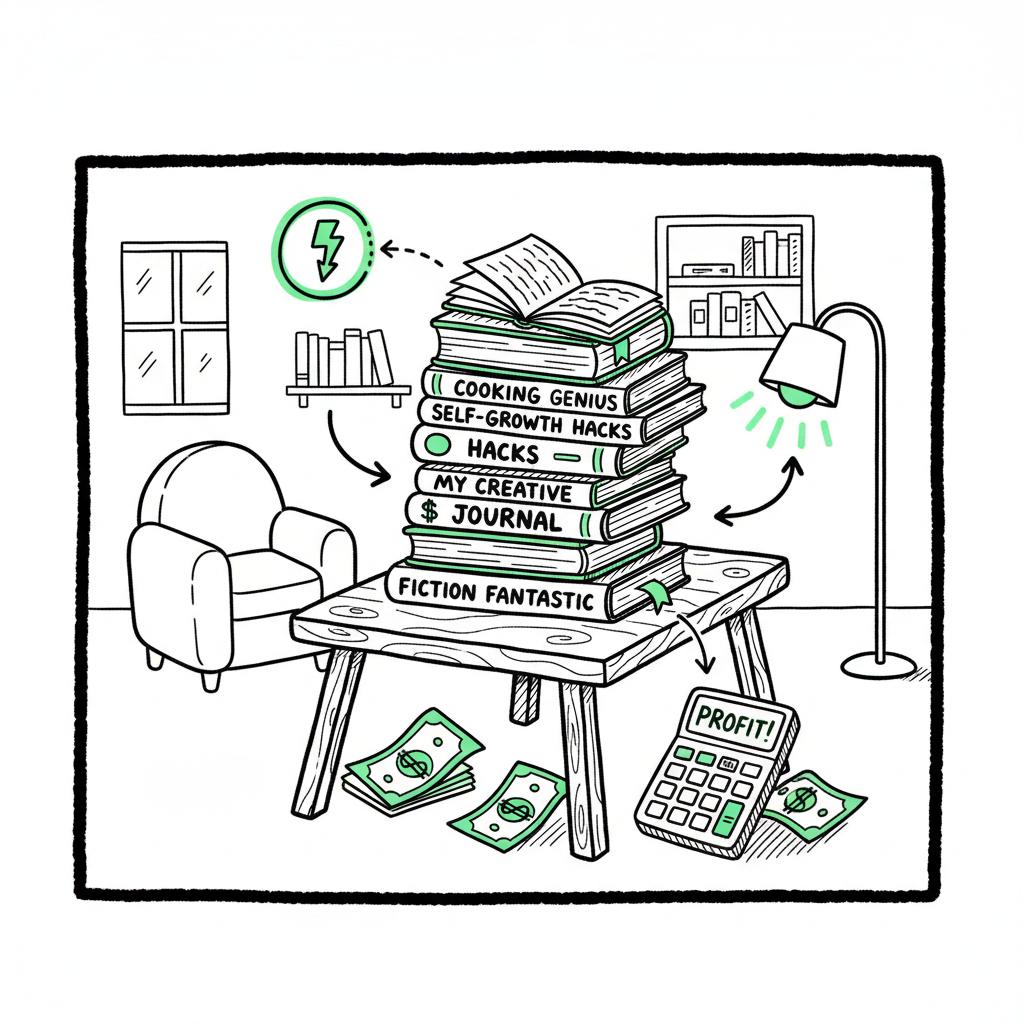
Book Niches with High Royalties for Self-Publishing 2026
Book niches with high royalties: Where to focus in 2026
Estimated reading time: 9 minutes
Key takeaways
- High-royalty opportunities combine buyer demand with low competition—think focused problems, giftable formats, or subscription-friendly reads.
- Fast-to-produce low-content books and targeted nonfiction (cookbooks, self-help, business guides, spiritual niches) often yield steady royalties with less upfront risk.
- Scale distribution across platforms and automate uploads to save time, reduce errors, and make wide distribution practical.
Table of Contents
- Why royalties vary and what matters
- Book niches with high royalties: practical opportunities
- How to publish and scale across platforms
- FAQ
Why royalties vary and what matters
Royalties are not just a percentage; they’re the result of price, sales velocity, and distribution strategy. A 70% royalty on a $2.99 ebook looks good on paper, but steady monthly income comes from repeat buys, discoverability, and formats that match buyer intent. Kindle Unlimited (KU), for example, changes the math: reads pay from a pool, so long-form fiction can earn differently than single-purchase nonfiction.
Two practical rules to remember:
- Solve a clear buyer problem. A cookbook that answers “what to cook with an air fryer for a Mediterranean diet” is easier to position than “general cooking.”
- Match format to behavior. Low-content books (journals, activity books, planners) can sell at lower price points but in volume. Premium photography cookbooks or niche business guides justify higher prices and higher royalties per sale.
If you want a quick starter list and categories that tend to outpace others, see Book Niches That Sell for ideas that match buyer patterns and platform behavior.
Book niches with high royalties: practical opportunities
-
Low-content and no-content books (journals, activity books)
Why: Fast to produce, easy to test different themes and niches. Buyers look for very specific variants—gratitude journals, cleaning checklists, or themed drawing journals for kids.
Production note: Use consistent interior templates and simple, on-theme covers to test multiple sub-niches quickly.
-
Coloring and activity books
Why: Giftable, repeatable, and often bought in volume for holidays, classrooms, or parents. Themes that perform: toddlers’ simple shapes, pixel art mosaics, and niche hobbies.
Production note: Keep page bleed and margins correct for print; consistent art quality increases repeat purchases.
-
Niche cookbooks and diet-specific recipe books
Why: Strong gift appeal and search demand. Focused angles—Mediterranean air-fryer recipes, beginner keto meal plans, or plant-based slow-cooker books—convert better than generic cookbooks.
Production note: Photography and clear recipes raise perceived value; even modest photo counts improve conversion.
-
Practical self-help and personal development
Why: Readers buy to solve a problem. Books that teach one skill (time-blocking for parents, budgeting for freelancers) are easier to market and collect positive reviews.
Production note: Include worksheets or companion low-content pages to increase perceived value and cross-sell.
-
Business and how-to guides for platforms and side hustles
Why: Evergreen demand from people starting small businesses or side gigs—tax steps for new sellers, beginner eBay guides, or how to start local services.
Production note: Keep updates realistic—buyers expect current info, so plan minor revisions rather than large rewrites.
-
Religious and spiritual niches with specific practices
Why: Highly engaged audiences who buy series and devotionals. Niche topics like pagan holiday rituals or focused meditation practices create repeat buyers and membership-style followings.
Production note: Respect cultural accuracy and provide clear sourcing or practice steps.
What raises royalty yield across these niches
- Price segmentation: Offer a paperback and ebook combo or a deluxe print edition. Higher-priced print books give bigger per-sale royalties.
- KU strategy: For fiction and some nonfiction, KU can add steady income through reads. Balance KU against wide distribution if you want other retailers.
- Listing optimization: Descriptions that solve a buyer’s question and category selection that reduces competition matter more than sheer keyword stuffing.
How to publish and scale across platforms
Getting one book live is the hard part. Getting dozens live across KDP, Kobo, Apple Books, Draft2Digital, and Ingram without wasting time is where the math changes. At scale, automation and standardized files are the difference between a few dozen titles and a reliable passive-income stream.
What to automate and why
- Metadata and category mapping: Reusing metadata spreadsheets cuts entry errors and preserves category choices that work.
- CSV batch uploads: A single CSV that contains titles, descriptions, prices, and keywords saves hours when publishing many variants.
- Platform-specific intelligence: Each retailer has quirks—trim sizes, allowed fonts, or image specs. cover generator processing can adapt a master file to multiple targets, reducing rejections.
Tools you’ll need
- Reliable ebook conversion: Converting a manuscript cleanly to EPUB and ensuring reflow across readers is crucial for Apple and Kobo. If you’re converting files at scale, an automated EPUB converter streamlines the process and reduces formatting rework.
- Cover production workflow: Covers still sell the book. Whether you’re commissioning art or using templates, a cover generator can process dozens of variants quickly so you can A/B test themes.
- Print and ebook creation: If you’re producing paperbacks and ebooks in volume, use a system that supports both formats from a single source file to prevent version drift and duplicate work.
Practical distribution choices
- Wide vs. exclusive: KU can be a fast path for certain titles, but once you commit, you limit other retailers. Use exclusivity strategically for specific series or titles that benefit from KU exposure.
- Multi-format bundles: Pairing a modestly priced ebook with a low-content companion (workbook, planner) can increase lifetime value per buyer.
- Error reduction: Rejected uploads waste time. Automating format checks and platform-specific validations reduces human error and publishing friction.
Making this practical
- Start with a single repeatable template for one niche—say, a 100-page guided journal with a standard interior and swap-in cover. Validate demand, then scale variants.
- Move to CSV batch uploads when you have validated titles. Automating the repetitive entries saves roughly 80–90% of the time once your templates and mappings are set.
- Consider the obvious upgrade once you’re serious about publishing: a service that automates uploads across Amazon KDP, Kobo, Apple Books, Draft2Digital, and Ingram and handles CSV batch jobs. Book creation workflow helps keep versions in sync.
(If you create or sell print-ready files, you may also want tools that handle paperback and ebook generation smoothly—these systems centralize creation and speed distribution.)
For additional tooling support, a EPUB converter and a book creation workflow can help maintain consistent formats across retailers.
Brand resources: cover generator processing can speed up cover testing.
FAQ
Q: Do low-content books still earn good royalties?
Yes. Low-content books often earn steady, predictable royalties when you target narrow buyer needs and maintain quality covers and interiors. Volume and niche targeting are the drivers.
Q: Is Kindle Unlimited necessary for high royalties?
KU helps for certain long-form fiction and titles that get steady read-throughs. For many nonfiction and print buyers, wide distribution and higher per-sale prices outperform KU. Choose based on title type and sales pattern.
Q: What’s the best format to start with?
Start with the format that matches the buyer’s behavior. If the niche searches and buys print (cookbooks, coloring books), prioritize print. If readers want quick advice, start with paperback and ebook.
Q: How should I price to maximize royalty?
Test price bands. For ebooks, many authors find $2.99–$9.99 sweet spots; for print, pricing should reflect production costs and perceived value. Higher-priced titles with real value (original photography, deep how-to) produce higher per-sale royalty.
Q: Should I publish wide or KU?
A mix often works best. Start with broad distribution to build discoverability, then test KU for titles that benefit from read-through and series opportunities.
Final thoughts
Focusing on book niches with high royalties means pairing a clear buyer problem with the right format and efficient production. Start small, test themes, and then use batch processes and platform-aware tools to scale. When publishing becomes a repeating operation, automation is no longer optional—it’s the way to turn good ideas into reliable income.
Visit BookUploadPro for more resources on multi-platform publishing.
Sources
- Most Profitable Amazon KDP Niches – Top 10
- THIS Book Niche Is The Most Profitable (Most People Pick Wrong)
- 5 Best KDP Niches Worth Starting in 2026
- My 2026 Amazon KDP Predictions (Where I’m Putting My Money)
Book niches with high royalties: Where to focus in 2026 Estimated reading time: 9 minutes Key takeaways High-royalty opportunities combine buyer demand with low competition—think focused problems, giftable formats, or subscription-friendly reads. Fast-to-produce low-content books and targeted nonfiction (cookbooks, self-help, business guides, spiritual niches) often yield steady royalties with less upfront risk. Scale distribution across…