Best Niches for Short Books That Sell on KDP and Retailers
Best niches for short books: where to publish fast and earn steady royalties
Estimated reading time: 8 minutes
Key takeaways
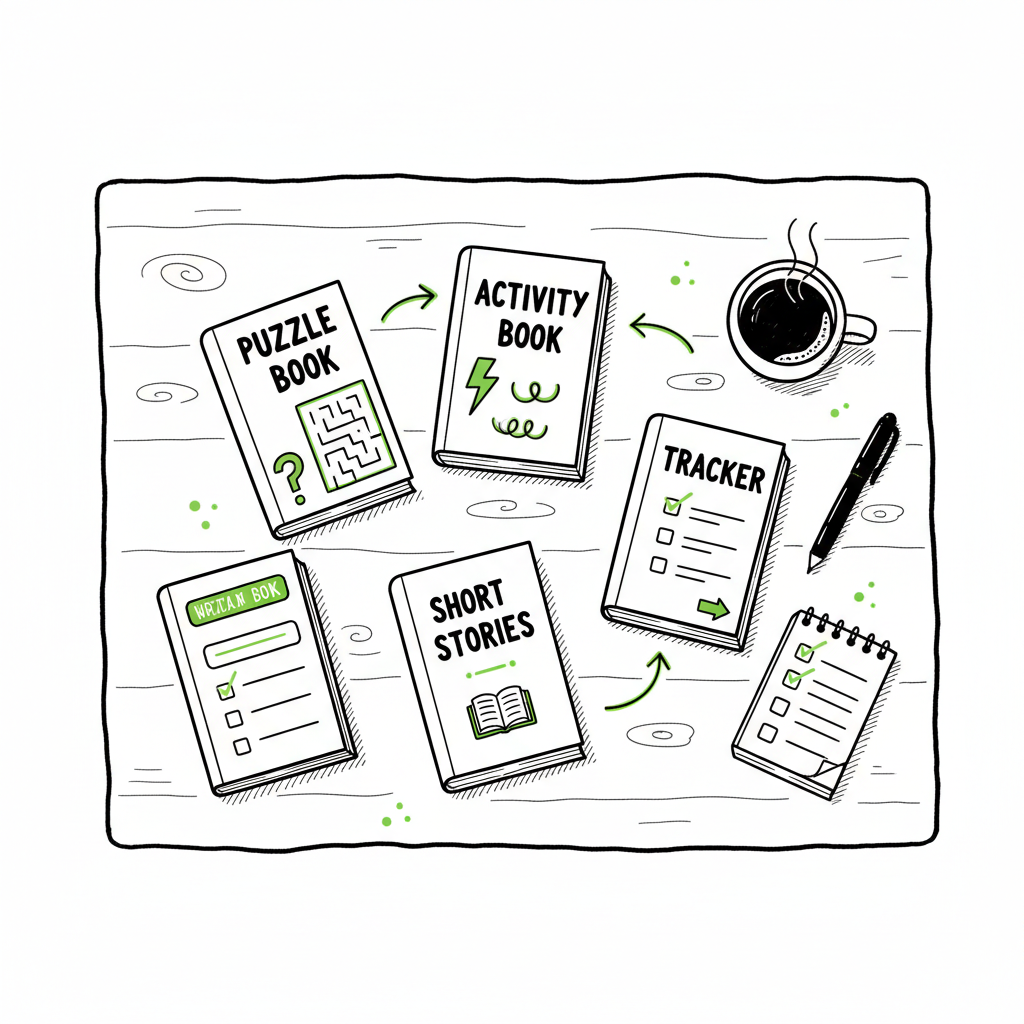
- Short books sell when they meet a clear, repeatable need: puzzles, activities, short stories, or focused low-content trackers.
- Niche down inside big categories (age, theme, skill level) to find low-competition corners that scale.
- Use efficient production and multi-platform automation to publish many variants fast and keep distribution errors low.
Table of Contents
- Why short books sell
- Top niches for short books
- Create, format, and publish short books quickly
- Scale distribution with automation
- FAQ
Why short books sell
Short books win when they solve a narrow problem or provide quick entertainment. Parents, teachers, hobbyists, and repeat buyers look for low-cost, focused products: a 24-page activity book, a themed coloring book, or a short story collection that fits a single reading level. Production time is low, so authors can test many ideas and iterate.
A practical rule: produce something that can be finished and uploaded in a few days, then observe sales and reviews. If you want a broader look at demand patterns, our post on Book Niches That Sell gives useful signals for choosing themes and sub-niches based on buyer intent.
Short formats also encourage repeat purchases. Puzzle and activity buyers often return seasonally or buy several titles in a series. That pattern changes how you price and promote: lower price, higher volume, and consistent discoverability.
Top niches for short books
Here are reliable short-book niches that perform well on KDP and other retailers in 2026. Each entry includes a practical sub-niche idea you can test quickly.
- Puzzle and brain-training books
- Examples: sudoku, crosswords, mazes, logic puzzles, math practice sheets.
- Sub-niche idea: “sudoku for elementary grades” or “holiday-themed crosswords.”
- Activity books for kids
- Examples: dot-to-dot, scissors practice, connect-the-dots, sticker books.
- Sub-niche idea: age-specific packs (preschool scissors skills, kindergarten tracing).
- Coloring books
- Examples: toddlers, educational themes, simple line art for kids.
- Sub-niche idea: narrow a theme (e.g., farm animals, emergency vehicles, insects).
- Short story picture books
- Examples: 24–40 pages, 500–2,000 words, with simple illustrations and an educational hook.
- Sub-niche idea: bedtime stories focused on daily routines or single social skills.
- Low/no-content planners and trackers
- Examples: habit trackers, reading logs, travel journal pages.
- Sub-niche idea: hobby-specific trackers (plant watering schedule, dog training log).
Why these work: they require minimal text, straightforward interior layout, and repeatable templates. The barrier to entry is low, but competition can be high—so niche down. Look for combinations of theme + audience + format (example: “space coloring book for preschool girls”).
Create, format, and publish short books quickly
Turn an idea into a sellable file without reinventing the wheel. Use templates for interiors and invest a little time in covers and metadata.
Covers matter more than length. A simple, bold cover with clear age and theme cues converts better than a crowded design. If you need a fast option for covers, consider a dedicated book cover generator to produce readable, platform-ready files.
Interior formats: PDFs for print, EPUB for most retailers. If you don’t want to wrestle with EPUB quirks, an EPUB converter will save time and reduce rejections. For paperback and ebook creation, a single source file and export workflow keeps versions aligned and reduces proofing cycles; tools that support batch exports make that practical.
Formatting tips for speed
– Use a grid-based interior for activity books so you can swap content and reuse layouts.
– Keep typography simple: large headings, clear instructions, and ample margins for print bleed protection.
– Create a “series template” with variable fields (title, age, theme) so you can produce dozens of variants from one master.
Production checklist (short)
– Finalize theme and target age.
– Produce interior pages using a template.
– Design or generate a clear cover.
– Export print-ready PDF + EPUB.
– Upload with correct metadata and keywords for discoverability.
When you mention covers, EPUB conversion, or creating paperbacks and ebooks, it’s worth using specialist tools to avoid manual errors. For quick cover work, a good book cover generator can speed up iterations. If EPUB formatting is unfamiliar, an EPUB converter reduces conversion mistakes. And if you’re creating multiple ebook and paperback variants, a platform that supports streamlined book creation keeps quality consistent.
Also, you can read about book creation workflow to streamline your process.
Scale distribution with automation
Publishing one short book is simple. Publishing dozens across Amazon KDP, Kobo, Apple Books, Draft2Digital, and Ingram is where automation saves real time.
A unified multi-platform publishing tool lets you:
– Upload once with CSV batch uploads and push to every store.
– Apply platform-specific intelligence (file checks, metadata tweaks) to reduce rejections.
– Cut repetitive tasks and errors, saving around 90% of time compared with manual uploads.
– Maintain consistent titles, descriptions, and pricing across retailers.
When you reach a steady cadence—say, a few new variants per month—manual uploads become the bottleneck. That’s when automation is an obvious upgrade. Use CSV workflows to produce a series quickly, and rely on platform checks to avoid wasting proof cycles.
Practical benefits of automation at scale
– Faster testing of sub-niches. Publish five themed coloring books in a week and see which one gains traction.
– Lower error rates. Automated validations catch bleed issues, wrong trim sizes, and metadata mismatches before upload.
– Affordable and predictable overhead. Automation replaces repetitive labor, not creative decisions.
Automate the upload. Own the distribution. When you’re publishing seriously, a multi-platform publisher that handles batch uploads and platform intelligence makes wide distribution practical and predictable.
FAQ
How long is a “short” book?
Short books range from low/no-content (24–80 interior pages) to short narratives (500–2,000 words, 24–40 pages). The key is clear scope and consistent quality.
Are short books profitable with low prices?
Yes. Profit comes from volume and series sales. Pricing lower encourages impulse buys and repeat customers, especially in kids’ categories.
Do I need illustrations for short story books?
For kids’ short story picture books, simple illustrations help. You can use repeatable art styles and templates to keep costs down.
Which platforms should I publish on?
Start with Amazon KDP for volume, then expand to Kobo, Apple Books, Draft2Digital, and Ingram to capture more channels and steady backlist revenue.
What should I do after publishing?
Keep testing sub-niches, produce variants, and automate distribution to sustain momentum.
Final thoughts
Short books are a practical, scalable way to build a backlist that earns passive income. Success depends on focused niches, repeatable production, and distribution that doesn’t require manual work for every title. Start small, niche down, and automate the heavy lifting so you can keep publishing.
Visit BookUploadPro.com to try the free trial and see how batch uploads and multi-platform publishing simplify scaling your short-book catalog.
Sources
Best niches for short books: where to publish fast and earn steady royalties Estimated reading time: 8 minutes Key takeaways Short books sell when they meet a clear, repeatable need: puzzles, activities, short stories, or focused low-content trackers. Niche down inside big categories (age, theme, skill level) to find low-competition corners that scale. Use efficient…