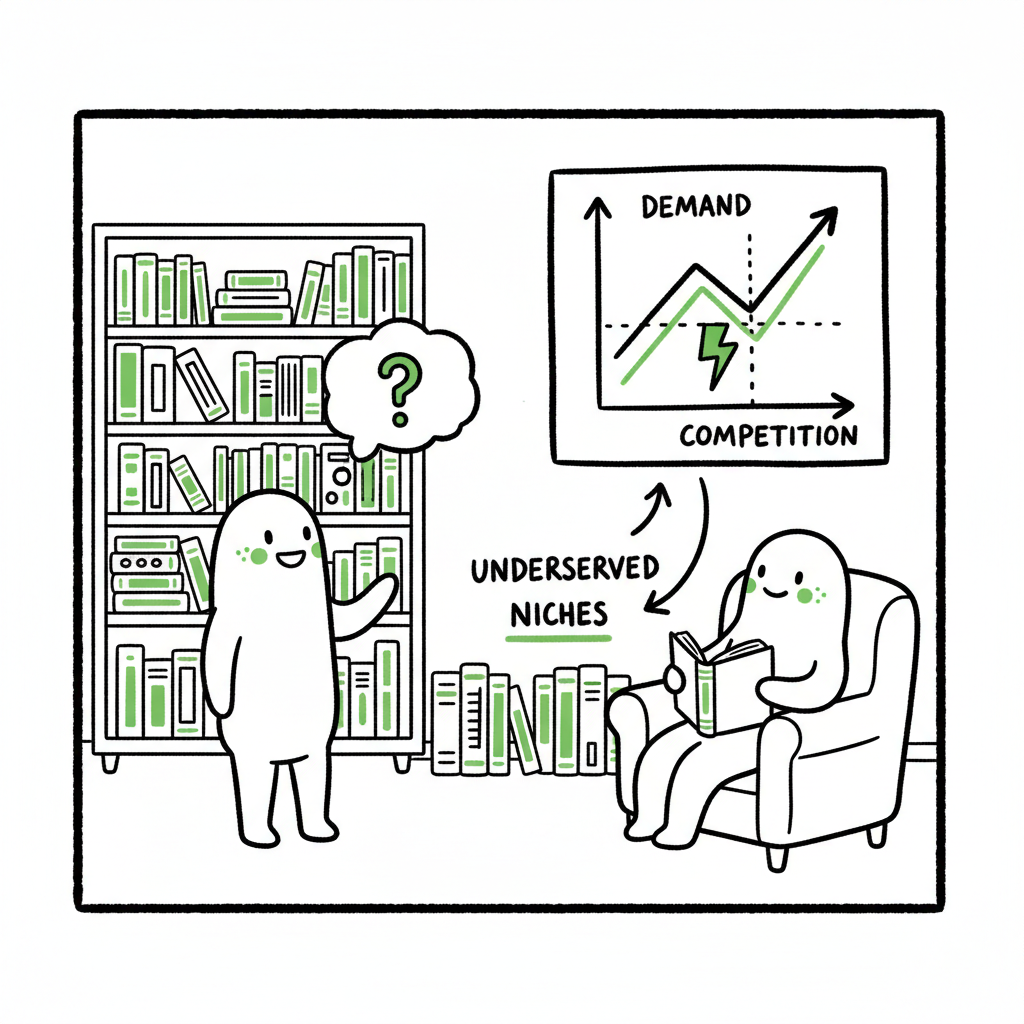
Underserved Book Niches for Self-Publishers to Scale
Underserved book niches: where to find small markets that scale
Estimated reading time: 6 minutes
Key takeaways
- Underserved book niches are specific sub-genres or product types with steady demand and low competition — ideal for rapid publishing and testing.
- Focus on measurable signals: low review counts, stable sales rank, and few dominant authors; pair those with quick formats like niche journals or focused children’s series.
- Use multi-platform automation to scale distribution and reduce repetitive work — CSV batch uploads, platform-specific checks, and error reduction matter once you publish seriously.
Table of Contents
- Why underserved book niches matter
- How to find and validate underserved book niches
- Formats, quick examples, and what sells
- Scale distribution with automation
- FAQ
Why underserved book niches matter
Underserved book niches are the small gaps readers are actively searching for but big publishers ignore. Those gaps can be a very specific journal (beekeeping logbooks), a focused kid’s series (Greek myths for ages 7–10), or a hands-on workbook for a narrow learning goal (early STEM prompts for toddlers). These niches matter because they let you test ideas cheaply, collect buyer data, and build repeatable products without going head-to-head with big authors.
Two practical advantages:
- Speed: low- and no-content products get produced fast and sell consistently when targeted right.
- Leverage: niche fiction and specialist non-fiction attract loyal buyers and reviews that compound.
For practical examples, see Book Niches That Sell.
How to find and validate underserved book niches
Start with data, then validate with a simple test product.
- Use measurable signals: Look for categories where top competing books have fewer than ~500 reviews, search volume is present, and a few recent releases rank well. Tools can surface these patterns, but you can also scan Amazon KDP sub-categories: pages with under 1,000 results, titles with clear micro-topics, and few repeat authors are good targets.
- Narrow the idea to a single reader problem: Turn a broad topic into a single promise: “gratitude journal for teen athletes” instead of “gratitude journal.” Narrowness reduces buyer confusion and improves discoverability.
- Validate with a minimum viable product: For low-content niches, publish a high-quality interior and simple cover quickly. Track early sales and reviews; if you see steady daily sales or repeat customers, expand with variants (different cover art, dated vs. undated versions).
Practical checks before you publish
- Reviews: top results with low review counts mean low competition.
- Sales rank: consistent rank (not viral spikes) shows steady demand.
- Price: avoid niches dominated by ultra-cheap listings unless you can compete on quality or extras.
Formats, quick examples, and what sells
Some niches favor low-content production; others need a bit more expertise. Below are practical formats and examples that match current trends.
Low- and no-content winners
- Hobby logbooks: knitting row counters, beekeeping trackers, gardening planners. These are repeat-purchase friendly and easy to produce.
- Niche journals and planners: gratitude journals for teens, cleaning checklist notebooks that match a homeowner persona.
- Activity and mindfulness books: family bonding activity books, breathing exercise activity books for kids.
Higher-content niche opportunities
- Children’s niche fiction: spooky short stories for ages 8–10, YA contemporary with specific identity themes, mythology retellings for middle readers.
- Specialized non-fiction: life coaching for autism, pagan holidays primer, or localized religious practice guides.
- Educational workbooks: early STEM prompts for toddlers, creative writing workbooks for tweens.
Production notes
- Covers: a clean, targeted cover sells. If you need to generate covers quickly, try a reliable book cover generator that streamlines processing and output.
- File formats: most retailers require EPUB or print-ready PDFs. Use a trusted EPUB converter to avoid formatting errors that block distribution.
- Paperback and ebook creation: if you plan both formats, use a consistent book creation workflow that standardizes interiors and trim sizes so you can push multiple variants efficiently.
Scale distribution with automation
Once you have a proven niche and repeatable assets, distribution friction becomes the limiter. That’s where automation changes the economics.
Why automation matters
Manually uploading one book to each platform is tolerable. Uploading dozens or hundreds is not. Automation pays off when you want:
- CSV batch uploads for many titles
- Platform-specific intelligence that maps metadata to KDP, Kobo, Apple Books, Draft2Digital, and Ingram
- Error checking before uploads to reduce rejections and misformatted files
What automation should do for you
- Transform one CSV row into a complete product upload across multiple platforms.
- Adjust metadata for each store (keywords, categories, price, territories).
- Flag issues like bleed settings for print, image DPI, or EPUB validation errors.
How BookUploadPro helps (practical, measurable)
BookUploadPro automates repetitive uploads across Amazon KDP, Kobo, Apple Books, Draft2Digital, and Ingram. It uses CSV batch uploads and platform-specific intelligence to save authors roughly 90% of the time they’d otherwise spend on manual uploads. That translates into faster release schedules and fewer formatting errors — making wide distribution practical and affordable. For authors publishing seriously, BookUploadPro is an obvious upgrade: Automate the upload. Own the distribution.
Workflow tip: treat your first 10 titles as a system build. Use the data to standardize interiors, trim sizes, and pricing, then batch-upload the rest. That’s where time savings and distribution depth compound.
FAQ
Q: Are underserved niches sustainable or just a temporary trend?
A: Many underserved niches are ongoing — hobbies, life stages, and educational needs persist. Validate with sales rank and repeat purchases; sustainable niches show stable demand over months, not just a one-week spike.
Q: How much time does it take to validate a niche?
A: A simple low-content product can validate in 30–90 days. Give it time to collect organic visibility and a few reviews before scaling.
Q: Do I need a professional cover or can I use templates?
A: Use the best cover you can afford. Clean, niche-focused covers outperform generic templates. For fast production, a reputable book cover generator can create consistent covers across variants.
Q: Which platforms should I prioritize?
A: Start with Amazon KDP for reach, then expand to Kobo and Apple Books. Using a distributor like Draft2Digital or direct distribution via Ingram increases availability for libraries and bookstores.
Q: How do I handle file conversions and formatting?
A: Automate EPUB conversion and PDF generation where possible to reduce errors. Use a reliable EPUB converter to check accessibility and retailer requirements before upload.
Final thoughts
Finding underserved book niches is a repeatable process: identify narrow demand, validate with a lean product, and scale with efficient production and broad distribution. The real leverage comes when you pair focused niche products with systems that remove repetitive tasks — that’s when publishing moves from a side project to a scalable business.
Sources
- How to Find Profitable Niches for Amazon KDP – BookBeam
- How to Identify Profitable Niche Markets Using BookBolt’s Research Tools
- Profitable Niches for Low Content Books: A Comprehensive Guide – Dibbly
- Most Profitable Amazon KDP Niches – Top 10 – LivingWriter
- How To Find Low Competition Niches For Amazon KDP – YouTube
Underserved book niches: where to find small markets that scale Estimated reading time: 6 minutes Key takeaways Underserved book niches are specific sub-genres or product types with steady demand and low competition — ideal for rapid publishing and testing. Focus on measurable signals: low review counts, stable sales rank, and few dominant authors; pair those…