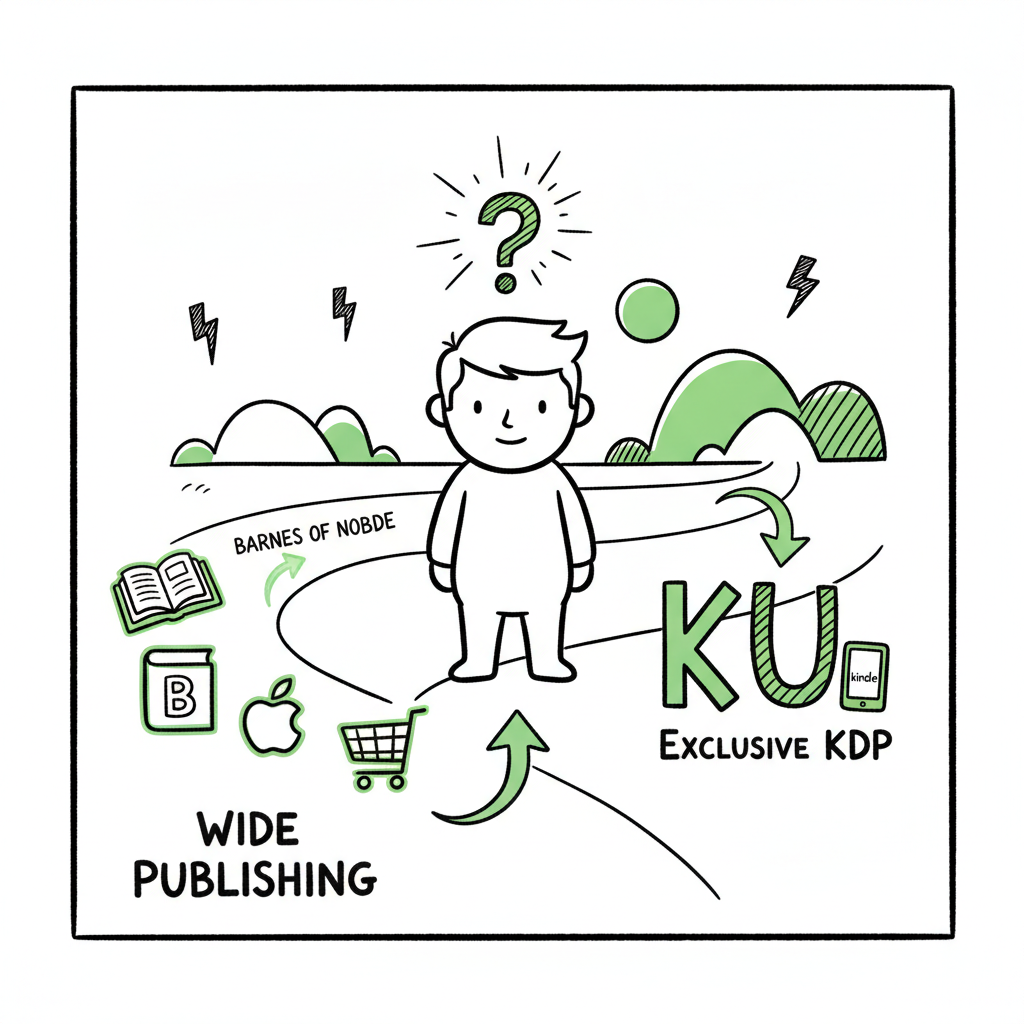
Publish Wide vs Exclusive KDP Practical Guide for Authors
Publish Wide vs Exclusive KDP: A Practical Guide for Self-Publishing Authors
Estimated reading time: 16 minutes
Key takeaways
- Kindle Unlimited exclusivity can boost fast visibility and page-read income for certain genres, while publishing wide spreads risk and opens more retail revenue channels.
- Choose based on genre, audience habits, and marketing bandwidth; you can test both by cycling in and out of KDP Select.
- Automation makes wide distribution practical at scale — CSV batch uploads, platform-aware settings, and error checks save time and cut mistakes.
- BookUploadPro helps authors publish wide efficiently and reliably, making multi-platform distribution an obvious upgrade once you’re publishing seriously.
Table of Contents
- How the systems work
- Pros and cons: exclusive KDP vs wide
- Which option fits your book and your goals
- Practical testing and a 90-day plan
- Scale publishing with automation
- FAQ
- Sources
How the systems work
There are two clear paths: enroll in KDP Select and commit to 90 days of Amazon exclusivity for ebook distribution, or publish wide and place your ebook on multiple retailers like Apple Books, Kobo, and Barnes & Noble. The choice may seem simple, but the trade-offs matter.
KDP Select gives you access to Kindle Unlimited (KU). KU pays per page read and pushes readers who subscribe to KU toward enrolled titles. It also unlocks Amazon-only promotions like Countdown Deals and Free Book Promotions. That can deliver a fast burst of reads when your book matches KU readers’ interests.
Publishing wide sends your ebook to more stores. You keep pricing control across retailers, reach international stores, and tap into library and distributor channels. Wide can mean more direct sales and income diversification. But it also requires more work: separate retailer accounts, different metadata, and marketing across platforms.
When you move from a single title to a catalog, the manual work becomes heavy. For authors ready to scale, a Publish Wide Self Publishing Workflow can save weeks of effort. If you plan to move several titles off exclusivity or set up new releases on many stores, that process is a practical way to stay consistent and avoid errors.
Pros and cons: exclusive KDP vs wide
Exclusive KDP — pros
- Fast visibility: Amazon promotes KU titles internally. That can help new authors get traction sooner.
- Page-read royalties: KU pays for reads, which can be steady for the right genre and reader habits.
- Simpler marketing focus: You run most ads and promotions on Amazon’s ecosystem.
Exclusive KDP — cons
- Locked distribution: A 90-day KDP Select enrollment means your ebook can’t be sold or distributed anywhere else during that period.
- Unpredictable royalties: KU payouts vary monthly and depend on total KU reading activity.
- Narrow audience: Readers who prefer non-Amazon stores or libraries can’t access your KU ebook.
Publishing wide — pros
- Multiple income streams: Sales from Apple, Kobo, Google Play, and Ingram add up over time.
- Better long-term control: You set prices and promotions independently on each retailer.
- Reduced platform risk: You aren’t dependent on one company for visibility or policy stability.
Publishing wide — cons
- More complexity: You must manage accounts, metadata, and files across platforms.
- Marketing spread thin: You need a plan for each store or a way to centralize promotions.
- Slower discovery on Amazon: Amazon may favor KU titles in some ranking algorithms, so wide titles may grow more slowly there.
Exclusive vs wide: the genre and audience split
Some genres earn strong KU reads. Romance, many types of thrillers, and serialized fiction often do well in KU, where subscribers read multiple books a month. If your book sits in a KU-friendly market and you’re building a reading funnel, exclusive KDP can be a smart short-term play.
Other genres — nonfiction reference, literary fiction, and niche nonfiction — do better wide. Sales may come from reader discovery across stores, library acquisitions, or direct ads to buyers who prefer owning a book outside a subscription. Wide is a diversification strategy: you accept slower ramps to avoid putting all revenue in one place.
Which option fits your book and your goals?
Deciding is part data, part market sense. Use this practical checklist to guide the choice.
- If your book is likely to earn steady KU reads
- Genre match: Romance, cozy mysteries, serial thrillers, and some light fantasy.
- Reader behavior: Fans who read multiple books monthly and use Kindle devices or the Kindle app.
- Marketing style: Heavy Amazon ad campaigns, email lists that push readers to KU.
- If your book is better wide
- Genre match: Nonfiction, literary fiction, technical, or specialty nonfiction.
- Sales channels: You expect meaningful sales from Apple, Kobo, or library systems.
- Long-term goals: Building a stable income across retailers and services.
- Hybrid approach: test both
- You don’t have to make a forever decision. Many authors run a test: enroll in KDP Select for 90 days, measure reads and royalties, then go wide and compare. If you publish multiple titles, consider staggering enrollments so you always have at least one title in KU while others grow wide. That balance spreads risk and keeps options open.
Practical testing and a 90-day plan
A simple, repeatable test beats guessing. Here’s a practical plan you can run with any new title.
- Prepare assets and metrics
- Track key metrics: KU page reads, KDP royalties, Amazon sales rank, and paid units.
- Prepare files: final ebook (EPUB or KPF), paperback files if relevant, backlist links, and promo images.
- Enroll in KDP Select for the first 90 days
- Run two focused promotions or a timed discount.
- Use Amazon Ads sparingly to test keywords and targeting.
- Watch reads weekly. KU royalties and page-read trends reveal reader engagement faster than front-of-book sales.
- Evaluate with clear rules at day 90
- If KU reads cover your revenue goals and you’re seeing sustained reader uptake, consider another 90-day enrollment.
- If KU performance is limited or you want bookstore/library reach, plan the wide launch.
- Move wide and track the same metrics
- Distribute to Apple, Kobo, Google Play, and distributors like Draft2Digital or Ingram.
- Run platform-specific promotions and test discoverability outside Amazon.
- Compare after six months
- Look at total revenue, discovery channels, and borrower-to-buyer ratios.
- Decide whether to rotate titles back into KU or keep them wide.
Scale publishing with automation
The tricky part for authors is not the decision itself but the work that follows. Publishing on many stores is repetitive. Metadata fields multiply. Cover crops vary. ISBNs and paperback setup add steps. Left manual, these tasks slow you down and invite errors.
Automation is the practical answer. When you start releasing multiple titles, a system that supports CSV batch uploads, per-platform intelligence, and automatic file conversion saves time. For example:
- Batch CSV uploads let you push dozens of titles with consistent metadata.
- Platform-specific intelligence adjusts cover sizes, trim settings, and territory rights automatically.
- Error reduction checks flag missing front matter, wrong ISBNs, or bad file formats before they reach stores.
BookUploadPro automates these repetitive steps and handles distribution to Amazon KDP, Kobo, Apple Books, Draft2Digital, and Ingram. That means ~90% time savings compared with manual uploads, fewer mistakes, and predictable processing. Automate the upload. Own the distribution.
How automation affects your choice. Once automation reduces the time and risk of going wide, the decision tilts differently. The overhead of managing multiple stores shrinks, making wide distribution more attractive for authors with more than a handful of titles. If your catalog exceeds a few books, automation is an obvious upgrade.
Practical notes on formats and assets
Saving time starts with consistent files:
- A clean EPUB or KPF for ebooks prevents rejections.
- Interior PDFs and correct trim sizes are essential for paperbacks and print-on-demand services.
- Multiple cover crops (thumbnail, full, banner) make promotions smooth.
If you need bulk processing for Book Cover Generator Processing for covers and interior files, or help converting many titles at once, tools that handle ebook creation and batch processing reduce manual work and let you scale. For streamlined ebook production and distribution, ebook creation tool can speed up the process and keep assets organized. And if you need a reliable way to prepare files for non-Amazon stores, an EPUB converter will protect your layout and metadata before upload.
Distribution partners and aggregator choices
You can publish wide two ways: direct and aggregator.
- Direct: Sign up and upload to each store (Kobo, Apple Books, Google Play). You keep more control, but it’s more work.
- Aggregator: Use services like Draft2Digital or Ingram for broad distribution to many retailers, libraries, and subscription services.
Aggregators simplify distribution but add a step and fees in the chain. They are useful when you want one interface to reach many smaller stores or libraries. Running direct to key stores while using an aggregator for secondary channels is a common hybrid.
Checklist for a clean wide launch
- Finalized manuscript and EPUB converted cleanly.
- Cover art formatted to each retailer’s specs.
- Metadata: title, subtitle, series, edition, keywords, and categories set for each store.
- Pricing strategy per region and per platform.
- Marketing assets: ad images, social posts, and newsletter copy.
- Distribution plan: direct stores vs aggregator choices.
If you need bulk processing for covers and interior files, or help converting many titles at once, tools that handle ebook creation and batch processing reduce manual work and let you scale.
Pricing and royalties: simple comparisons
- KDP Select: KU page reads plus regular Amazon sales. You may earn more in KU if reader engagement is high.
- Wide: Royalty rates differ by store and price point. Apple and Kobo often pay well for direct sales; libraries and Ingram provide long-tail revenue.
A few notes:
- KU reads pay from a shared pool that changes monthly.
- Wide sales bring clearer per-unit royalty math but require sustained visibility and promotion.
- Consider long-term lifetime value: a reader who discovers you on Apple might follow you across platforms and buy more books.
Error reduction and quality control
A major hidden cost of going wide is mistakes. Wrong metadata, missing front matter, or incorrect ISBNs cause rejections or create duplicate listings. Automating validation before upload prevents these issues.
BookUploadPro’s platform includes per-platform checks and automated corrections to avoid common pitfalls. For teams or authors with many titles, these safeguards save time and protect your brand.
Rights, exclusivity alternatives, and distributor rules
Remember that KDP Select requires strict ebook exclusivity during enrollment. That blocks sales through other retailers and certain library distribution routes. If you use a distributor, check whether they have exclusive windows or rights that affect future decisions.
Consider the “rotating” approach as an alternative: enroll select titles in KU while keeping others wide. Rotate titles in and out of exclusivity to test performance without tying up your entire catalog.
Real examples and what to measure
Track these numbers during any test:
- KU page reads and borrow-to-buyer ratios
- Paid units on Amazon and other stores
- Revenue per channel (monthly)
- Ad cost per acquisition and long-term reader value
A practical example: a romance author might see many KU borrows and solid page reads on KU. Those reads might convert to newsletter signups and later paid sales. A nonfiction author may find most income from Apple and direct sales, with libraries providing steady orders over time.
Wrap-up and next steps
The choice between publish wide vs exclusive KDP is not a one-time judgment. It is a strategic experiment that depends on genre, marketing capacity, and how fast you want growth. KDP Select offers fast visibility and KU income for genres with hungry readers. Wide offers control, diversification, and long-term stability.
If you are planning to scale, automate the repetitive parts. A Publish Wide Self Publishing Process reduces manual errors and saves time so you can focus on writing and promoting. Use clear metrics to test 90-day KU enrollment and compare real results, not assumptions.
FAQ
Q: Can I switch between KDP Select and wide?
A: Yes. KDP Select enrollments are 90 days long. At the end of an enrollment, you can choose not to renew and distribute the ebook wide.
Q: Will Amazon penalize a book for going wide?
A: Amazon may prioritize KU titles in certain rankings, but going wide does not incur a penalty. You may see changes in Amazon visibility, so plan promotions accordingly.
Q: Is KU worth it for new authors?
A: KU can be helpful for rapid discovery in the right genres. For new authors in KU-friendly markets, a 90-day test is a reasonable way to gather data.
Q: How do I handle paperback distribution when I publish wide?
A: Paperbacks are usually set up per platform (Ingram and KDP for print-on-demand). You can use Ingram for wide print distribution and KDP for Amazon print. Check trim sizes and ISBN rules for each.
Q: What’s the minimum catalog size that makes automation worthwhile?
A: For most authors, automation starts to pay off at around 3–5 titles, depending on how often you release. If you plan regular releases or manage many backlist updates, automation is valuable.
Sources
- Wide vs Kindle Unlimited – Pros, Cons, and Best Distribution
- Should You Publish Your Book Wide or Go Exclusive with Amazon?
- Wide Vs. KDP: What Is “Wide,” And Why Consider It?
- Pros & Cons of Self-Publishing Your Book WIDE
- Wide vs. Exclusive: A Tale of Two Marketing Systems
Publish Wide vs Exclusive KDP: A Practical Guide for Self-Publishing Authors Estimated reading time: 16 minutes Key takeaways Kindle Unlimited exclusivity can boost fast visibility and page-read income for certain genres, while publishing wide spreads risk and opens more retail revenue channels. Choose based on genre, audience habits, and marketing bandwidth; you can test both…