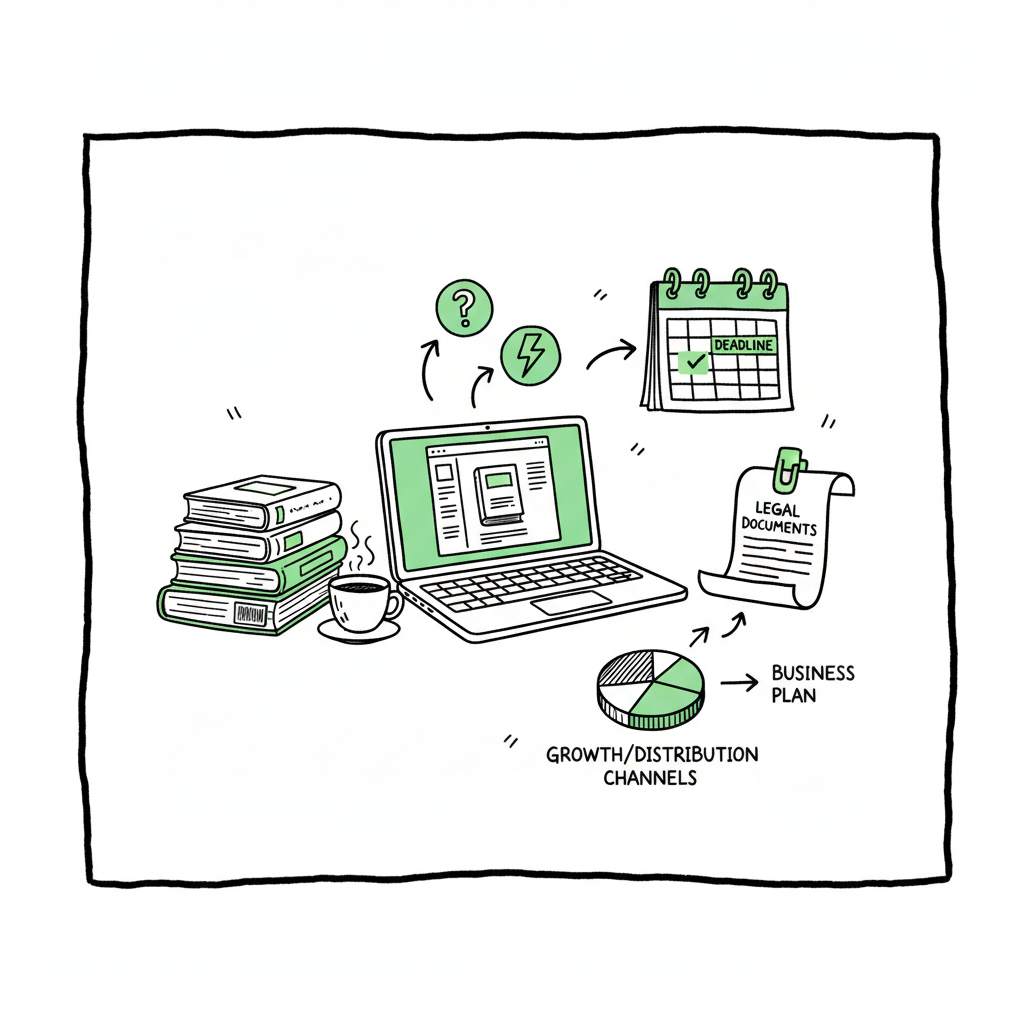
Self Publishing Business Setup Step-by-Step for Authors
Self publishing business setup: a practical guide for authors
Estimated reading time: 9 minutes
Key takeaways
- Treat publishing like a business when you want scale or liability protection; otherwise keep the setup simple and tax-aware.
- Focus first on legal structure, basic identifiers (EIN, ISBN), and reliable distribution channels. Use print-on-demand and CSV batch tools to lower risk.
- Tools that handle multi-platform uploads can save about 90% of the repetitive work and make wide distribution practical.
Table of Contents
- Why set up a self publishing business
- Step-by-step self publishing business setup
- Final thoughts and next steps
- FAQ
- Sources
Why set up a self publishing business
Setting up a self publishing business is less about paperwork and more about control and scale. If you plan to publish a single book and keep things simple, you can operate as a sole proprietor and track income on your personal taxes. If you intend to publish many titles, hire staff or contractors, sell rights, or limit personal liability, a formal entity like an LLC is a sensible next step.
A clear setup helps you:
- Separate personal and business finances (banking, taxes, bookkeeping).
- Protect your Social Security number by using an EIN for vendor accounts and payments.
- Present a consistent publisher name, which supports distribution and retail listings.
- Use systems and tools that let you publish faster and with fewer errors across Amazon KDP, Kobo, Apple Books, Draft2Digital, and Ingram.
When authors reach consistent revenue or start scaling beyond solo projects, formalizing the business becomes not only helpful but cost-effective. And when the goal is volume publishing, production tools that support unified multi-platform publishing become an obvious upgrade.
Step-by-step self publishing business setup
Start with a simple checklist and only add complexity when it solves a real problem.
Legal foundation
- Choose a business structure. For many small publishers, an LLC provides liability protection with minimal fuss. Sole proprietorships work for hobby-level publishing or very early stages, but they mix personal and business risk.
- Register a DBA or publisher name if you want to publish under a name other than your legal name.
- Get an EIN from the IRS. You’ll use it to open a business bank account and register with platforms that prefer business identifiers.
- Consult an accountant about state sales tax, income tax, and how to report royalties. This is a one-time, small investment that avoids bigger headaches.
Identifiers and rights
- Buy ISBNs in blocks from your national agency (in the U.S., Bowker). If you plan many titles, buy a block of 10 or 100 to keep unit costs low.
- Register copyright where applicable immediately after publication. Consider a Library of Congress control number if you want cataloging.
- Track editions and formats carefully—each ebook, paperback, and hardcover version needs its own ISBN or identifier depending on the platform.
Brand, banking, and basic infrastructure
- Secure a domain and email address that match your publisher name. A simple website gives you a home for metadata, author pages, and contact info for retailers and rights inquiries.
- Open a business bank account and set up basic accounting. Even a simple bookkeeping system or low-cost accountant will pay off.
- Build a team of reliable freelancers: editor, designer, formatter, and an accountant. Outsource what you can’t do well and keep the repetitive tasks automated.
Production and distribution
- Rely on print-on-demand (POD) to avoid upfront inventory costs. POD makes it practical to offer paperback and hardcover without storing stock.
- Prepare a clean master file for ebooks. If you need to convert manuscript files to EPUB format, use a reliable converter rather than manual tweaks; EPUB converter can help reduce errors and speed up the process. You can use a tested EPUB conversion tool to handle complex layouts and reduce formatting rework.
- Design clean, retail-ready covers. If you’re creating a cover or experimenting with options, a dedicated cover generator can process images and templates faster than starting from scratch each time; a professional cover will materially affect discoverability.
- Decide where to distribute. Amazon KDP is essential for most authors, but wide distribution through Kobo, Apple Books, Draft2Digital, and Ingram opens global reach and library channels.
Scaling publishing operations
- Use CSV batch uploads and platform-specific intelligence to push large catalogs at once. Manual uploads are fine for a handful of titles; beyond that, batch automation is the only practical way to scale without errors.
- Track royalties and payment cadences across platforms. A simple spreadsheet or an accounting tool that imports royalty statements will save hours of reconciliation.
- Maintain a versioned master for each title (manuscript, interior, cover) and a change log for metadata updates like ISBNs, prices, and territory rights.
Why efficient processes matter
Once you publish multiple titles, repetitive tasks—metadata entry, format conversion, cover resizing, and re-submissions—become a bottleneck. Tools that enable multi-platform uploads reduce manual errors and can cut upload time by around 90%, letting you focus on product quality and marketing rather than form fields.
production workflow with cover generator and EPUB converter tools can streamline the process.
BookUploadPro automates repetitive uploads, offers platform-specific intelligence, and supports CSV batch uploads to save time and reduce errors. It’s an obvious upgrade once authors start publishing seriously: automate the upload. Own the distribution.
Final thoughts and next steps
Setting up a self publishing business is a mix of legal setup, reliable production workflows, and practical distribution choices. If you publish casually, keep the setup lean. If you publish repeatedly or hire help, an LLC, dedicated banking, and processes are worth the cost. Print-on-demand and centralized upload tools make wider distribution affordable and low-risk.
If you handle cover creation, conversion to EPUB, or producing paperback and ebook formats, use the right tools to avoid manual rework. For example, a book cover generator speeds cover production and iteration, an EPUB converter handles complex formatting cleanly, and a reliable production workflow lets you publish print and digital versions without repeated manual tasks.
BookAutoAI lets you publish across platforms, offers platform-specific intelligence, and supports CSV batch uploads to save time and reduce errors. It’s an obvious upgrade once authors start publishing seriously: automate the upload. Own the distribution.
FAQ
Q: Do I need an LLC to self-publish?
A: Not immediately. Many authors start as sole proprietors and form an LLC when revenue, risk, or team size grows. Consider liability exposure, contractual obligations, and tax advice from an accountant.
Q: How many ISBNs should I buy?
A: If you plan multiple formats or many titles, buy a block of 10 or more. Single ISBN purchases are fine for one-off projects but cost more per unit in the long run.
Q: Can I use one ISBN across platforms?
A: Each format should have its own ISBN. Some platforms issue their own identifiers for certain editions—track them carefully in your records.
Q: Should I distribute everywhere or focus on Amazon?
A: Start with Amazon for visibility, then expand to Kobo, Apple Books, Ingram, and aggregators to reach libraries and international markets. Wide distribution is practical when you use automated uploads.
Sources
- The Step-by-Step Guide to Setting Up a Self-Publishing Business by Carla King
- How to Start a Publishing Company: 8 Steps (+ Insights from an Expert)
- How to Start a Publishing Company (Legal + Strategy)
- The Basics of Self-Publishing Business Structure
- Set-Up for Self-Publishing
- Tips for Starting a Publishing Business
Try BookUploadPro: Visit BookUploadPro to try the free trial and see how multi-platform uploads save time and reduce errors.
Self publishing business setup: a practical guide for authors Estimated reading time: 9 minutes Key takeaways Treat publishing like a business when you want scale or liability protection; otherwise keep the setup simple and tax-aware. Focus first on legal structure, basic identifiers (EIN, ISBN), and reliable distribution channels. Use print-on-demand and CSV batch tools to…